
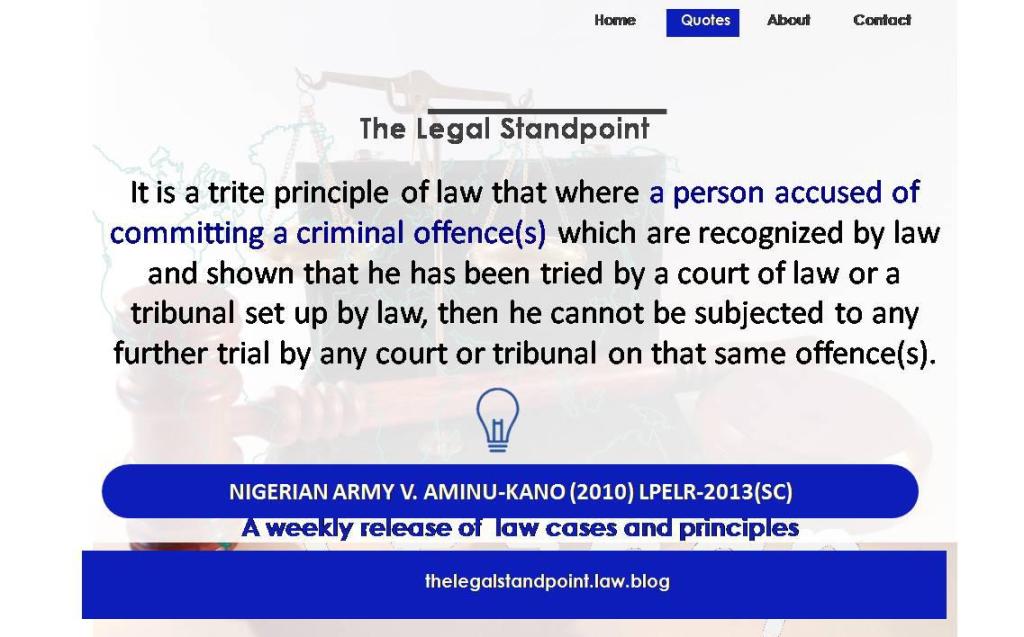
Under the Constitution of the Federal Republic of Nigeria 1999 (as amended), every person has Rights, including those persons accused of commission of any crime. To these sets of persons, S.36 of the Constitution has been the Constitutional haven as it clearly stipulates the safeguards to ensure a fair trial of the accused or defendant. Out of all these rights, our attention today will be on the doctrine of Double Jeopardy.
Double Jeopardy is a procedural defence which prevents an accused person from being tried again on the same or similar charges and on the same facts, following a valid acquittal or conviction of the first one. Gotten from the maxim non bis in idem, which translates literally as not twice against the same thing, double jeopardy prohibits a person being tried or punished twice for the same offence with the same set of facts.
S.36(9) of the Constitution provides thus: No person who shows that he has been tried by any court of competent jurisdiction or tribunal for a criminal offence and either convicted or acquitted shall again be tried for that offence or for a criminal offence having the same ingredients as that offence save upon the order of a superior court. The rationale for this doctrine is the protection of the individual from the oppressive tendencies of the state, which, with its vast resources can perpetually deprive an individual his personal liberty through several frivolous trials. The doctrine is a universal concept in criminal law jurisprudence. This also received judicial pronouncement by Black J, of the Supreme Court of the United States in Green v United States (1957) 355 U.S 184, at 187-8.
However, before an accused person can raise the plea of autrefois acquit or autrefois convict, this plea must satisfy the following conditions:
1. The first trial of the accused person must have been on a criminal charge. In R v. Jinadu (1948) 12 WACA 368, the accused was a policeman who committed assault. He was first tried in the Police orderly room, acquitted but got demoted. Later, he was charged with assault under the Criminal code. His plea of autrefois convict was refused because the first trial was not a criminal trial but an administrative one. As such, the breach of a club or association or professional rule which carries sanctions would not qualify as a criminal offence.
2. The first trial of the accused person must be by a court of competent jurisdiction. For example, a murder case cannot be tried in a magistrate court because the court does not have jurisdiction. Hence, In Umeze v. The State (1973) 6 SC 221, the conviction of the appellant was set aside by the Supreme Court when it was shown that the Magistrate who conducted the committal proceeding was not competent to do so. As such, the plea of autrefois acquit was not available. See also Chief of Air Staff v. Iyen
3. The first trial of the accused person must have ended with a conviction or an acquittal. If during the first trial, the Attorney General entered a nolle prosequi (I wish not to prosecute) and peradventure the case was continued by another Attorney General, the defense of autrefois convict will not be available since the first trial did not end in a conviction or an acquittal. See the case of Clarke v AG Lagos State (1986) 1 QLRN 119, where the accused persons were rearrested and arranged after the entry of nolle prosequi.
4. The offense for which the accused person is now charge must be:
(a) The same with the first offence for which he was tried or
(b) An offence for which the accused person could have been convicted at the first trial, although he was not changed with the offence.
Let us now imagine someone was acquitted and a few months later, a fresh evidence came in proving his culpability, can he still be tried? The Supreme Court in PML (Securities) CO. Ltd v. FRN (2018) LPELR-47993(SC) Per AUGIE, J.S.C gave the answer when he held thus: Suppose that a transgressor is charged and acquitted for lack of evidence, and evidence has now come to light showing beyond doubt that he committed the crime. Even so, he cannot be tried a second time. He has what is termed in legal Frenglish (sic), the defence of autrefois acquit. Similarly, if he is convicted, even though he is left off very lightly, he cannot afterwards be charged on fresh evidence, because he will have the defence of autrefois convict.
At this juncture, it is pertinent to note that there is a difference between an accused being discharged and being acquitted. A person who has been acquitted cannot be arrested for the same case in which he has been acquitted by the Court. A discharge does not bar the institution of fresh proceedings when new or better evidence becomes available against the accused. The effect of this is that for the plea of autrefois acquit or autrefois convict to be properly raised, the accused person must have been either acquitted or been convicted by a court of competent jurisdiction. Given this assertion judicial flavour, the court in Samson Umen Sunday v. The State (2017) LPELR-42140 (CA) opined that a person who is only discharged may be charged again for the same offence if some other testimony is discovered against him; however, a person who is acquitted of a charge can never be put on the trial for the same offence.
Other things to note about this doctrine are:
(a) It is only applicable in criminal cases but a similar doctrine called resjudicata exists in civil cases. See Suleiman v. FRN (2018) LPELR-46813(CA)
(b) The doctrine will not be available in this situation: let’s imagine James robbed two banks the same day in two different cities, Ibadan and Lagos. He was tried in Ibadan and convicted or acquitted, can he still be charged in Lagos? Yes, he can. The first thing we need to understand when it comes to this scenario is that there are TWO DIFFERENT OFFENCES here. The offences are as follows: 1. Armed robbery at a bank in Lagos. 2. Armed robbery at a bank in Ibadan. If he is apprehended and convicted in the High court of Oyo state, Ibadan just for the armed robbery in Ibadan, nothing stops him from being tried and convicted in the High court of Lagos for the armed robbery in Lagos because those are two offences and double jeopardy frowns against punishing for THE SAME OFFENCE twice.
Now, when it comes to criminal jurisdiction in cases where there are chain of actions (offences) that cut across different states for e.g Lagos, Oyo, Ogun, Ondo, etc, the defendant can be charged at ANY OF THE HIGH COURTS IN ALL THESE STATES. So in this instance, the robber can be charged in either the high court of Lagos or Oyo state on TWO separate counts in the same charge sheet. The plea of autrefois convict will now defend him if after being tried in either of the Courts (let us say Ibadan) on the two separate counts, they still proceed to charge him again for the robbery in Lagos.
(b) The doctrine is not without its exceptions. One of them is in accordance with the last phrase of S.36(9) of the Constitution which reads thus: save upon the order of a Superior Court.
(c) A defendant can be charged with two identical but separate crimes. If, for example, a defendant is acquitted of robbery a bank on March 13, the defendant can still be tried for robbery another bank on May 17. These incidents are viewed as separate crimes, so double jeopardy will not apply.
(d) If a defendant is tried for a criminal case, double jeopardy does not protect them from also being tried for a related offense in civil court. For instance, if the state brings murder charges against a defendant, the family of the victim may also sue the defendant for liquidated damages.
In conclusion, the whole doctrine could be summed up as ‘punish me once, my blame, punish me twice on the same issue, your blame.’
Thank you for reading. See you next week.✌


 THELEGALSTANDPOINT