
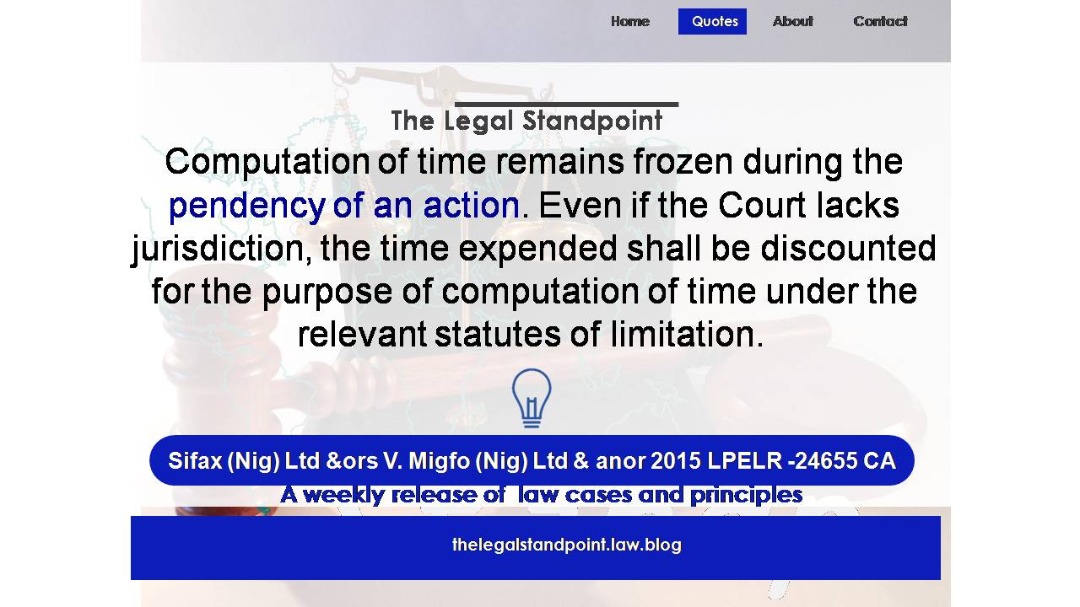
The crux of this publication is to discuss the 2018 novel principle of law given by the Supreme Court on the issue whether the statute of limitations will affect an action instituted in a court that lacked jurisdiction (competence) to hear the matter. Nevertheless, there is a need to give an introduction on the Statute of Limitations to aid our understanding, especially that of our non-law readers. So, enter into my Ferrari Portofino😎, let me take you on a ride.
There is a maxim called ubi jus ibi remedium meaning where there is a wrong, there is a remedy. It means that no wrong should be allowed to go without any compensation provided it can be redressed by a court of law. As such, if someone assaulted me, I can sue for damages having fulfilled all requirements.
However, there could be a wrong without a remedy. One of the factors that can cause this is the Statute of Limitations. This is a law that sets the maximum time the parties involved have to initiate legal proceedings from the date of an alleged offence, whether civil or criminal. In Mercantile Bank (Nig) Ltd v Feteco (1998) 3 NWLR (PT.540) 143,156 Tobi JCA (as he then was) held: “A statute of limitation is designed to stop or avoid situations where a Plaintiff can commence an action anytime he feels like doing so even when human memory would have normally faded and therefore failed. Putting it in another language by the statute of limitations, a Plaintiff has not the freedom of the air to sleep or slumber and wake up at his own time to commence an action against a Defendant. The different statutes of limitation which are essentially founded on the principles of equity and fair play will not avail such a sleeping or slumbering Plaintiff.”
The rationale behind this law is aimed at diligent prosecution of claims so as to provide finality in legal matters and to ensure that claims will be resolved while evidence is still freshly available with parties and witnesses still alive. In addition, once this time period limited by the statute of limitations expires, a plaintiff’s right of action will be extinguished and become unenforceable against a defendant and can be referred to as having become statute-barred. A.G Adamawa & Ors v A.G Federation(2014) LPELR-23221(SC).
Generally, an action to recover land and enforce a simple contract must be instituted within 12 years and 6 years respectively. Though there are little variations in the laws of each state. For instance, S.18 of the Limitation Law of Delta State specifies a period of five years for actions founded on contract.
THE CASE AT HAND
In 2005, the 1st appellant and the respondents(Migfo and Denica services) signed an MOU to jointly bid for the concession and joint management of Terminal “C”, Tin Can Island Port, Apapa, Lagos which was being concessioned by the Federal Government through the Bureau of Public Enterprises and the Nigerian Ports Authority. Part of the MOU was that if the bid was successful, the joint partners would incorporate a joint venture company to manage the operation of the Port. The bid was successful, but the 1st, 3rd, and 4th appellants secretly incorporated the 5th Appellant to the exclusion of the respondents. When the respondents became aware of the 5th appellant, they conducted a search at the CAC and found that only the 1st and 3rd appellants were shareholders and directors of the 5th appellant.
The respondents instituted an action and judgment was given in their favour both at the Federal High Court and Court of Appeal. Dissatisfied, the Appellants further appealed to the Supreme Court. Unfortunately, the Supreme Court struck out the case because the Federal High Court does not have the jurisdiction (competence) to sit on this matter because it was a simple contract. Rather, it was the State High Court that has the jurisdiction. Hence, they had to start all over.😥
On 18 July 2012, the respondent began a new suit at the Lagos State High court. The appellant raised the doctrine of statute-barred invoking S.8(1)(a) of the Limitation Law of Lagos State which provides that claims based on simple contracts cannot be sued on after 6 years.
The High Court of Lagos State and the Court of Appeal both dismissed the appellants’ objection and held that the respondents’ claim was not time-barred, though in reaching this conclusion, the Appeal Court relied on a secondary source of Nigeria law which was a foreign textbook named Limitation Period by Andrew Mc Gee.
Dissatisfied with both decisions, the Appellants then appealed to the Supreme Court. In this case, the Supreme Court established a landmark precedent. Just like how the sun stood still during Joshua’s battle against the Canaanites, the Supreme Court, for the first time, held that the time will pause – hold still – for the entire time when an action is in court pending the determination. The Court further stated that if a litigant commences an action in the wrong court and that action is struck out after a long period of time, the period when the action was in court would not count in the computation of time for the purpose of limitation, and the litigant may still be able to refile in the appropriate court despite the time that may have passed.
In conclusion, I will say this landmark decision is quite persuasive on this recondite area of law because it shuns strict adherence to rigid procedural requirements and it is in tandem with the interest of justice and public policy.
With this, we have gotten to our destination. You can alight from my car🤗. See you next week🙏.

 THELEGALSTANDPOINT