
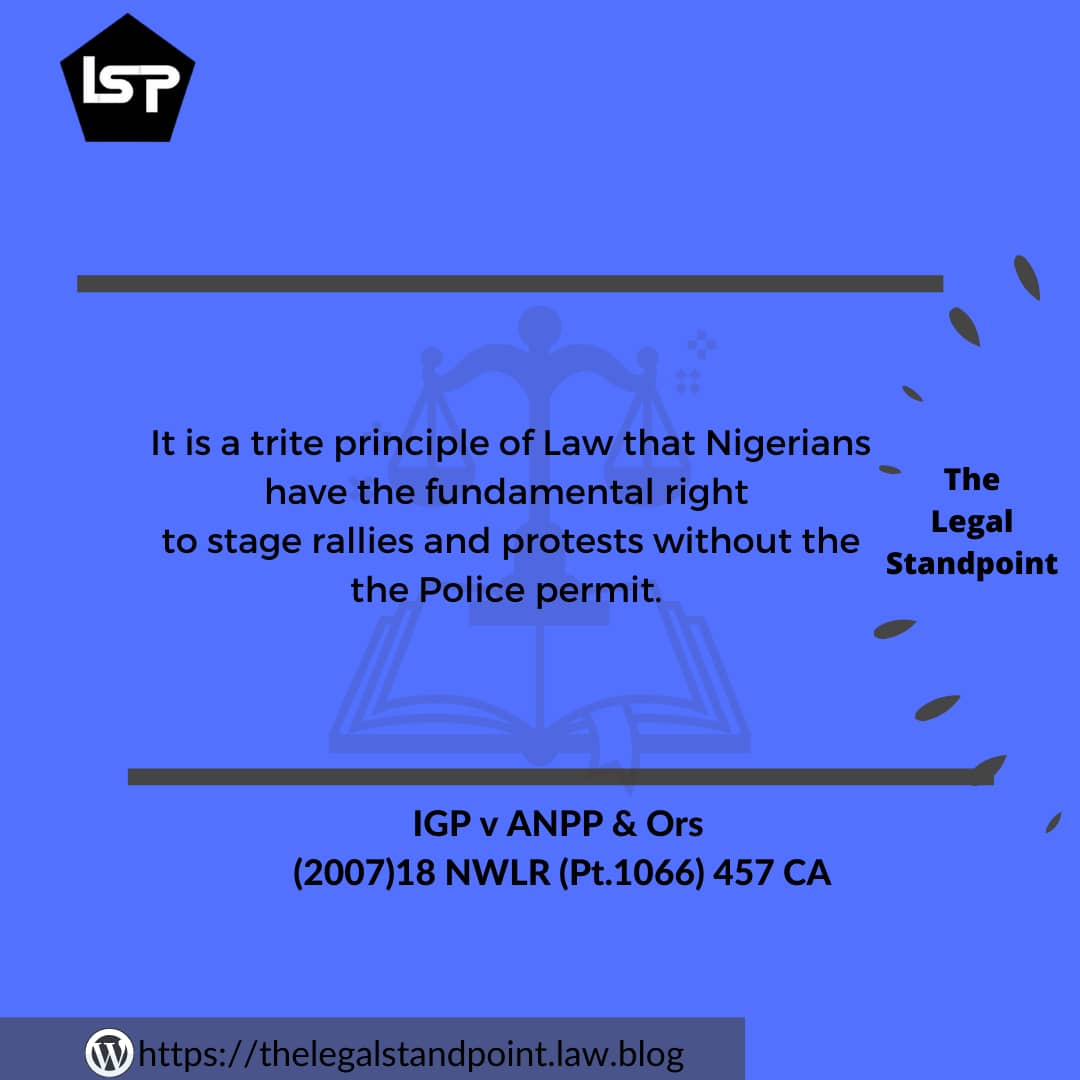
When it comes to protests, not only is Nigeria way too big, we are also twice as tall. Starting from the #RemovalofFuelSubsidy, to the #RevolutionNow, leading to the #EndSarCampaign and #NomeansNo, protests are endemic to the Nigerian sociopolitical space. Being one of the methods of political participation, protests provide the opportunity for citizens to openly ventilate their waves of anger on certain political, economical, and/or social issues that they do not agree with. More often than not, they also signal a clarion call for accountability and responsibility on part of the leaders. After all, had it been things were normal, protests would have been reduced to the barest minimum.
In addition, while some governments seek to underfmine the longevity of protest movements by acquiescing to protesters’ demands, whereas others choose to quash them with force. The latter has been on a recurring situation in Nigeria. The vast majority of unprovoked attacks on protesters are totally unwarranted especially where the protests are entirely peaceful, devoid of rancor or any form of violence, and constitute no security risk nor a violation of any known law.
In Nigeria, citizens’ right to a peaceful protest is drawn from the right of Expression, Peaceful assembly, and Movement as enshrined in Sections 39 and 40 of the Constitution of the Federal Republic of Nigeria, 1999 (as amended) and Articles 10 and 11 of the African Charter on Human and Peoples’ Rights (Ratification and Enforcement) Act. Just like every other right, the Right of Freedom of Association and Assembly are qualified rights, that is, they have exceptions. The exceptions are assemblies that are violent, leading to the breakdown of law and order in society will not be allowed by the Law enforcement agencies whose primary responsibility is the maintenance of law and order.
THE FACT OF THE CASE
The All Nigeria Peoples’ Party had requested the Inspector-General of Police to issue police permits to its members to hold unity rallies throughout the country to protest the rigging of the 2003 elections. The request was refused by the police chief without any reason. The ANPP decided to hold the rallies. The first rally which held in Kano on the 22nd of September 2003 which was attended by the party’s presidential candidate, General Muhammadu Buhari, and other leaders of the ANPP was violently disrupted by the police on the ground that the organizers had not obtained a police permit.
THE ONE MILLION NAIRA QUESTION
The relevant issue that came up for determination was whether a permit is needed before one can engage in a rally and protest paying cognizance to S. 1(1)(2) of the Public Order Act. For clarification sake, these sections will be summarized. S.1 of the Act empowered the Governor of each state to direct the conduct of all assemblies, meetings, and processions on the public roads or places of public resort in the State and prescribe the route by which and the times at which any procession may pass. S.2 states that any person who is desirous of convening or collecting any assembly or meeting or of forming any procession in any public road or place of public resort shall, unless such assembly, meeting or procession is permitted by a general licence granted under subsection (3) of this section, first make application for a licence to the Governor not less than 48 hours.
From this aforementioned, it is obviously seen that the provisions of the Police Order are contrary to that of the Constitution. Based on the Supremacy Clause embedded in S.1(3) of the Constitution, If any other law is inconsistent(in this case, the Police Order Act) with the provisions of this Constitution, the Constitution shall prevail, and that other law shall, to the extent of the inconsistency, be void. See Abacha &Ors v. Fawehinmi (2000) LPELR -14 SC.
THE JUDGMENT
The court held per Adekeye JCA (as he then was) that “Public Order Act should be promulgated to compliment sections 39 and 40 of the Constitution in context and not to stifle or cripple it. A rally or placard carrying demonstration has become a form of expression of views on current issues affecting government and the governed in a sovereign state. It is a tread recognized and deeply entrenched in the system of governance in civilized countries – it will not only be primitive but also retrogressive if Nigeria continues to require a pass to hold a rally. We must borrow a leaf from those who have trekked the rugged path of democracy and are now reaping the dividend of their experience.
Recalling that the British colonial regime had introduced and imposed the Public Order Ordinance to stop the Nigerian people from protesting against foreign domination and exploitation Justice Adekeye was compelled to ask “…how long shall we continue with the present attitude of allowing our society to be haunted by the memories of oppression and gagging meted out to us by our colonial masters through the enforcement of issuance of permit to enforce our rights under the Constitution?”
On the fear usually expressed by the Police that a peaceful protest might be hijacked by hoodlums leading to a breach of the peace, the Court was of the view that “If as speculated by law enforcement agents that breach of the peace would occur, our Criminal Code has made adequate provisions for sanctions against breakdown of law and order so that the requirement of permit as a conditionality to holding meetings and rallies can no longer be justified in a democratic society.”
This stamp of approval given by the Appeal Court, in this case, is also similar to the decision given by the Ghanaian Supreme Court in the celebrated case of NPP V IGP 1992-1993(585-2000) 2 HRLRA 1 where the Court came to the unanimous decision that “I wish to add a few words to demonstrate that police permits are colonial relics and have no place in Ghana in the last decade of the twentieth century – the Public Order Decree that provided that the holding of all public processions and meetings should be subject to the obtention of prior police permission was unconstitutional because it was inconsistent with article 21(1) (d) of the 1992 Constitution, which granted every citizen the freedom of assembly, including freedom to take part in processions and demonstrations.”
In view of the aforesaid judicial pronouncement, the authorities of the Nigeria Police Force have recognized the fundamental right of Nigeria to protest peacefully without police permit. Hence, Principle 6 of the Nigerian Police Code of Conduct states that the Police shall: Maintain a neutral position with regard to the merits of any labour dispute, political protest, or other public demonstration while acting in an official capacity. However, the Police are, sometimes, governed by this principle, and most times, they conspicuously and unapologetically violate it.
Fundamental Rights are guaranteed by the Constitution. Hence, they can only be abridged or restricted by a procedure permitted by law. As such, if a police officer has information that any rally or demonstration may lead to a breakdown of law and order, he/she is advised to apply for an injunctive relief in a competent Court of law.
In conclusion, this landmark decision restricts the power-drunk members of the SARS and other law enforcement agencies who always seek to escape punishment by hiding under the cloak of the Police Order Act. By extension, the right to protest peacefully within the ambits of the law is one that cannot be taken away in a democratic society bounded by the rule of law.
Thank you. See you next week.

 THELEGALSTANDPOINT
Leaving a big thumbs up here.
LikeLiked by 1 person
Leaving a big thumbs up here.
LikeLike
Woah… Enlightening… ” the right to protest peacefully within the ambits of the law is one that cannot be taken away from a Democratic society…”
LikeLike