It is a trite principle of law that for an individual to sue or be sued, such an individual must be a recognized person under the law. In law, there are two recognized persons. The natural persons which are, of course, human beings and juristic persons. A common example of a juristic personality is a company.
Besides, an association can also be made a juristic person either by registration under Section 832 of the Company and Allied Matters Act 2020 or through a legislation. In this second instance, they will be referred to as statutory bodies. For example, the NNPC created under The NNPC Act.
If an association has not been incorporated by either of these two methods, such an association can not sue and be sued in their name (eo nomine). However, they can sue through their members or officers which are representatives of the action. In Dairo & Ors v Registered Trustees of the Anglican Diocese of Lagos (2017) LPELR-42573(SC) the Court held that: Where an association of persons is unincorporated, it does not have the legal status of a juristic person. Consequently, it can sue only by a representative action. Likewise, any person who has been wronged by such an association of persons can only sue it by suing some of its members as representatives of the association.
This is the point that was surprisingly omitted in the two cases under review as the NBA was sued eo nomine (in its name).
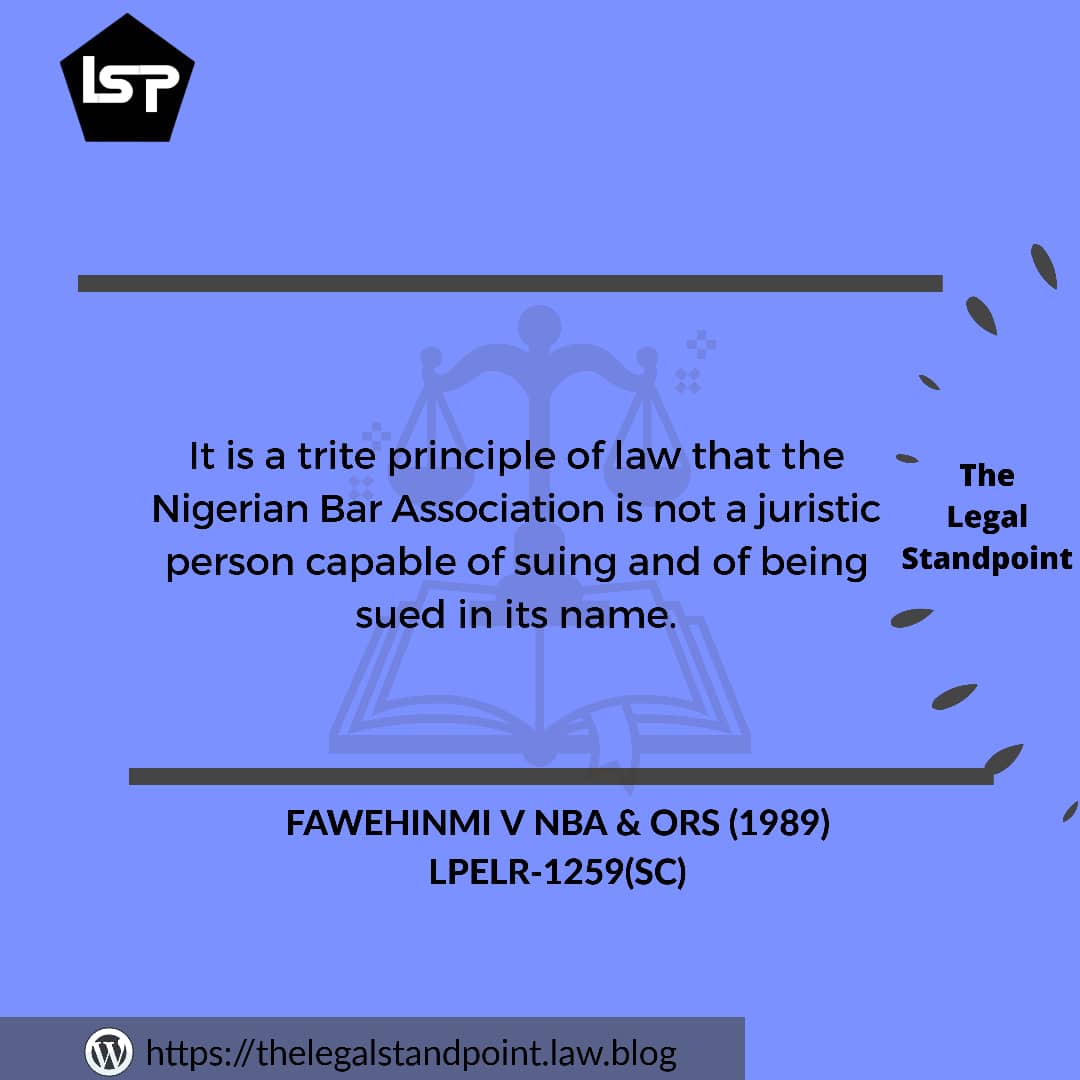
In the celebrated case of Fawehinmi v NBA (supra), the court giving reasons for the non-juristic personality of the NBA held that: The Constitution of the Nigerian Bar Association is not a statutory instrument. It is not a subsidiary legislation to the Legal Practitioners Act. It is a pure and simple private document which the members of the Nigerian Bar Association were entitled to draw up in exercise of their right to provide a constitution for the Association to regulate its affairs…. this does not make the Nigerian Bar Association a juristic person. It only gives the body recognition as a legal entity made up of legal practitioners.
This landmark decision also received judicial affirmation in the 2019 recent case of Moses v NBA (2019) LPELR-46918(SC).
THE FACT OF THE CASE
In this case, the Appellant, a Legal Practitioner practicing in Port Harcourt, Rivers State, represented a Member of the Rumu-Amadi Family in a case involving family land. The Appellant’s client lost at the High Court and while the case was on appeal, it was alleged that the Appellant partitioned the family land and sold plots of land; and he misrepresented himself as the Family’s lawyer and began negotiating more sales without valid authority.
Infuriated, the family wrote a petition to the Disciplinary Committee of the NBA, who after its investigations, held that the Appellant was found guilty. The NBA then filed a complaint at the Legal Practitioners Disciplinary Committee (LPDC) against the Appellant. The LPDC, after due consideration, found the Appellant guilty of improper conduct in the course of performing his duty as a legal practitioner and directed the Chief Registrar of the Supreme Court to strike out the name of the Appellant from the roll of Legal Practitioners.
The Appellant challenged the decision of the LPDC by an appeal to the Supreme Court. In the appeal, the NBA was named as Respondent by the Appellant. The Respondent (NBA) raised a preliminary objection on the ground that it is not a juristic person and as such, cannot sue or be sued.
The Appellant contended that since the NBA was the complainant before the LPDC, the NBA can validly be a Respondent for the purpose of the appeal filed at the Supreme Court. The contention is logical in the sense that if the NBA could stand as complainant at the proceedings before the LPDC, then there is no reason it should not be a proper party at the appeal. Otherwise, as argued by the Appellant, the proceedings before the LPDC should be declared a nullity.
THE JUDGMENT
As logical as the contention of the Appellant may sound, the Supreme Court held that same was however misconceived because the NBA was merely playing the role assigned to it under the Legal Practitioners (Disciplinary Committee) Rules (as amended) whereby the NBA can validly forward a report of any investigation to the LPDC for proper action, pursuant to Sections 1(1) and 10(1)(b) of the Legal Practitioners’ Act. In effect, while the NBA plays its part, the LPDC will go ahead and consider the complaint.
The Supreme Court concluded that an appeal against the decision of the LPDC can be brought while making the LPDC a party instead of the NBA. This is because the LPDC is a legal person that can sue and be sued. See LPDC v. Fawehinmi [1985] 2 NWLR (Pt. 7) 300.
REPOSITIONING THE PROPER CONTEXT
For a proper determination of suit against the NBA, the party should be: Registered Trustees of NBA, because they are the ones that possess a juristic personality. Registered Trustees of NBA are those people that have been appointed by the NBA to be the Trustees, the equivalent of directors in a company, and they are distinct from NBA in that they have juristic personality.
THE EFFECT OF AN INCOMPETENT PARTY IN A LAWSUIT
It is well settled that for an action to be properly constituted so as to vest jurisdiction in the Court to adjudicate on the matter, there must be a competent Plaintiff and a competent Defendant, and where either of them is not a legal person, the action is liable to be struck out for being incompetent. See Maersk Line & Anor V Addide Investments Investments Ltd & Anor (2002) LPELR-1811(SC) and Agbonmagbe Bank Ltd. v. General Manager G.B. Ollivant Ltd. & Ors. (1961) 1 All NLR 116; (1961) 2 SCNLR 317.
Thank you and see you next week❤.
Month: November 2020
LSP014: Spraying of Nigerian Currencies in Party: the Position of the Law.
From mummy Risi’s Ówambẹ̀ to Prof. Okonkwo’s retirement party down to Musa’s hangout, parties are 5 unit courses Nigerians don’t like carrying over. In fact, being that Nigerians are hardworking, we always create time to unwind, enjoy life, and reconnect with family and friends before the resumption of our routine activities.
In all these parties, Nigerians have a culture of spraying money either on the musician, the celebrant, or even both. Will it be an exaggeration if I aver that social events in Nigeria and the spraying of money have been inseparable? I doubt it. If you have been a guest at any social event, you will attest to this fact.
Aside from being a norm, money spraying culture also serves as an effortlessly sign of flamboyance especially when you are spending higher denominations. It portrays, on one hand, the I have arrived mentality. On the other hand, it appears people are doing this even without the showoff mentality. Some are engaging in this practice simply because they are ignorant that there is a law that regulates such activity.
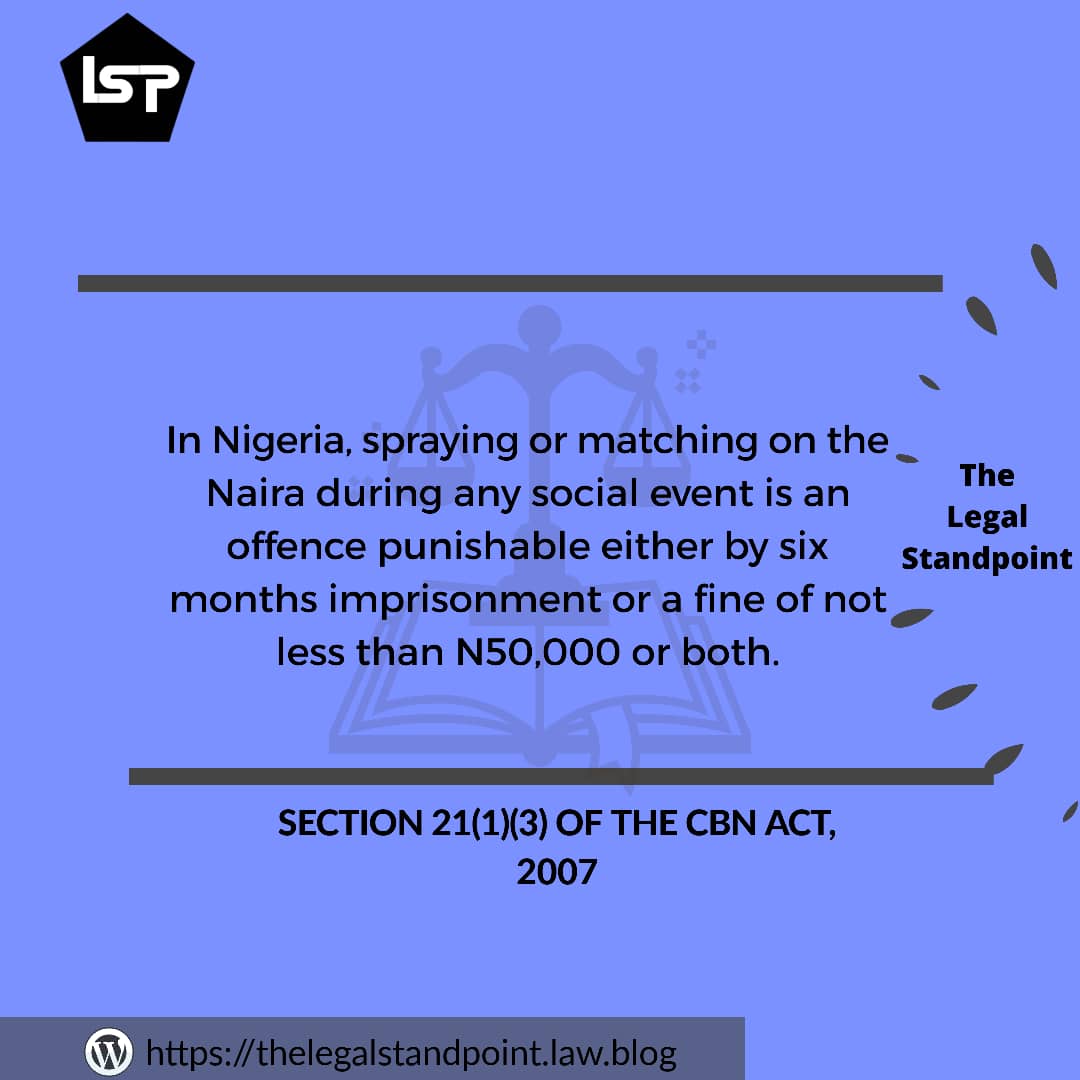
However, this practice is against the law as prescribed in Section 21 of the CBN Act 2007 because it is illegal and an abuse of the banknotes. S. 21 provides that: ‘For the avoidance of doubt, spraying of, dancing or matching on the Naira or any note issued by the Bank during social occasions or otherwise howsoever shall constitute an abuse and defacing of the Naira or such note and shall be punishable under Sub-section (1) of this section…. imprisonment for a term not less than six months or to a fine not less than N50,000 or to both such fine and imprisonment.’
It is pertinent to state that this is the law. Because we see people engage in this activity and go scot-free doesn’t make it less than the law neither does it allow us to indulge in it. As seen in this Latin maxim: dormiunt aliquando leges, nunquan moriuntur, which translates to mean, law sometimes sleeps, but never dies. It is better to know and adhere to the law so that its provision will not be raised against you.
Regarding the process to wake this law from its slumber, The CBN made its intention known, last year, to see that those who engage in this practice face the music. Interestingly, if someone is caught, the regularized court processes will be dispensed with and such an individual will be tried instantly. According to The CBN spokesman, Isaac Okorafor, ‘mobile courts would be deployed nationwide to enforce the law, confirmed the police and officials of the Federal Ministry of Justice would be involved in the monitoring and enforcement of the law…. If a celebrant is dancing and you spray him/her, you may go to jail from the party venue, because the law enforcement agents will be there, waiting to arrest you.’
In conclusion, the Nigerian currencies are symbols of national unity and sovereignty, which most be treated with respect.
Thank you. See you next week.❤
LSP013: Product Liability in Law of Torts
Today, our convoy has gotten to the street of Negligence in the famous city of Tort. Being a broad street, we shall only be visiting the home of Product Liability.
In law, when someone acts carelessly and causes an injury to another person, under the legal principle of negligence, the careless person will be legally liable for any resulting harm. Hence, the tort of negligence is a legal wrong that is suffered by someone at the hands of another who fails to take proper and reasonable care to avoid what a reasonable person would regard as a foreseeable risk. For instance, a person who forgets to remove a banana peel on the floor in a house after several hours consequently leading to the injury of another person may likely be liable for negligence. This is because there is a foreseeable risk that someone will go through that place and most likely get injured.
To succeed in an action for negligence, the plaintiff (the one who suffered harm due to the omission of the other party) must establish three things:
(a). He must prove the existence of a duty of care owed by the defendant to the plaintiff.
(b). He must prove the breach of that duty of care by the defendant.
(c). He must prove the damage resulting from the breach.
For the first requirement, a duty of care can be viewed as a social contract – the implicit responsibilities – held by individuals to act with thoughtfulness and exercise reasonable care towards another. Over time, through constant judicial pronouncements, there have been some recognized care of duty instances that have gained prominence. One of such is Product Liability.
Product liability is the area of law in which manufacturers, distributors, suppliers, retailers, and others in the supply chain, who make products available to the public are held responsible for the injuries those products cause. For example, let us imagine you bought a Coca-Cola drink from one mummy Tope in your street and while drinking, you saw a dead mice in the drink, who will be held liable? Is it mummy Tope or the manufacturing company? Most times, it is the latter that will be held liable because all manufacturers owe a duty of care to their final consumer and the former will escape liability if it can be proven that she didn’t tamper with the products when gotten from the manufacturer.
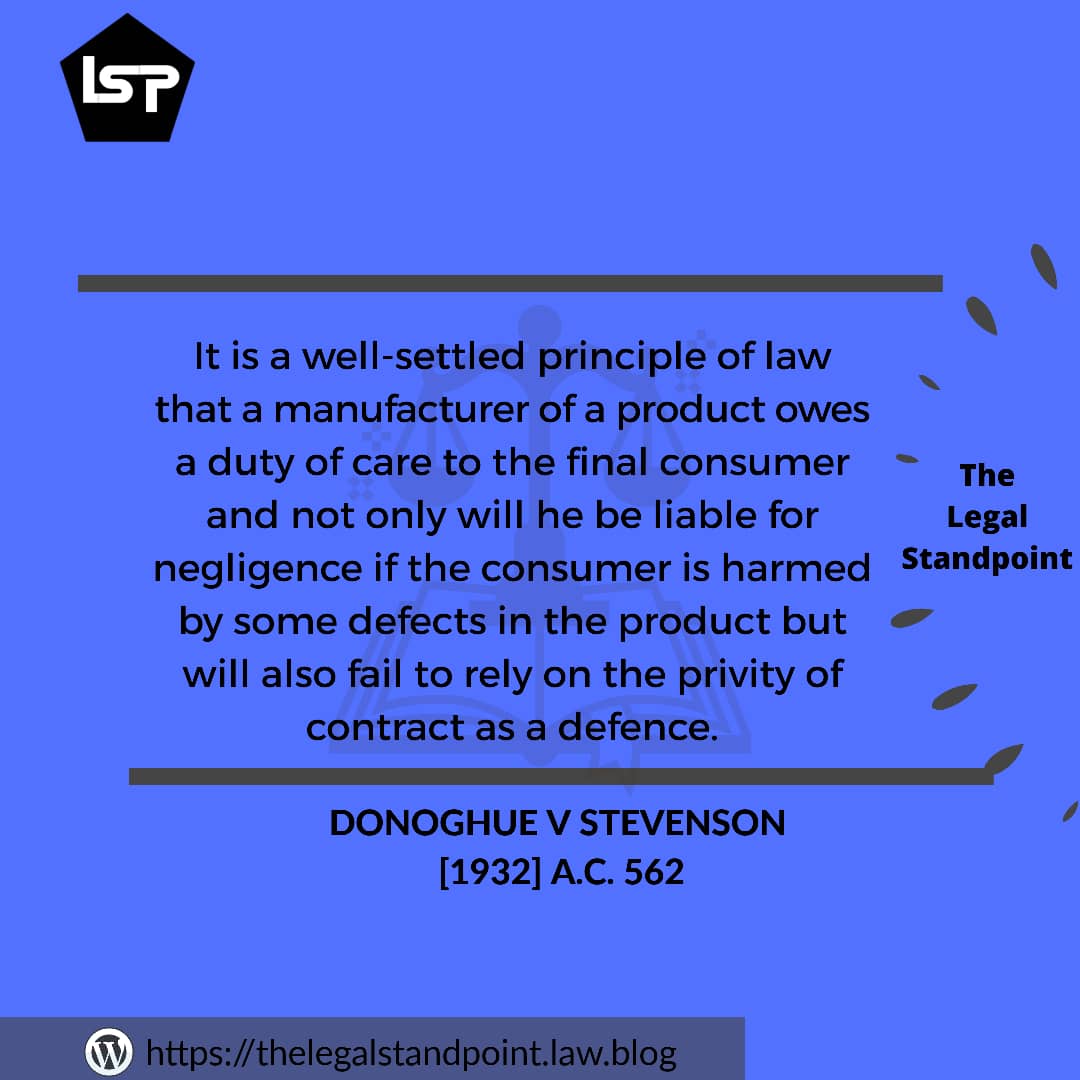
In the celebrated case of Donoghue v Stevenson [1932] A.C. 562, Donoghue bought and drank a bottle of ginger beer in a café. A dead snail was in the bottle. She fell ill, and she sued the ginger beer manufacturer, Mr. Stevenson. The House of Lords held that the manufacturer owed a duty of care to her, which was breached because it was reasonably foreseeable that failure to ensure the product’s safety would lead to harm to consumers. Even though the contract was between Donoghue and the retailer, the court held that manufacturers owe the final consumer of their product a duty of care (at least in the instance where the goods cannot be inspected between manufacturing and consumption) and there need not be a contractual relationship, or privity between the final consumer and the manufacturer, in order for the final consumer to sue in negligence.
Being a locus classicus, the principle in the celebrated case of Donoghue has found its way into Nigerian jurisprudence. In the case of Osemobor v Niger Biscuits Co. Ltd (1973) 7 CCHCJ 71, the plaintiff, in course of chewing a biscuit purchased at a supermarket, felt something hard in her mouth which turned to be a decayed tooth. As a result, she became ill. Finding the defendants liable in negligence, the court, per Kassim J (as he then was), held that: I am satisfied that there was no probability of an intermediate examination of the biscuits before they reached the plaintiff and I find myself unable to uphold the submission of the learned counsels for the defendants that she was bound to look at the biscuits before she put them in her mouth…. A person who manufactures goods, which he intends to be used or consumed by others, is under a duty to take reasonable care in their manufacture so that they can be used or consumed in the manner intended, without causing physical damage to person or property.
This decision also received a stamp of approval by the Supreme and Appeal Courts in Okwejiminor v Gbakeji & Anor (2008) LPELR-2537(SC) and Nigeria Bottling PLC v Jokotade Ibrahim (2016) LPELR-41943(CA).
At this juncture, it is pertinent to note a product liability is not limited to defects in drinks. It also includes all medical devices, commercial/personal vehicles, aircraft, and consumable goods such as food and prescription drugs. In Nigeria, agencies such as Standard Organisation of Nigeria (SON), National Agency for Food and Drugs Administration and Control (NAFDAC); the Federal Competition and Consumer Protection Commission (FCCPC) are some of the regulatory agencies saddled with the responsibility of ensuring consumers’ protection.
In conclusion, manufacturers owe a duty of care to all those who can reasonably be expected to make use of their product and a claim in negligence is not limited by the doctrine of privity of contract, which states that only a party to a contract can sue under it.
Thank you for reading. See you next week.
 THELEGALSTANDPOINT