
It is a settled principle in Criminal Law that before any person can be charged with an offence and convicted for the commission of that offence, there must be a written law that can be referred to. This long-standing principle has a constitutional backing by virtue of S.36(12) of the Constitution and several judicial hortatories in cases such as Aoko v Fagbemi (1961) 2 All NLR 400; AG Federation v Isong (1996) 1 QLRN p. 75, Bode George v Frn (2011) 10 NWLR (PT 1254) 66, etc.
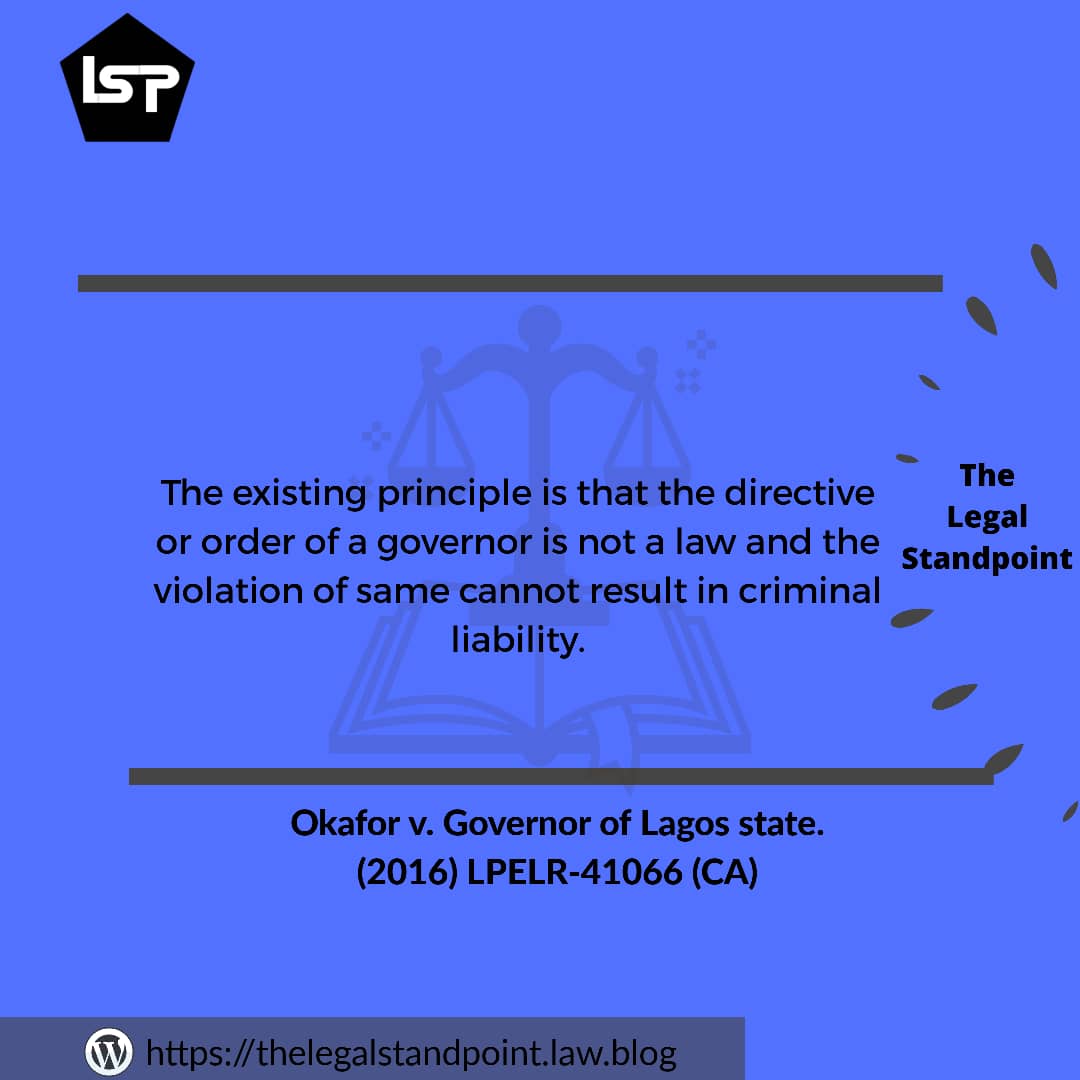
Moving on, the question then is can the directive given by the Governor of a state amounts to a law in which penalty can be attached to? In determining this question, the Court of Appeal held in negative. In this case under review, one Faith Okafor was arrested by officials of the Lagos State government for violating the restriction of movement order during the Environmental Sanitation on the last Saturday of the month. She was arraigned before the Special Offences Court on a charge of wandering and loitering in violation of the compulsory monthly environmental sanitation exercise. She pleaded guilty and was fined the sum of N2,000.00.
However, she filed an action at the Lagos State High Court claiming that her arrest and detention amounted to an infringement on her rights to personal liberty and freedom of movement. Despite her action being dismissed, she proceeded to the Court of Appeal where the court ruled in her favour by holding that: “I find worrisome the contention of the Respondents that the directive of the Governor can be equated to a Law for which criminal sanctions will lie, and a person tried and convicted for the offence of violating the directives of the Governor…I shudder at this submission which in its elastic ramification takes us back to the dark ages of the Hobbesian state of nature.
Though the respondent(other party) agreed that there was no written law in Lagos State which restricts the movement of people on environmental sanitation days and making it an offence, the counsel still posited that the restriction was valid having being directed by the Governor. To this end, the court held that: I find it shocking that the disobedience of the directive of the governor in this regard has been elevated to a crime for which criminal sanctions attach, as in the conviction of the Appellant and the fine imposed on her.”
Though not entirely within the purview of this discourse, the writer submits, as an aside, that the conviction of the popular actress, Funke Akindele, early this year for ‘flouting’ the Covid-19 directives will likely be set aside on appeal. Some of the reasons will be that her offence was unknown in law, the principle of Covering the Field wasn’t followed among others. The reason for this was that most executive orders that were given to contain the spread of Covid-19 were made without fulfilling some constitutional and statutory provisions. Of importance here was the unlawful demolition of two hotels in Rivers State by Governor Wike.
Nevertheless, an order or directive can become binding when it is backed up by a law enacted by the National Assembly or State House of Assembly for a state. As such, an order by a Governor that all suspects must be treated with dignity will be binding because such a right has already been guaranteed by the Constitution. See S.34 of the Constitution.
In conclusion, a Governor cannot suo moto (on his own), no matter his good intention is, turns a directive into a law which violation of it will result in criminal liability.
Thanks and see you next week.
 THELEGALSTANDPOINT