
Month: December 2020
LSP018: Invitation to Treat
In our daily simple transactional activities, have you ever been in a position where you brought a product or goods in a shop for a price higher than the price tag? For instance, the price tag on Hypo sachet in Nigeria is N20 yet it’s being sold for N30 or even 40 naira in most Nigerians stores. Peradventure a buyer insisted on purchasing it at N20 naira and the seller rejected it, can the buyer bring an action against the seller for a breach of contract?
In law, this hypothetical scenario falls under the scope of an Invitation to Treat under Contract. But before we discuss Invitation to Treat, it is important to briefly touch on another important concept which is Offer.
An offer is a definite undertaking or promise made by one party with the intention that it shall become binding on the party making it as soon as it is accepted by the party to whom it is addressed. For example, if Sansa Stark tells Raymond Reddington that she wants to purchase his laptop for the sum of N75,000, that’s an offer and Raymond, can either use to accept or reject. If he accepts, then a contract is formed. A breach of this contract will attract legal action.
On the other hand, an Invitation to Treat is not the same as an Offer. It is an invitation to another person to make an offer. Also known as an Offer to Chaffer, it refers to the preliminary effort to invite or induce others to make an offer. So if you’re travelling and you see an Always billboard advertisement stating that their smallest sanitary pad is now N300, they are basically enticing prospective customers to make an offer around that price and not necessary for that stated price.
An Invitation to Treat is not, by itself, capable of being accepted so as to form a binding agreement. As held by the Court in Neka B.B.B. Manufacturing Co. Ltd. Vs A.C.B. Ltd. (2004) 2 NWLR (Pt.858) 521, ‘an invitation to treat is not an offer that can be accepted to lead to an agreement or contract and therefore cannot form the basis of any cause of action.’
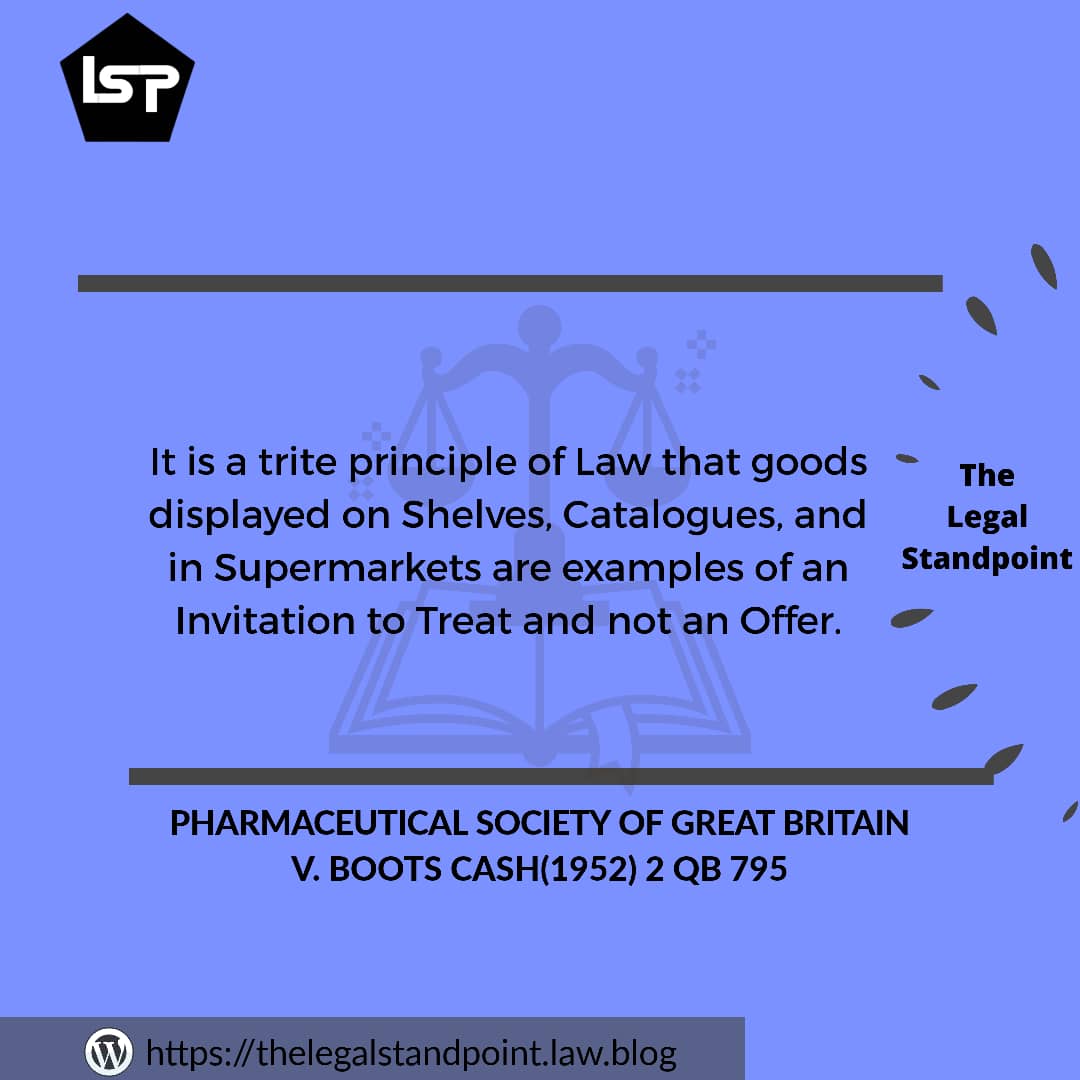
Generally in law, displays of goods in a supermarket, catalogues, shelves, etc are examples of an Invitation to Treat. In Pharmaceutical Society of Great Britain v Boots Cash(1952) 2 QB 795, it was held that goods displayed in a chemist store are examples of an Invitation to Treat. The Offer comes into play when the buyer takes the goods to the cashier. The cashier can then decide to accept or reject the offer. See also Fisher v Bell(1961) 1 QB 394. Other examples of an Invitation to Treat are auctions, advertisements, a call for interviews, etc.
Back to our earlier scenario, the buyer cannot claim a breach of contract because there was no contract in the first place. All that happened was just an Invitation to Treat. It became an Offer when he took the Hypo sachet and presented 20 naira. Since the seller rejected, there was no acceptance that could then metamorphose into a contract.
Thank you for reading and see you next week❤
LSP017: Marital Rape in Nigeria

Marital rape is a non-consensual sexual intercourse with one’s spouse. In most cases, it will be the husband having sexual intercourse without the wife’s consent. Being a despicable act, the consequences of rape and marital rape are associated with fear, depression, and other life traumatic experiences.
In Nigeria, the offence of rape is encapsulated in the Criminal Code (applicable to the Southern States) and the Penal Code(applicable to the Northern States). It is worthy of note that both statutes have similar features on this issue. According to Section 357 of the Criminal Code: “Any person who has unlawful carnal knowledge of a woman or girl, without her consent, or with her consent, if the consent is obtained by force or by means of threat or intimidation of any kind or by fear or harm, or by means of false and fraudulent representation as to the nature of the act or in the case of a married woman by impersonating her husband, is guilty of rape”.
From this provision, one can, on the superficial look, argues that marital rape is an offence in Nigeria. However, upon a thorough examination, one will realize that it is not an offence because the mischief in that provision is caused by the phrase “Unlawful carnal knowledge”. Section 6 of the Criminal Code defines unlawful carnal knowledge as that which takes place otherwise than between husband and wife; and the offence is complete upon penetration.
Putting it in perspective, can a husband rape his wife in Nigeria? Yes. It happened and it is still happening. Can he be held guilty under the law? No.
The following can thus be deduced from the provisions of S.357 and 6 of the Criminal Code:
(a) The scope of S.357 is narrow because it is gender-specific in that that it is only men who can commit the offence of rape. (b) The act amounting to rape is limited to penile penetration of the vagina. Anal or oral sex does not constitute sexual intercourse for the offence of rape. (c) Marital rape is not an offence.
Furthermore, there was a law that came into force in 2015. It is known as The Violence Against Persons [Prohibition] Act 2015(VAPPA). This law also touches on the issue of domestic violence. Fortunately, unlike the Criminal and Penal Codes, it widens the scope that both genders are capable of committing the offence of rape. In addition, it extends rape to any penetration of any opening in the body of a victim and with anything. Now there is no need to prove rape only by penetration of the vagina with the penis since penetration of any opening in the body (including, mouth and anus,) now suffices. Unfortunately, it was silent on the issue of marital rape.
The notion that a husband cannot be guilty of rape upon his wife is predicated on the then generally accepted view of the Common Law. It was based on a theory articulated by Mathew Hale, Chief Justice in England in the 18th century who wrote in 1736 that: the husband cannot be guilty of a rape committed by himself upon his lawful wife, for by their mutual matrimonial consent and contract, the wife hath given up herself in this kind unto her husband which she cannot retract. This is known as the Hale Theory of Implied Consent. Also, there is the Theory of Oneness which has its root in the Bible. It states that a husband and his wife are one and inseparable making it impossible to rape oneself.
In Nigeria, the ugly picture painted through the concept of bride-price has made the majority of people see a wife as a property bought by his husband who subsequently has hegemony over her in all spheres. The effect of Lord Hale’s pronouncement is that upon entering marriage, there is an implied consent to sexual intercourse and it is inconsequential whether the wife wants it or not.
THE WAY-OUT
In Nigeria presently, there are no reported cases of marital rape. The reasons for this are not farfetched. In Africa and mostly Nigeria, a mother will rather choose to stay in an abused home and take care of her children rather than report a marital rape case. Other factors also include societal shame and stigmatization, ignorance, and fear of the perpetrator’s reprisal.
Unfortunately, this is the law until it will be changed. Marital rape is not an offence in Nigeria which a punishment is attached. As such, marital rape in Nigeria is a wrong without a remedy. This has made some vile men to hide under the cloak of this ‘protection’ to perpetuate this ignoble act.
However, if a victim (woman) is bent on taking legal actions against her husband, she can decide to bring an action for sexual assault.
Though not explicitly stated, one can infer that Lagos State, through the enactment of the Protection Against Domestic Violence Law 2007, has ruled out the marital rape exception clause. Section 18(g)(v) defined Sexual abuse as any conduct that abuses, humiliates, degrades or otherwise violates the sexual integrity, or dignity of the victim. Obviously, marital rape is captured under this definition because it violates the dignity of the victims. However, the success or otherwise of any action predicated on this provision is based on the Court’s discretion.
In conclusion, one of the functions of law is that it is meant to keep up with the pace of society. As such, the Nigerian Law on marital rape ought to reflect the present-day realities in society by repealing the marital rape exceptions or amend the provision of S. 6 of the Criminal Code not to distinguish between marital rape and ordinary rape. Several countries in the world such as Belgium, Poland, Cyprus, South Africa, Ghana, Liberia, France, etc have taken a bold step against marital rape exceptions in their respective laws. Nigeria shouldn’t be left behind either.
Thank you for reading. See you next week.❤
 THELEGALSTANDPOINT