
Law

LSP023: Liability for Keepers of Animals

Animals are all around us. Some are for commercial purposes; some are reared, while some are kept either for entertainment or study purposes. Over the years, numerous stories have inundated the media about people who were attacked or injured by animals.

On few unfortunate occasions, the attacked persons also doubled as the narrators.Just like cars, buildings, inventions, etc, animals are also properties belonging to certain people.

Since they are properties, the law may hold the owner answerable to actions caused by them. Generally, one of the classifications of animals by type is Wild and Domestic Animals.

The law of Torts classified the former as Animals Ferae Naturae and the latter as Animals Mansuetae Naturae. Animals Ferae Naturae

The position of law is that individuals that keep naturally dangerous animals, for example, Lion, Tiger, Liger, etc as exotic pets, are strictly liable for any harm it may cause and it is immaterial whether such a pet had not attacked anyone in the past or done any damage.

Thus, the keeper of a wild animal keeps it at his own detriment. In the case of Behrens v Bertram Mills Circus Ltd 2 QB 1 (1957), Bertram Mills Circus Ltd. (Defendant) granted Whitehead (Plaintiff’s manager) a license to have Mrs. J. H. W. Behrens (Plaintiff) and her husband work at Defendant’s circus. Defendant forbade the presence of dogs. Plaintiff’s husband ignored the prohibition and brought his dog to the circus. The dog barked at one of Defendant’s trained elephants, which began to chase the dog. Consequently, the elephant injured Plaintiff and damaged her booth. The plaintiff brought a suit and the court ruled in his favour.

Animals Mansuetae Naturae
In Nigeria, the common domestic animals we find around are Cats, Goats, and most especially Dogs. In fact, dogs are generally regarded as man’s best friend.

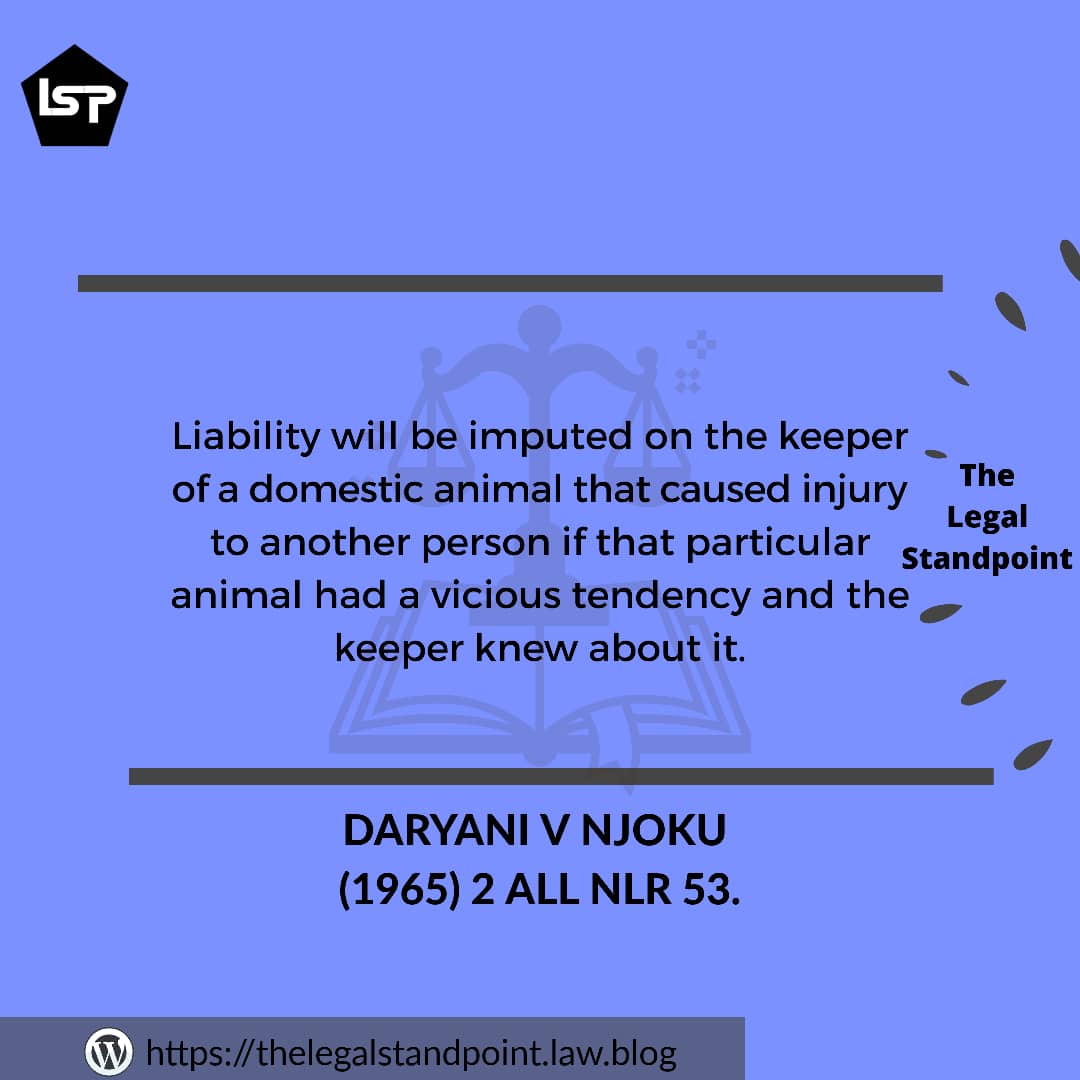
Generally, these animals are normally tame and they do not cause injuries. But happen if they do? The position of the law is that liability will only arise if:

(a) The particular animal had a vicious tendency; and

(b) The keeper knew of that tendency. In the Nigerian case of Daryani v Nwoku (1965) 2 ALL NLR 53, the plaintiff was attacked and injured by the defendant’s dog. Evidence was given that the dog had on a previous occasion attacked a housemaid and the incident was reported to the wife of the defendant. Since the knowledge of the vicious tendency of the dog was known by the wife, the Court held the defendant to be liable because she should have told her husband.

However, the position of the court in this aforementioned case would have been different had it been the dog in this particular case had it the past attacked other animals and not humans.

As established in Glanville v Sutton (1928) 1 K.B. 5.7.1, it was held that because a horse bit other horses in the past was insufficient to show a vicious tendency when a person was bitten.

Defences

Just like every law, there are always exceptions. One of the exceptions to this rule is when the plaintiff is at fault. This occurs when the plaintiff, at the time he was injured, was trespassing on the defendant’s land. See the case of Sarch v Blackburn 1830 172 ER.

Another noticeable defence is violenti non fit injuria, which means that if someone willingly places himself in a position where harm might result, knowing that some degree of harm might result, he will not be able to bring a claim against the other party. This defence applies where persons whose employment is to deal with dangerous animals such as zookeepers and animal trainers and they injured in the cause of their work. They won’t be able to bring a claim because of the violenti non fit injuria principle.

It is the 23rd post. Alexa play me Burna Boy’s 23.Thank you for reading. See you next week.

Law

LSP022: The Calculation of Post Call Years for Legal Practitioners in Nigeria

Until now, there has been a foggy of uncertainty about the calculation of post-call years for legal practitioners in Nigeria. For instance, if an individual was called to the Nigerian Bar in November 2019, how many years has such an individual spent at the Bar till now?

This uncertainty has been demystified by the Federal High Court Abuja in the case under review. The Court stated ‘…. that the moment a person is called to bar, his Post Call year begins to count from that year he was called and the person must pay practicing fee for that year he was called to bar’.

Back to our example, an individual who was called to the Bar in November 2019 and paid his practicing fee in that year is deemed to have used one year at the Bar. If he pays in 2020, that makes it two years, and payment in 2021 makes it 3 years.

At this juncture, it is pertinent to state that the payment of the practicing fee is between January 1 of every year and March 31st of that year. The exception is for the new wigs who are usually not called to the Bar within that time frame. Nevertheless, they are required to pay their practicing fee within one month of enrollment. See Rule 9 (1) of the Rules of Professional Conduct.

Furthermore, the consequence for nonpayment of practicing fee means that such a legal practitioner will not practice for that defaulting year. In addition, the fee varies and it is determined on how many years a lawyer has spent at the Bar.

The payment schedule is:

•Senior Advocates & Honourable Benchers – N50,000
•Legal Practitioners of 15 Years & above post call – N25,000
•Legal Practitioners of 10-14 Years post call – N17,500
•Legal Practitioners 5-9 Years post call – N10,000
•Legal Practitioners of 1-4 Years post call – N5,000

Thank you for reading. See you next week.

Law

LSP021: Dual Citizenship and its Effect on Electoral Positions

One of the irrefutable laws in life is that humans have origins. No matter how distant and clumsy the trace may be, we are all citizens of at least one country.

Citizenship can be defined as the status of being a citizen in a sovereign state. In Nigeria, Section 25-28 of the Constitution of the Federal Republic of Nigeria 1999 as amended (hereinafter referred as CRFN 1999) extensively provides for three classes of citizenship. These are: citizenship by Birth, Registration, and by Naturalization.

On the issue of dual citizenship, S.28(1) CFRN 1999 provides that: Subject to the other provisions of this section, a person shall forfeit forthwith his Nigerian citizenship if, not being a citizen of Nigeria by birth, he acquires or retains the citizenship or nationality of a country, other than Nigeria, of which he is not a citizen by birth.

Furthermore, S.66 subsection(1)(a)CFRN 1999 states that: No person shall be qualified for election to the Senate or the House of Representatives if: (a) subject to the provisions of section 28 of this Constitution, he has voluntarily acquired the citizenship of a country other than Nigeria or, except in such cases as may be prescribed by the National Assembly, has made a declaration of allegiance to such a country.

Speaking in the same vein, this provision also echoes the similar position for prospective candidates into the position of a President, Governor, and the House of Assembly as seen in S.137, S.182 and S.107 of the CFRN 1999.

Now, the aforementioned provisions of the Constitution raise questions such as: is S.28 contrary to the provision of S.66(1)(a), does that mean an individual that possesses dual citizenship cannot seek an elective post in Nigeria?

These questions were judiciously proffered answers to in the Court of Appeal case of Dr Willie Ogebide v. Mr. Arigbe Osula.

Before giving the ratio decidendi (reason for judgment) of the Court, there is a need to comment on the phrase subject to as used in that provision of the Constitution. It’s a trite and well-settled principle of judicial interpretation that whenever the phrase “subject to” is used in a statute, the intention and legal effect is to make the provisions of the section inferior, or limited and restricted in application to the section to which they are made subject to. In other words, the provision of the latter section shall govern, control, and prevail over the provision of the section made subject to it. It renders the provision of the subject section subservient liable subordinate and inferior to the provisions of the other enactment. See the case of Tukur v. Government of Gongola State (1989) 4 NWLR (Pt. 117) 592.

In this present case, it means S.66(1)(a) S.137(1); S.182(1), and S.107(1) are subjected to S.28. It’s not really about the numbers durgggg😀.

Based on this background, the Court of Appeal per Onnoghen JCA (as he then was) stated unequivocally that: ‘it is clear and I hereby hold that the acquisition of dual citizenship by a Nigerian per se is not a ground for disqualification for election to the National Assembly particularly where the Nigerian citizen is a citizen by birth. That is the clear meaning of the provisions in sections 66(1) and 28 of the 1999 constitution when taken together. The only Nigerian citizen disqualified by the said sections is one who is a citizen of Nigeria by either registration or naturalization who subsequently acquires the citizenship of another country in addition to his Nigerian citizenship…’

Putting it in a prospective, if Charlie is a Nigerian by birth and goes ahead to acquire the citizenship of another country, making it a dual citizenship, he cannot be barred from contesting in an elective office. However, if a Ghanian man comes to Nigeria and becomes a Nigerian through Naturalization after fulfilling the requirements, then proceeded to acquire the citizenship of another country, such a person will not be allowed to contest.

From a keen observation, we could see that the court that gave this erudite pronouncement was the Court of Appeal. Could such a decision be changed by the Supreme Court? After all, the Supreme Court is the highest court in the land and has the power to set aside any other courts’ decision. The answer is no. The reason being that by virtue of S.246(3) CFRN 1999, the decisions of the Court of Appeal in respect to appeals arising from the National and State Houses of Assembly election petitions are final. See the cases of: Onuaguluchi v Ndu [2001] 7 NWLR (pt.712) 309; Awuse v Odilli [2013] 18 NWLR (pt.851) 116, Abubakar & Anon v Usman v Ors [2017] LPELR-SC. 167/2016

Please click on the like button. Thank you for reading. See you next week.