
It is the first article for 2021 and we are officially wishing our esteemed readers a prosperous new year.
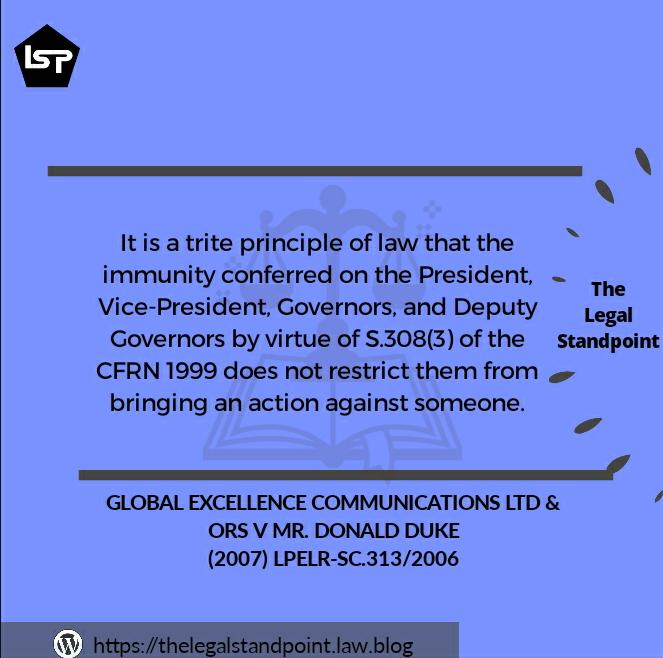
Today’s analysis centers on whether or not the beneficiaries covered by the Immunity Clause under the Constitution can sue someone else.
Immunity can be defined as the exemption from a prosecution granted by statute or government authority. The rationale behind this protection is that if the beneficiaries are not distracted and pressurized as a result of litigation, they will have ample time to discharge their functions without encumbrance.
The Immunity Clause is entrenched in S.308 of the Constitution of the Federal Republic of Nigeria 1999 (as amended) and it protects the President, Vice President, Governor, and Deputy Governor.
The section of the Constitution that pertains to this analysis provides that: Notwithstanding anything to the contrary in this Constitution, but subject to subsection(2) of this section: (a) No civil or criminal proceedings shall be instituted or continued against a person to whom this section applies during his period of office….
In this case under study, the respondent brought an action of alleged libel against the appellants and claimed for the sum of N5 million (Five million naira) damages for libel and exemplary or punitive damages of N10 billion (Ten billion naira).
Conversely, the appellants argued, that by virtue of S.308 of the Constitution, a Governor cannot be sued neither can he sue. The rationale behind their submission was that it will amount to absurdity and lead to injustice to hold that the respondent who is immune from legal proceedings by any person is the very person who is also free to institute actions against any person in his personal capacity for any wrong during the period of immunity.
However, the court jettisoned this argument. The court in this present case was aided by the principles guiding the court in interpreting or constructing the provisions of the constitution as enunciated in the case of AG Bendel State v. AG Federation & Ors (1982) 3 NCLR 1, (1981) 9 S.C. (Reprint) 1 at 78-79 one of which is that, the language of the Constitution, where clear and unambiguous, must be given its plain evident meaning.
While giving the lead judgment, Onnoghen JSC (as he then was) held that: ‘from the words used by the framers of section 308 of the 1999 Constitution, it is clear that their intention is explicitly to confer absolute immunity on the respondent and the others therein mentioned without a corresponding disability on them to the exercise of their rights to institute actions in their personal capacities in any relevant court of law for redress during their tenure of office, as in the instant case.
Furthermore, Aderemi J.S.C (as he then was) took the court on a longevity pilgrimage to emphasize that the court will interpret the law according to the ordinary meaning by opining that: ‘it must always be remembered that judges have no business expanding the law or even making same: that is the exclusive function of the lawmakers. It is often said that a Judge, in interpreting the provisions of any law, must get at the intention of the legislators. Yes, that is a true statement; but in demonstrating his judicial interpretative skill, a judge can get to know the intention of the legislators only through the wordings of the provisions of the statute or section of the Constitution being interpreted. Let it be remembered that when in the words used in couching the provision, there is no ambiguity, then no exposition contrary to the expressed words used, is to be made. There is NOTHING and I repeat NOTHING PREVENTING a Governor or Deputy Governor from taking out a writ of summons or originating summons or better put, suing anybody whilst still in office. The above is the clear and, in my humble view, a true interpretation of that section; that is a true declaration of the law. To do otherwise is to declare what the law ought to be which is not the function of the judex. If it is thought that the law ought to be amended, let that be the exclusive function of the legislators-members of our National Assembly. Section 308 of the aforesaid does no more than to confer absolute immunity on the holder of the position of the Governor or Deputy Governor in the state without drawing away from them their rights to seek a redress for any wrong done to them by instituting actions in their personal capacities against anybody they may think has transgressed their rights even while they are still in office’.
The ratio decidendi (rationale for the decision) also followed the cases of Tinubu v IMB Securities (SC 32/2001) [2001] 10, Chief Onabanjo v Concord Press of Nigeria Ltd. (1981) 2 NCLR 398, etc.
Thank you for reading and see you next week. Kindly like this post.

 THELEGALSTANDPOINT