
 Animals are all around us. Some are for commercial purposes; some are reared, while some are kept either for entertainment or study purposes. Over the years, numerous stories have inundated the media about people who were attacked or injured by animals.
On few unfortunate occasions, the attacked persons also doubled as the narrators.Just like cars, buildings, inventions, etc, animals are also properties belonging to certain people.
Since they are properties, the law may hold the owner answerable to actions caused by them. Generally, one of the classifications of animals by type is Wild and Domestic Animals.
The law of Torts classified the former as Animals Ferae Naturae and the latter as Animals Mansuetae Naturae. Animals Ferae Naturae
The position of law is that individuals that keep naturally dangerous animals, for example, Lion, Tiger, Liger, etc as exotic pets, are strictly liable for any harm it may cause and it is immaterial whether such a pet had not attacked anyone in the past or done any damage.
Thus, the keeper of a wild animal keeps it at his own detriment. In the case of Behrens v Bertram Mills Circus Ltd 2 QB 1 (1957), Bertram Mills Circus Ltd. (Defendant) granted Whitehead (Plaintiff’s manager) a license to have Mrs. J. H. W. Behrens (Plaintiff) and her husband work at Defendant’s circus. Defendant forbade the presence of dogs. Plaintiff’s husband ignored the prohibition and brought his dog to the circus. The dog barked at one of Defendant’s trained elephants, which began to chase the dog. Consequently, the elephant injured Plaintiff and damaged her booth. The plaintiff brought a suit and the court ruled in his favour.
Animals Mansuetae Naturae
In Nigeria, the common domestic animals we find around are Cats, Goats, and most especially Dogs. In fact, dogs are generally regarded as man’s best friend.
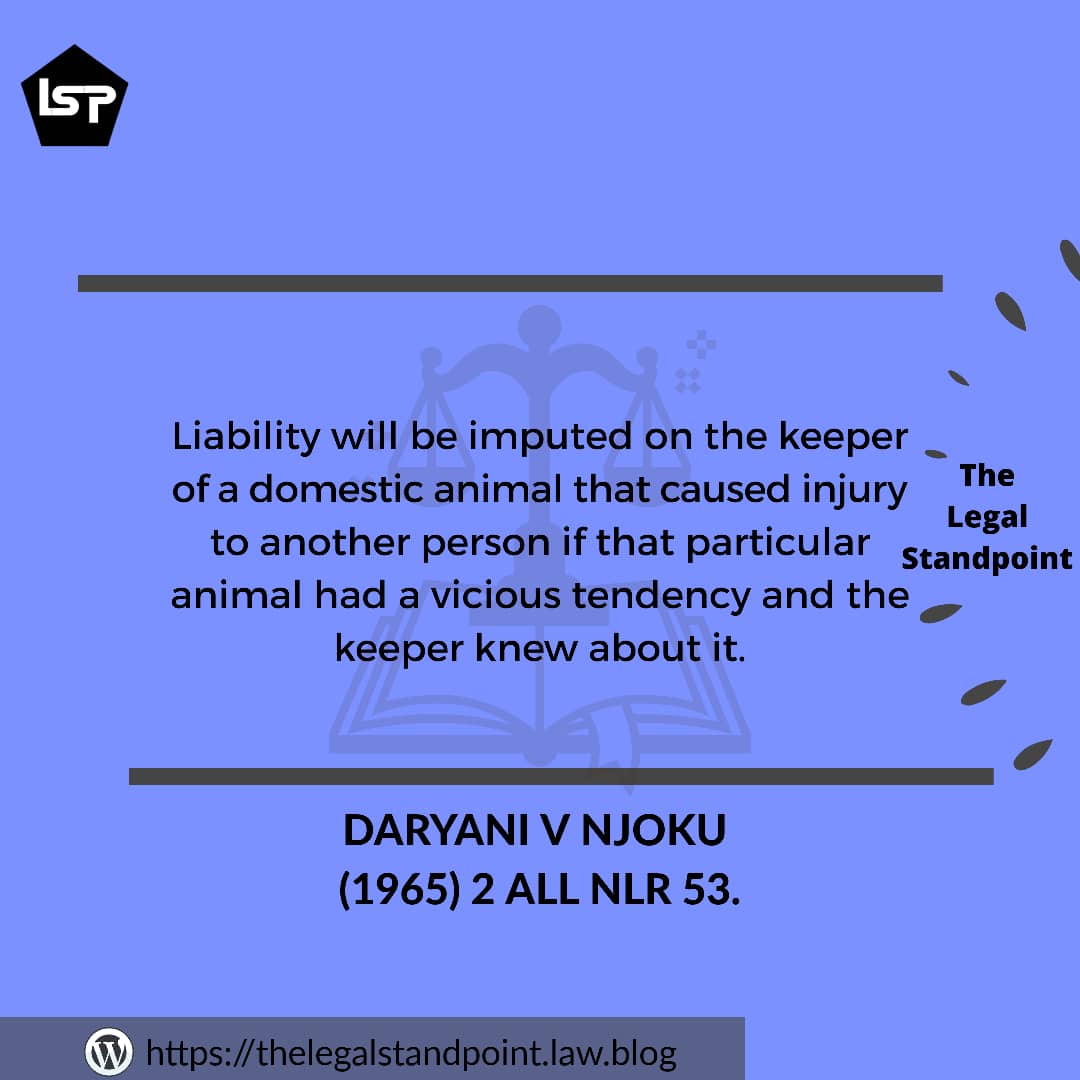
Generally, these animals are normally tame and they do not cause injuries. But happen if they do? The position of the law is that liability will only arise if:
(a) The particular animal had a vicious tendency; and
(b) The keeper knew of that tendency. In the Nigerian case of Daryani v Nwoku (1965) 2 ALL NLR 53, the plaintiff was attacked and injured by the defendant’s dog. Evidence was given that the dog had on a previous occasion attacked a housemaid and the incident was reported to the wife of the defendant. Since the knowledge of the vicious tendency of the dog was known by the wife, the Court held the defendant to be liable because she should have told her husband.
However, the position of the court in this aforementioned case would have been different had it been the dog in this particular case had it the past attacked other animals and not humans.
As established in Glanville v Sutton (1928) 1 K.B. 5.7.1, it was held that because a horse bit other horses in the past was insufficient to show a vicious tendency when a person was bitten.
Defences
Just like every law, there are always exceptions. One of the exceptions to this rule is when the plaintiff is at fault. This occurs when the plaintiff, at the time he was injured, was trespassing on the defendant’s land. See the case of Sarch v Blackburn 1830 172 ER.
Another noticeable defence is violenti non fit injuria, which means that if someone willingly places himself in a position where harm might result, knowing that some degree of harm might result, he will not be able to bring a claim against the other party. This defence applies where persons whose employment is to deal with dangerous animals such as zookeepers and animal trainers and they injured in the cause of their work. They won’t be able to bring a claim because of the violenti non fit injuria principle.
It is the 23rd post. Alexa play me Burna Boy’s 23.Thank you for reading. See you next week.

 THELEGALSTANDPOINT
Rich content, user-friendly format. Great job
LikeLike
Thank you.
LikeLike
Educative
LikeLike
Thank you, sir.
LikeLike
… always worth taking time to read.
Good job.
Thank you.
LikeLike
Thank you, sir.
LikeLike
Educative. Kudos!
LikeLike
Thank you.
LikeLike
Educative. Kudos!
LikeLike