
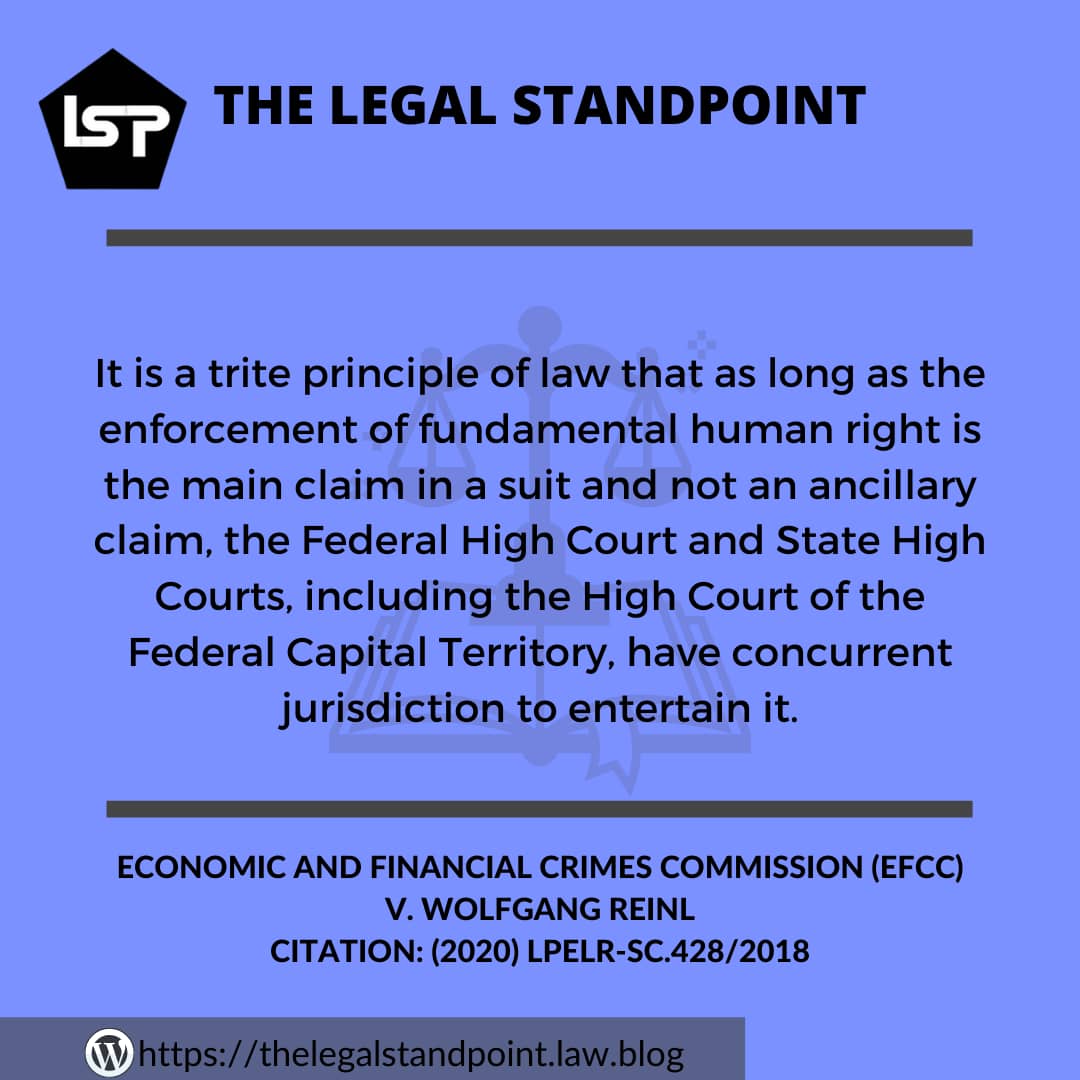
Overtime, the question as to which court has the jurisdiction to entertain cases involving breach of Fundamental Human Rights has been reoccurring. Its reoccurrence has led to several (mis) interpretations. In course of this article, attention will be paid to the factors that led to these misinterpretations and the correct position of the law. Before that, attention will quickly be given to the definition of Jurisdiction and Fundamental Human Rights.
Jurisdiction is the authority which a court of law has to determine matters or issues which are litigated before it or to take cognizance of issues presented in a formal way for its resolution. See the case of UTIH & ORS. V. ONOYIVWE & ORS. (1991) LPELR-SC.160/1988.
Human rights are those rights which every individual born into the world possesses regardless of race, sex, nationality, ethnicity, language, religion, or any other status simply because he or she is human. Fundamental Human Rights, on the other hand, are the human rights which are recognized, supported, and protected by the state usually in a written constitution. See the case of Ransome-Kuti V. Attorney General Federation (1985) 2 NWLR (PT. 6) 211.
In Nigeria, Fundamental Human Rights are enshrined in Chapter 4, Section 33-46 of the Constitution of the Federal Republic of Nigeria (1999 as amended). Some of these rights are: Right to Life, Right to Dignity of the Human Person, Right to Freedom of Expression, etc. These rights are sacred, sacrosanct, and meant to be enjoyed by all citizens without fear or victimization. However, several situations abound on the breach of these rights.
The salient question is which court has the jurisdiction to entertain the breach of any of these rights. Section 46(1) of the CFRN 1999 as amended states: Any person who alleges that any of the provisions of this Chapter has been, is being or likely to be contravened in any State in relation to him may apply to a High Court in that State for redress. (Emphasis on IN).
At this juncture, it is pertinent to note that there are two issues to be resolved. First off, people often overlook the preposition IN in that aforementioned section. A High Court in that state could mean the State High Court or the judicial division of the Federal High Court in a state, including the Federal High Court, FCT. In fact, Order 1 Rule 2 of the Fundamental Rights (Enforcement Procedure) Rule 1999 defines a court as meaning Federal High Court or the High Court of a State or the High Court of the Federal Capital Territory, Abuja.
In law, once the provisions of a statute or law are clear, they should be given their natural and ordinary meaning. Ergo, both the Federal High Court and State High Courts have the authority to entertain issues bothering on breaches of Fundamental Human Rights. Giving the rationale behind these alternative choices, KEKERE-EKUN, J.S.C in the case under review stated that: ‘The violation of a citizen’s fundamental right is reviewed so seriously that the framers of the Constitution sought to ensure that no fetters are placed in the path of a citizen seeking to enforce his rights. In other words, the provision ensures that he has access to any High Court as long as it is within the State in which the alleged infraction occurred. Indeed it would negate the principle behind the guarantee of fundamental rights if a citizen were to have any obstacle placed in the path of enforcing those rights. There is no ambiguity in the provisions of the Constitution or of the fundamental rights (Enforcement Procedure) Rules… regarding which Court has jurisdiction to entertain an application for the enforcement of fundamental rights.’
In addition, the second issue centers on the breach of Fundamental Human Rights by a Federal Agency. This issue, like fire on a bush during the harmattan season, is further complicated by virtue of Section 251 of the CFRN 1999. Section 251(1)(P) states that: Notwithstanding anything to the contrary contained in this Constitution and in addition to such other jurisdiction as may be conferred upon it by an Act of the National Assembly, the Federal High Court shall have and exercise jurisdiction to the exclusion of any other court in civil causes and matters -(p) the administration or the management and control of the Federal Government or any of its agencies.
In essence, what this section is saying is that the Federal High Court has the exclusive jurisdiction to entertain all civil matters that involve a federal agency.
Thus, it appears that the provisions of Section 46(1) and 251(1(P) conflict. These aforementioned provisions raise some questions. For example, if an agent of the EFCC, which is a federal agency, acting in his official capacity, attacks an individual without a just cause, this is clearly a breach of the Fundamental Right. However, which court has the jurisdiction to entertain this matter? Is it the State High Court? Or the Federal High Court since it involved a federal agency?
The position of law has always been that where there is a conflict between a general and specific provision in a statute, the latter will prevail. Tobi JSC(as he then was) in KRAUS THOMPSON ORGANISATION V. NATIONAL INSTITUTE FOR POLICY AND STRATEGIC STUDIES (2004) LPELR-SC.38/2000 held that: ”It is a well-established canon of statutory interpretation that where an issue in a statute is governed by a general provision and a specific provision, the latter will be invoked in the interpretation of the issue before the court. This is because the specific provision will be deemed to have anticipated the issue as against the general provision.” See also Jack V. University of Agriculture Makurdi 2004 LPELR-SC.262/2000. So, while Section 251(1)(P) is a general provision, Section 46(1) is a specific provision and thus will prevail.
Furthermore, the high court in a state also extends to the National Industrial Court. As such, when a breach of fundamental human rights occurs in the course of employment, the National Industrial Court will have the jurisdiction to entertain the suit.
In conclusion, the position of law is that irrespective of the parties involved, as long as the enforcement of Fundamental Human Rights is the main claim, the State High Court, Federal High Court, the High Court of the Federal Capital Territory including the National Industrial Court in applicable instances have the concurrent jurisdiction to entertain the matter.
Kindly subscribe to the mailing list if you haven’t. Go to the homepage and scroll down.
Thank you for reading. See you next week.
 THELEGALSTANDPOINT