
One of the indisputable facts is that Nigeria is a multilingual country. With over Two Hundred and Fifty Languages (250) across the nation, the Giant of Africa conspicuously ticks the first requirement of a multilingual speech community.
Despite the plethora of these languages, the official language of the country is English. The English language is at the apogee stage of importance. It occupies a marquee function due to its constant usage as a medium of expression in Education, Administration, Workplace, Media, Judiciary, etc.
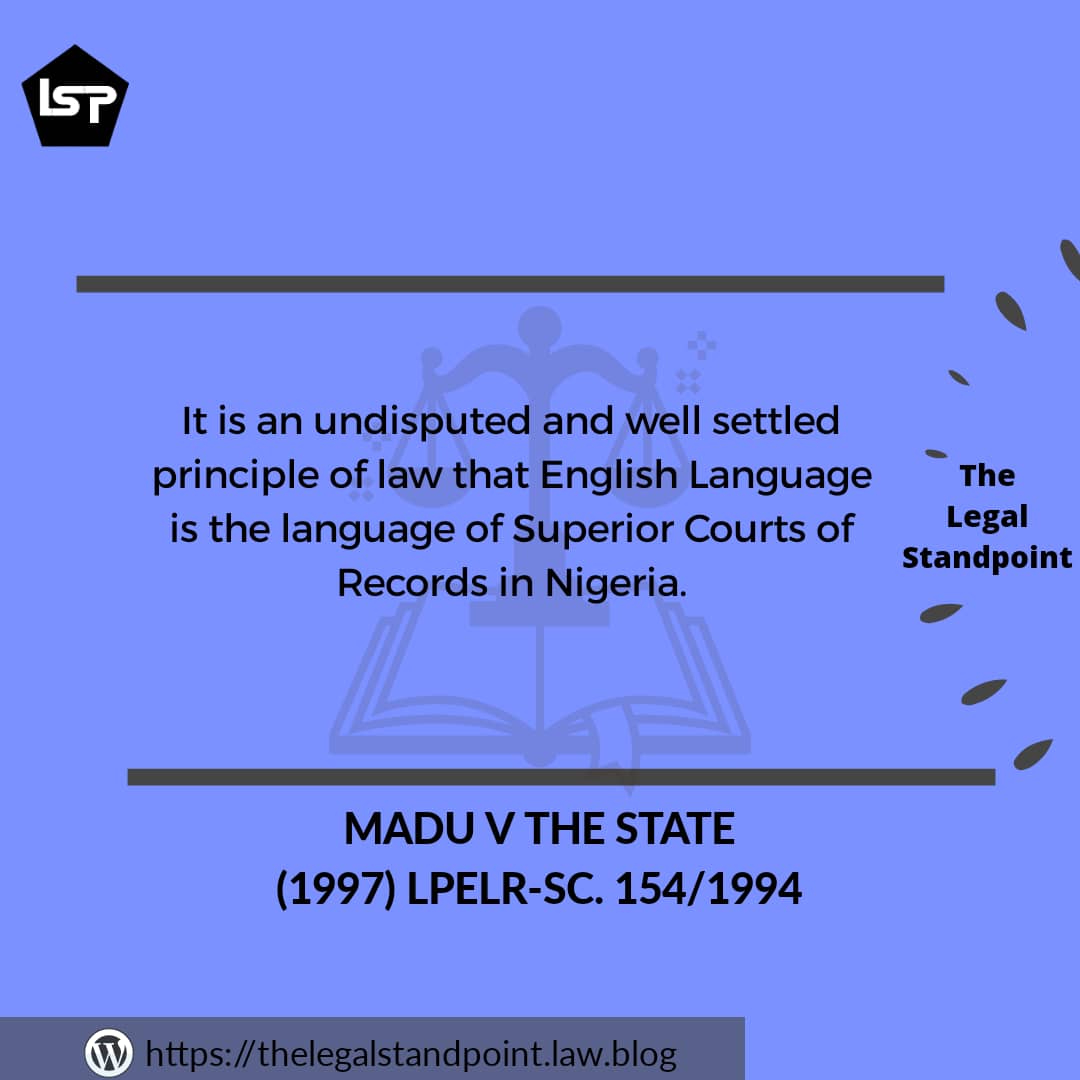
The superior Courts in Nigeria also use English Language as a medium of expression. This principle has received judicial approvals in cases such as Madu v. State (1997) 1 NWLR (pt. 482) pg 403 para B, Ogunye v. The State (1999) LPELR-SC.47/1997, etc.
In Babarinde & Ors. v. The State (2012) LPELR-CA/IL/C.18/2010, the Court held that it is a cold fact that Yoruba vernacular has never been the official language in the Nigerian courts. As such, Africa Magic Yoruba conducting Court proceedings using the Yoruba language is, in law, wrong. ‘Lori iro‘.
However, does that mean that all Courts in Nigeria employ the English Language as a medium of proceeding? No. This principle only applies to the Court of Superior Records. These courts are The Supreme Court, The Court of Appeal, The Federal High Court, Sharia Court of Appeal Abuja, The Federal High Court Abuja, The Customary Court of Appeal Abuja, The State High Court, The Sharia Court of a State, The Customary Court of a State.
Hence, any local language can be used as a medium of expression in Areas and Customary Courts. See Onyia v. The State (2008) LPELR-SC 232/2006 (P.28, Paras F-G).
AN INTERPRETER
It is possible that a party to a proceeding does not understand the English language. The law already envisages this situation and makes a provision for the Right of such a person to an Interpreter. This is enshrined in Section 36(6)(E), Constitution of the Federal Republic of Nigeria, 1999 (as amended).
The Court held in Akeem v. The State (2017) LPELR-SC.589/2014, that The law is trite that where an accused person does not understand the English language which is normally, the language of the Court, it is his responsibility to tell the Court, at the earliest opportunity, that he did not understand the English language which is the language of the Court or ask his lawyer (if any) to inform the Court of that challenge.
EVIDENCE TENDERED IN OTHER LANGUAGES
In Damina v. The State (1995) 9 SCNJ 254, it was held that a court of law is presumed to be an illiterate in any document written in any Nigerian local language as it cannot comprehend its content no matter the dexterity of the Judex in that language.
Ergo, any document sought to be relied upon by a party which otherwise is not written in the English Language must be translated by the party seeking to rely upon it in evidence into the English Language. It is entirely the responsibility of the party that intends to rely on such documents to translate that document from that language to the language of the Court. The Court cannot call for its translation or interpretation suo motu (on its own) as to do that will amount to making a case for the appellant which is not the duty of the court. See the case of Ojengbede v Esan (2001) 18 Part 746 Page 771 at 790 para A-B.
Thank you for reading. See you next week.
 THELEGALSTANDPOINT