
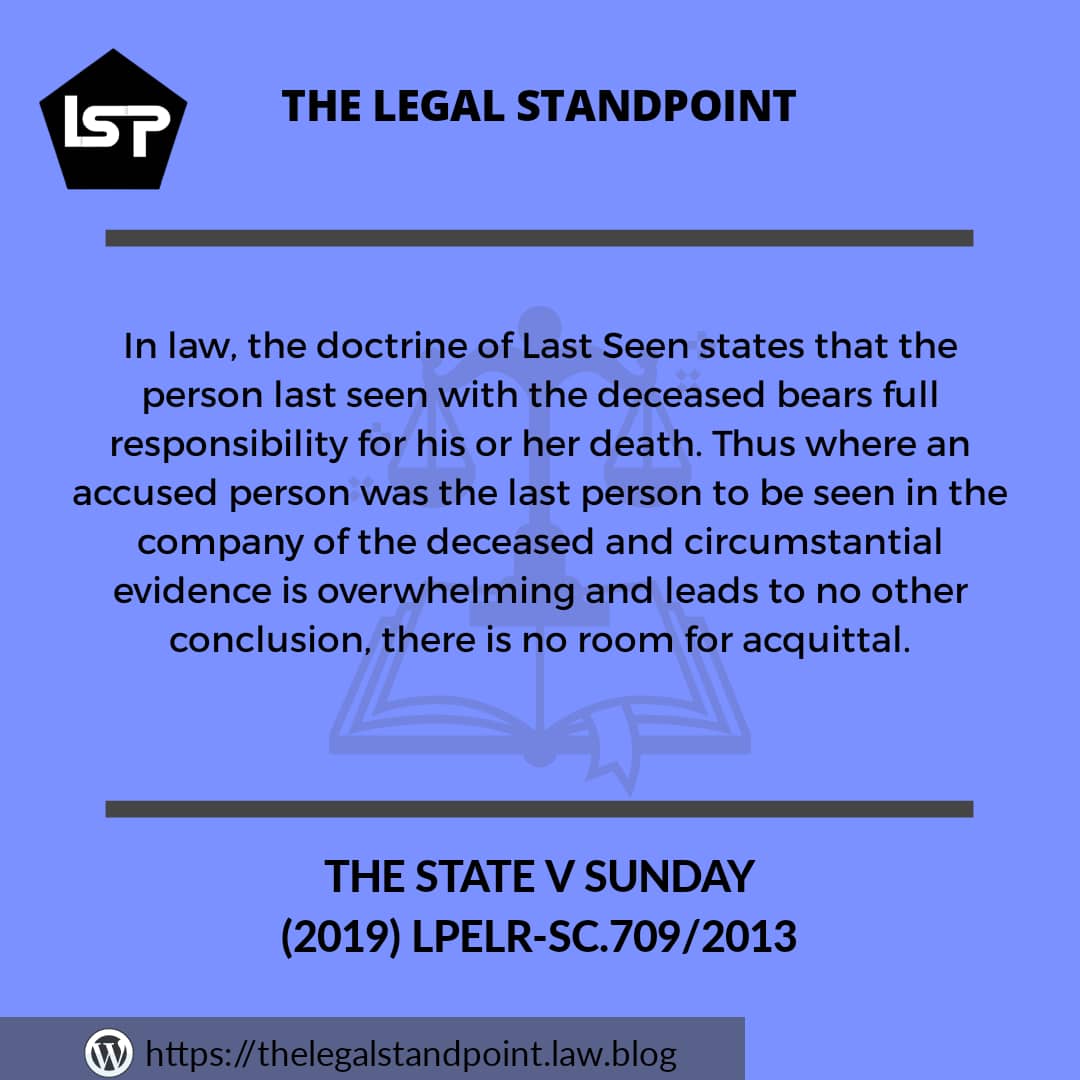
The Doctrine of Last Seen states that the person last seen with a deceased bears full responsibility for his or her death. For example, if Mrs. Katharina Rostova was last seen alive with or in the company of Mr. Raymond Reddington and the next thing that happened was the disappearance of Katharina, the irresistible inference is that she was or had been killed by Reddington.
This doctrine is one of the fundamental principles of the Nigerian Criminal Jurisprudence and it is mostly used in murder and manslaughter cases. By extension, this theory is not restricted to the Nigerian Criminal Jurisprudence alone. It is a principle of universal application. See the Indian case of Rajashkhanna v State of A.P. (2006) 10 SCC 172.
Although the Nigerian statutes and laws do not provide for this doctrine, it has, nevertheless, gained notoriety in the criminal jurisprudence through various judicial pronouncements.
Commenting on this doctrine, the Apex court per Adekeye, J.S.C, (as he then was) in Haruna v. AG of Federation (2012) LPELR-SC.72/2010,(Pp. 30-31, paras. F-B) held that: “The doctrine of “last seen” means that the law presumes that the person last seen with a deceased bears full responsibility for his death. Thus where an accused person was the last person to be seen in the company of the deceased and circumstantial evidence is overwhelming and leads to no other conclusion, there is no room for acquittal. It is the duty of the appellant to give an explanation relating to how the deceased met her death in such circumstance. In the absence of a satisfactory explanation, a trial court and an appellate court will be justified in drawing the inference that the accused person killed the deceased.
The Doctrine of Last Seen thrives on presumption and like every presumption in law, it is rebuttable. Generally, the trite principle of law is that the burden of proof is always on the prosecution to prove the guilt of the accused person beyond reasonable doubt through credible and reliable evidence in proof of the case against the accused person. See Section 135 of the Evidence Act 2011. However, under the Doctrine of Last Seen, this general principle changes, and the burden of proof thus shifts from the prosecution to the accused to adduce credible evidence to show that he or she was not the one who killed the deceased.
In the case of Madu v. State (2012) LPELR-SC.12/2009, the court held: “If it turns out that the person last seen with the deceased is dead, the doctrine, therefore, lays a burden on the accused to give an explanation on how the deceased met his or her death.”
It is pertinent to state that in determining the guilt or otherwise of the accused, attention is heavily placed on the time gap by the Courts. if the time when the accused and the deceased were last seen alive and the deceased is found dead is so infinitesimal that the possibility of any person other than the accused coming in contact with the deceased becomes impossible, the doctrine may likely be applied. However, it would be difficult in some cases to successfully establish that the deceased was last seen with the accused when there is a long gap and existence of the possibility of other persons coming in between.
Furthermore, this doctrine is not meant to be applied in isolation. In addition to it, there must also be overwhelming circumstantial evidence pointing to the guilt of the accused. Circumstantial evidence in criminal law is the proof of circumstances from which according to the ordinary course of human affairs, the existence of some fact may reasonably be presumed.
Owing to this, the principle was not applicable in the 2019 recent case of State v. Sunday (2019) LPELR-SC.709/2013 involving the alleged murder of a father by his son while it was applicable in Anyasodor v. State (2018) LPELR-SC.655/2015 involving the death of a man through his estranged lover. Hence, the applicability depends on the facts of each case and the circumstantial evidence. The rationale behind this is to avert the miscarriage of justice.
Thank you for reading. See you next week.
 THELEGALSTANDPOINT