
Life is like a proof. It has to be….woo, I really don’t know😃. It is sha a proof. Nevertheless, I know that proofs are important in both civil and criminal cases.
To determine the guilt of the accused or secure a conviction in a criminal case, there has to be proof beyond reasonable doubt. This has been given statutory provision in Section 135 of the Evidence Act.
In criminal cases, the legal burden is entirely on the Prosecution to prove the guilt of the Defendant. This resonates with the landmark principle of law that who asserts must prove. As such, if an individual is being accused of committing a crime, the prosecution has the onus of adducing clear and credible evidence showing the culpability of the accused to the alleged offence.
It is pertinent to state that this legal burden does not shift if the prosecution must secure conviction. This is because, there is the presumption of innocence in favour of the Defendant, by virtue of Section 36(5) of the Constitution of the Federal Republic of Nigeria 1999 (as amended), as he has no responsibility in law to prove his innocence.
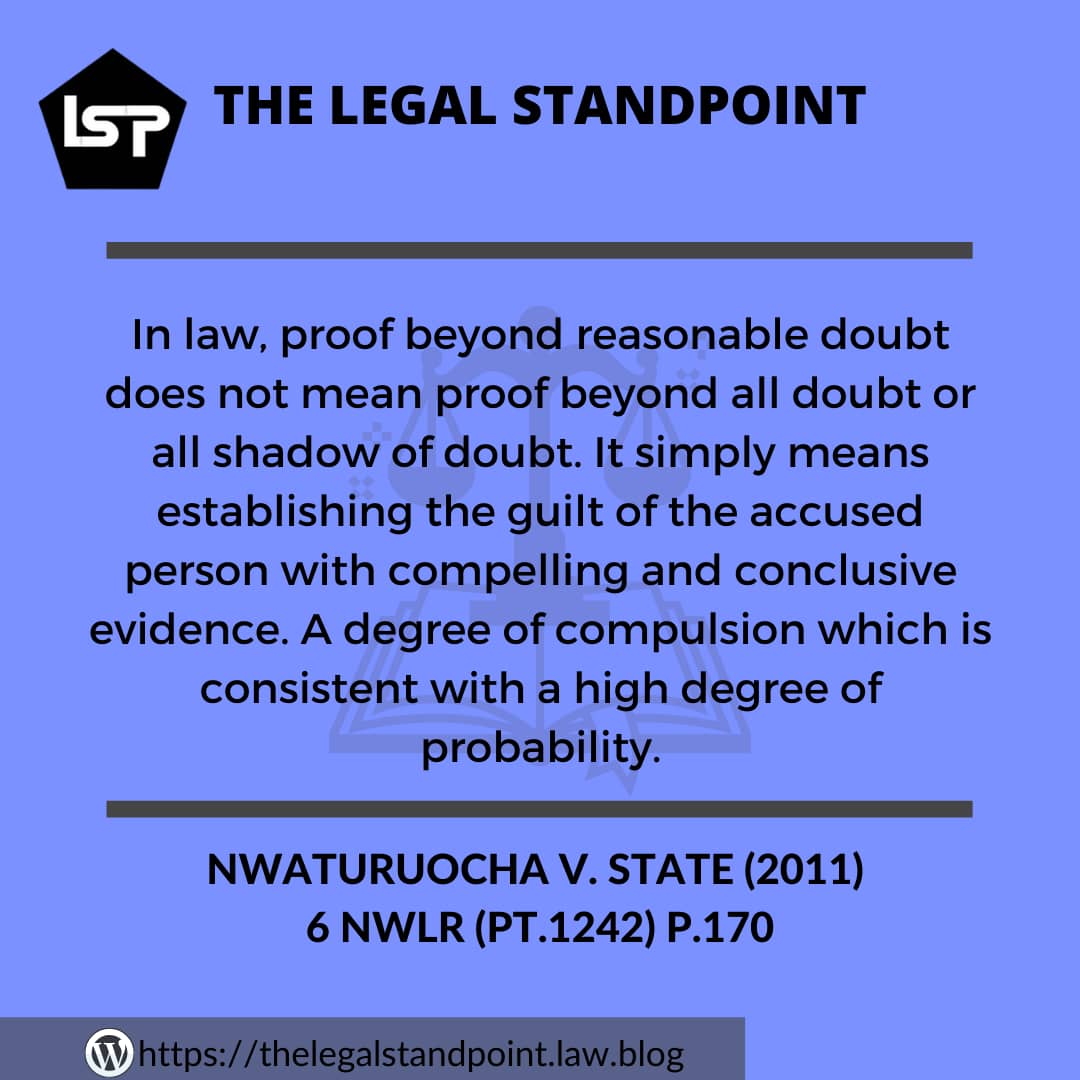
What then is Proof beyond Reasonable Doubt? The Supreme Court, in a plethora of cases, defined the principle to mean the standard which the prosecution must meet in order to successfully find the accused guilty of a crime. For instance, if an accused is charged with a homicide (murder), the prosecution must prove that:
(a) the deceased is dead;
(b) that the death was caused by the accused;
(c) that the accused intended to either kill the victim or grievously harm. him. See Idemudia v State @2001 FWLR (PT.55) 549 at 564, Akpan v State (2001) FWLR (Pt.56) 735; Madu Vs. State (2012) 15 NWLR (Pt.1324) 405 etc. If these vital ingredients are proven by clear and compelling evidence to the satisfaction of the Court, then the persecution has successfully proved the case beyond a reasonable doubt. Contrary, when there is any doubt in the course of proving any ingredient of the offence; the doubt will be resolved in favour of the Defendant which will lead to his exculpation as that will mean that the prosecution has not proved his case beyond reasonable doubt.
Furthermore, there are very few things in this world that we know with absolute certainty, and in criminal cases, the law does not require proof that overcomes every possible doubt. In fact, there cannot probably be any proof that can be beyond all doubts or shadow of doubt. For as long as we are on this side of life, we are limited to grasp the total truth of what transpired in a matter. As such, it will be wilting to prove a criminal case beyond any shadow of a doubt. The Courts frown on proving a case beyond all doubt or shadow of doubt because it is practically impossible. Fabiyi (JSC) (as he then was) stated in the case under review that ‘Proof beyond reasonable doubt should not be stretched beyond a reasonable limit. Otherwise, it will cleave.’
In conclusion, presenting evidence to prove the guilt of the accused beyond reasonable doubt is one of the important features of criminal trials. The burden which is stationary placed on the Prosecution doesn’t mean the case should be proved beyond all shadow of doubts. Rather, the prosecution must successfully establish every ingredient for the offence charged. Once this is achieved, then such a case has been proven beyond reasonable doubt. Failure to establish all ingredients of a crime will lead to the accused being exculpated.
NB: The traffic on the site is blooming. Thank you for always reading and sharing the link. It means a whole lot to me. See you next week, esteemed readers.🥰.

 THELEGALSTANDPOINT