Generally, there are two kinds of proceedings in the Nigeria Legal System. These are criminal or civil proceedings. These proceedings are mutually exclusive. However, there is a possibility of an action being both a crime and a civil wrong at the same time. For instance, assault, defamation, and false imprisonment are all civil wrongs and crimes by virtue of Sections 252, 373, and 365 of the Criminal Code respectively.
Putting it into a perspective, let us say Mr. A engaged the services of Mr. B to build a house. Due to Mr’s B mischievous nature, he used materials lower in quality in the construction of the house. Upon completion, the house collapsed leading to the death of some persons. In this scenario, Can Mr. B be charged with an offence of Murder and also be liable to pay damages for the breach of his contract with Mr. A?
If this question were to be asked a few years ago, the answer would have been a resounding NO because of the common law rule in Smith v Selwyn (1914) 3 KB 98. This principle of law established in that case was that where a civil wrong is also a crime, prosecution of the criminal aspect must be initiated, or reasons for default of prosecution given, before any action filed by the plaintiff in the civil court can be heard.
However, at this time, the answer will be a welcoming YES because the rule of Smith v Selwyn has become obsolete and no longer applicable in Nigeria. There are cornucopia of statutory provisions and judicial pronouncements which have made the rule inapplicable in Nigeria. The latter is Section 6(6) (b), 17(2) (e), 46(1), and 315 (3) of the 1999 Constitution of the Federal Republic of Nigeria (as amended), Section 8(2) of the Interpretation Act. The rationale behind this is that a person’s right of access to court is guaranteed under the Constitution and the act of non-simultaneous prosecution of a criminal charge and a civil suit runs contrary to it.
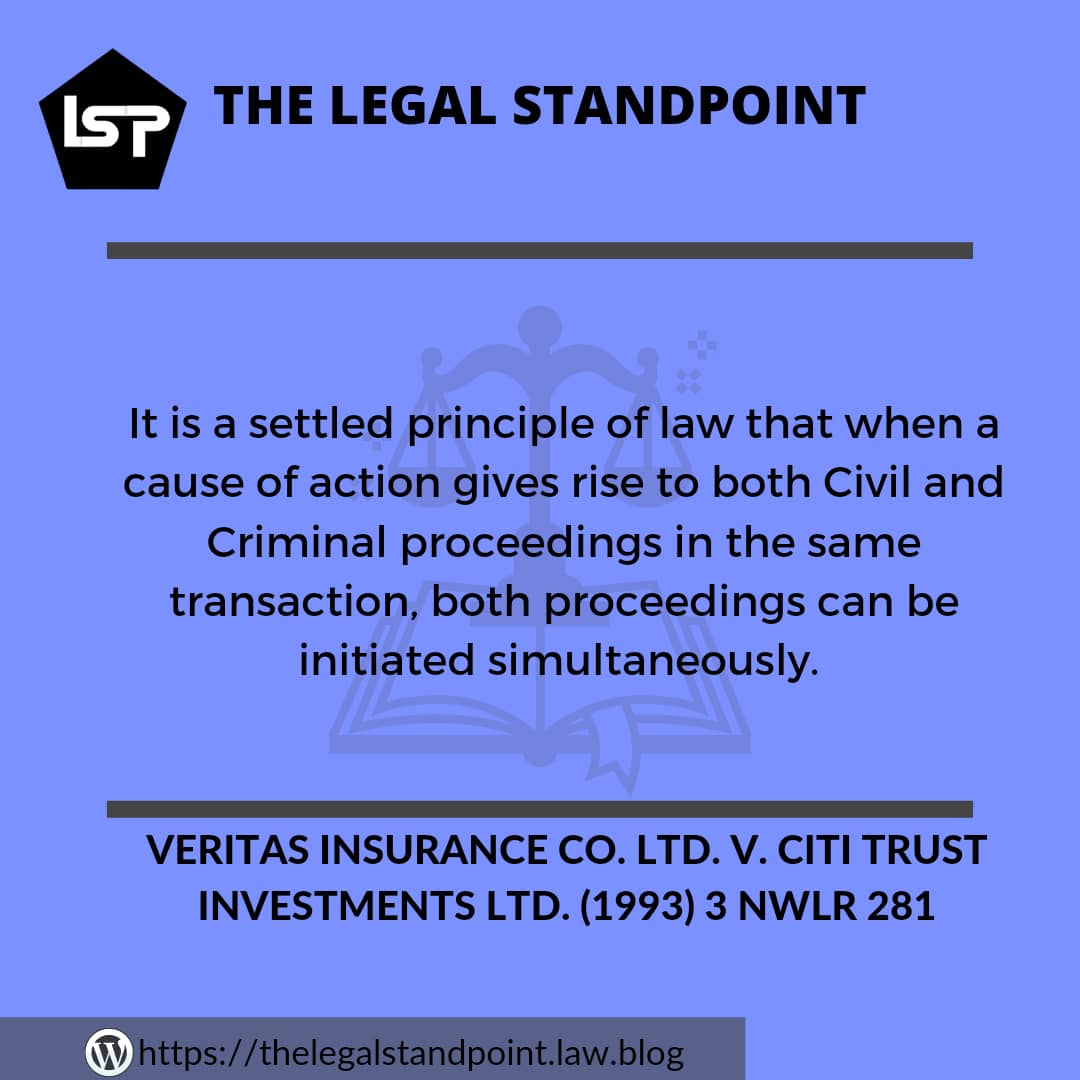
Regarding judicial authorities, Justice Niki Tobi (as he then was) in Veritas Insurance Co. Ltd. v. Citi Trust Investments Ltd held that: ‘It appears that the decisions to the effect that the rule (in Smith v. Selwyn) applies in Nigerian law were made per incuriam. It is my view that the rule is not applicable in Nigeria in view of the very clear two local statutory provisions. Section 5 of the Criminal Code Act is one, section 8 of the Interpretation Act is another…. Apart from the clear position of our law, it does not even seem to be a sensible thing to stop a plaintiff from instituting an action merely because the criminal action on the same matter has not been prosecuted. Certainly, a man who is aggrieved should have nothing to do with a criminal matter before instituting a civil action. The criminal matter is the concern of the State, so to say, while the civil matter is the concern of the aggrieved individual.’
In conclusion, a strict adherence to the rule of Smith v Selwyn will occasion hardship, consequently being a clog in the administration of the wheel of justice. The abolition of the rule is a welcome development. On this, the determination of a criminal case is time-consuming. Thus, waiting for the completion of a criminal case before the commencement of a civil action could be likened to Waiting for Godot. Even when it is finally settled, being that a crime is tried at the instance of the State, the victim will only get an appeasement, which in most instances, is not usually enough to cover the injury suffered by the victim. Hence, the abolition of the rule allows the plaintiff to bring a civil action for monetary compensation, specific performance, injunction, etc depending on the fact of each case.
Thank you for reading. See you next week❤.

 THELEGALSTANDPOINT
Gbam! 📌
🤲🤲🙇🏾♀️
LikeLike
Thanks so much. It’s educative and helpful
LikeLike
Thank you, sir. I’m glad you enjoyed it
LikeLike
You’re mostly welcome…..
We’re looking forward to another one
LikeLiked by 1 person
Thanks for the energy invested into this.
LikeLike
Thank you so much.
LikeLike
Thank a lot this is very helpful
LikeLike
You’re welcome
LikeLike
Thank you. This is the application which I have to oppose before a Judicial Panel of Inquiry and your contribution is an insight.
LikeLike
We are grateful to have been of help.
LikeLike
This was really insightful…but I got a question in my tort that there are some exceptions to when the smith V Selwyn rule can be used under the Nigerian legal system after the abolishment…can you help me out?
LikeLike