
“This school has zero-tolerance for examination malpractices. If you’re caught engaging in this act, you will be handed over to the Police” Anonymous
Have you heard those words before? Probably you would. I heard mine in examination halls when I was at Obafemi Awolowo University. Back then, it didn’t make sense to me. It wasn’t meant to actually😊. Then, my stance was that examination malpractice is an internal affair of the University, why should the Police be involved? In course of this article, we will proffer an answer.
Academic institutions are statutory bodies established pursuant to an enabling enactment. For instance, the University of Ibadan Act 1962 established the University of Ibadan. The Act, like all establishment Acts of all academic institutions in Nigeria, sets out the rules and regulations governing the activities of all actors in the university. For instance, Section 11 centers on the Discipline of Students.
Examination malpractice is an academic dishonesty contrary to the official rules governing an examination which aims to give the malpractitioner an undue advantage. In Nigeria, examination malpractice is both an administrative wrong and a crime.
At this juncture, it is pertinent to examine the effects of the principle held in Garba &Ors v University of Maiduguri (1986) 1 NWLR (Pt.18)550 on this subject matter. In that case, the appellants were expelled by the respondent for riotous behaviour which led to vandalization of properties and assault on persons. The Court held that the appellants’ acts were crimes which the guilt or otherwise could only be determined by the Courts. Accordingly, the purported investigation by the Investigating Panel and Disciplinary Board and the punishment meted out to the appellants cannot stand and are declared a nullity.
Over the years, the Supreme Court has modified the position of the law stated in Garba and Ors. v. University of Maiduguri (supra). In the case of Federal Civil Service Commission and Ors. v. Laoye (1989) 2 NWLR (Pt.1O6) 652, 679, Eso JSC (as he then was) held that “I would like to emphasise herein that the decision in Garba should not be taken as a prohibition of instituting disciplinary measures against civil servants (students) where there has been a criminal charge or accusation. This principle was also reiterated in University of Calabar v. Ugochukwu and Ors. (No.2) (2007) 17 NWLR (pt.1063)
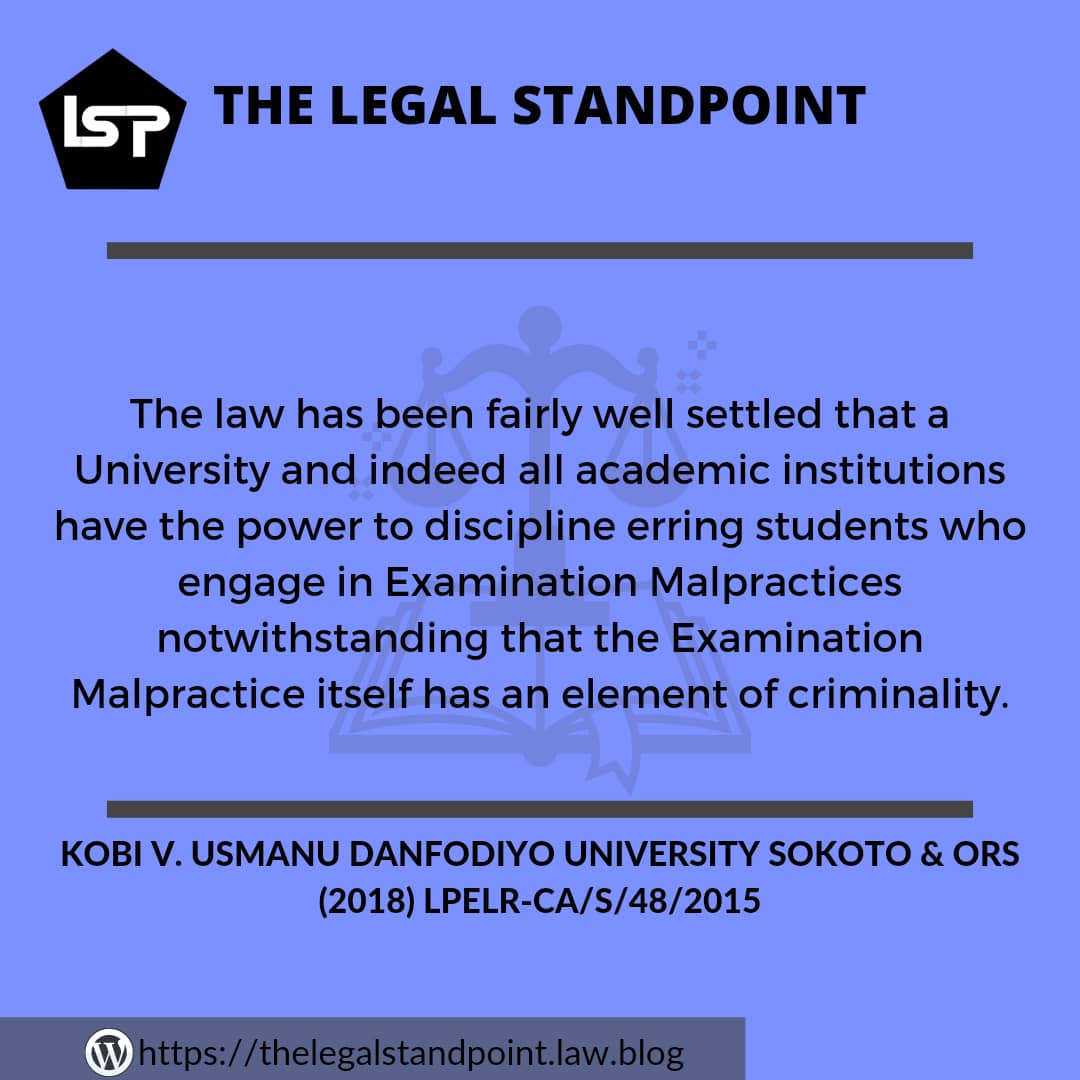
Relying on these authorities, the management of any institution has the authority to discipline any student or group of students who engaged in examination malpractices notwithstanding an element of criminality. Nevertheless, the courts are ever ready to swing into action when the Constitutional Rights of fair hearing of the students are breached.
The doctrine of Fair Hearing states that an accused person, whether be before the regular courts or before Tribunals, Boards, or Panels of Inquiry, must be given the opportunity to:
(a) Know what is alleged against him. (b) Be present when any evidence against him is tendered.
(c) be given a fair opportunity to correct or contradict such evidence, including cross-examination of the witnesses presented by his accuser(s).
The disequilibrium of power between academic institutions and students has lead to a blatant violation of this right by the former. In Futminna &Ors v Olutayo (2017) LPELR-SC.344/2009, the Supreme Court condemned the action of the appellant for expelling the respondent without listening to her side of the story.
EXAMINATION MALPRACTICE AS A CRIME
Crime, used interchangeably with offence, is an act or omission which renders the person doing the act or making the omission liable to punishment under any written law. It is a public wrong and prosecuted by the State.
Examination Malpractice is an offence under section 1 and punishable under section 1(2)(a) of the Examination Malpractices Act. In the case of a person under the age of eighteen years, a fine of Nl00,000 or imprisonment for a term not exceeding three years or to both such fine and imprisonment; in the case of a principal, teacher, an invigilator, a supervisor, an examiner, or an agent or employee of the examination body concerned with the conduct of an examination, an imprisonment for a term of four years without the option of a fine; and in any other case, to imprisonment for a term of three years without the option of a fine.
Furthermore, when satisfactorily established that a student engaged in examination malpractices and the university management observed the principle of fair hearing before meting out the civil punishment, nothing stops the Police from arresting such a person and commencing a criminal action against him. The gist – shora fun examination malpractices.
In conclusion, examination malpractices is both an administrative wrong and a crime. The former is within the purview of an academic institution while the latter is an offence against the state. In determining allegation of examination malpractices against a student(s), academics institutions must comply with the principle of fair hearing. Failure to adhere will lead to nullity of the proceeding.
Thank you for reading🙏. See you next week❤.

 THELEGALSTANDPOINT