
In the spirit of festivity, Happy Eid-l-fitr to all our Muslim readers. We pray Allah answer all your prayer requests during and even after Ramadan. Send my meat if you dor wanra see crazy😃.
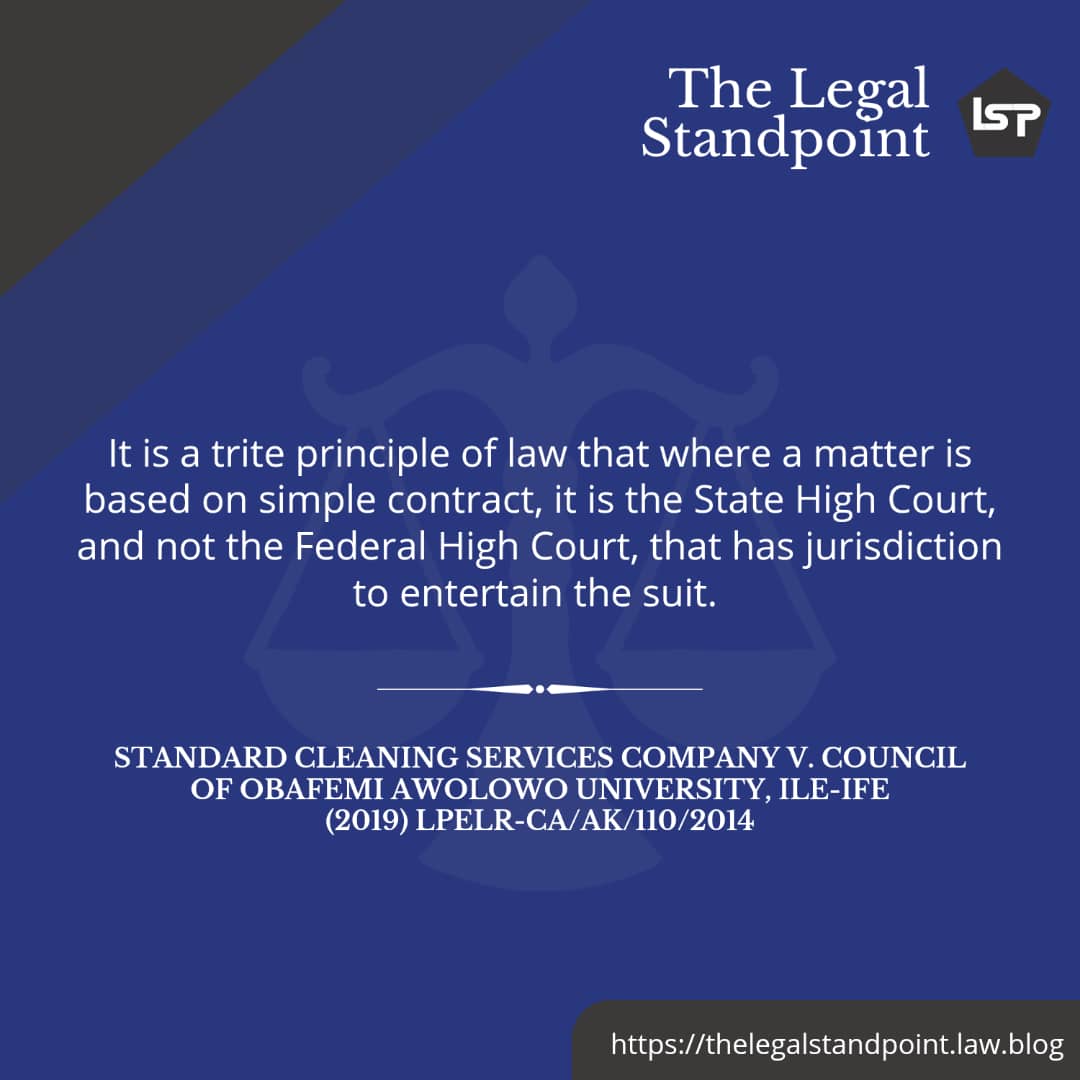
Moving in, today’s discourse centers on the Court which has the jurisdiction to entertain simple contract actions when a Federal Government agency is involved.
According to Professor Sagay, simple contracts are all contracts other than formal contracts or contracts required to be under seal. They may be in writing or oral. In this form of contract, it is only a party who has furnished consideration that can bring an action for enforcement of the contract.
Section 251(1) of the Constitution of the Federal Republic of Nigeria(1999 as amended) houses a long list of actions in which the Federal High Court has exclusive jurisdiction to entertain. Particularly, it provides that the Federal High Court shall have exclusive jurisdiction in any matters involving the agencies of the federal government. However, to every rule, there is an exception.
Thus, where an agency of the Federal Government is a party in a matter, the question of jurisdiction becomes two dimensional, that is, Party Jurisdiction and Subject Matter Jurisdiction which the Courts are expected to consider.
The position of Law is that if the res of the suit comes within the provisions under Section 251, then the Federal High Court will have exclusive jurisdiction. However, if the subject matter falls outside the precincts of Section 251, then a State High Court will be vested with jurisdiction notwithstanding that the party involved is a Federal Government agency.
The res of an action basically means what is being litigated upon – the subject matter of the action which both parties seek to preserve for themselves. And in determining the res of a matter, attention is often given to the plaintiff’s statement of claim. See the case of Obiuweubi v. C.B.N. (2011) ALL FWLR (Pt. 321) p.208.
It is worthy to mention that the principle in the celebrated case of NEPA v Edegbenro (2002) 13 SCM P. 78 at 89 is often being erroneously relied upon to canvass argument for party jurisdiction. The principle then was that the Federal High Court should always have jurisdiction when the agencies of the federal government are involved irrespective of the claim. Nevertheless, as stated by Adekeye JCA (as he then was) at (P. 14, paras. A-D) in Isuama v Governor of Ebonyi State of Nigeria & Ors (2005) LPELR-CA/E/163/2004: The case (Nepa v Edegbenro) did not decide on subject-matter jurisdiction.
Based on this, the fact that an action is against agents of the Federal Government of Nigeria does not ipso facto bring the case within the jurisdiction of the Federal High Court, unless the subject matter of the action falls squarely within the jurisdiction of the Federal High Court before the Court can assume jurisdiction in the case against the Federal Government or any of its agencies. Subject matters like breach of Contracts, Negligence, etc against Federal Government Agencies are not within the purview of Section 251 of the CFRN 1999. And since it is impossible to place something on nothing and expect it to stands, it becomes an exercise in futility for the Federal High Court to entertain a matter in which it does not have the authority.
In Essi V. Nigeria Ports, Kekere-Ekun, JSC stated thus: Where the exclusive jurisdiction of the Federal High Court is in issue, the mere fact that an agency of the Federal Government is a party is not sufficient, without more to confer jurisdiction on the Court. The Court deciding the issue will also take into consideration the nature and subject matter of claim.
Hence, the Supreme Court in a plethora of cases such as Onuorah v. K. R. P.C. Ltd. (2005) 6 NWLR (Pt.921) 393; Socio-Political Research Development v Ministry of FCT & ORS (2018) LPELR-SC.203/2008; ROE LTD v. University of Nigeria (2018) LPELR-SC.42/2007; Adelekan v. BCU-line NV (2006) 12 NWLR (pt. 993) 33 at 54, Dec Oil & Gas LTD v Shell Nig Gas LTD, etc have held that disputes founded on contracts are not among those envisaged in the exclusive jurisdiction conferred on the Federal High Court under Section 251 of the CFRN. Hence, the State High Court has the jurisdiction to entertain such matters.
In conclusion, it is evident that the Nigerian Courts have tilted towards subject matter jurisdiction over party jurisdiction when it involves agencies of the Federal Government. With this, the era of using the Federal Government or its agencies as a blanket cover to give Federal High Court jurisdiction on matters which are clearly outside Section 251 of the CFRN 1999 is over.
Thank you for reading. See you next week.
Read up on past similar article on the Jurisdiction of Courts when it involves Federal Government agencies and Human Rights Violations here.
 THELEGALSTANDPOINT