
In criminal law, there are classifications of offences. One of them is inchoate offence. Inchoate offences are offences which has not been committed nonetheless punishable. They are also called uncompleted offences.
Generally, attempt, conspiracy, solicitation, and incitement are examples of inchoate offences. Putting it in an example, if A wants to kill B and goes ahead to purchase a poison, put it in B’s food and then invites B over but before B starts eating, the Police comes in and interrupts. That is an attempt to commit murder and irrespective that A has not completed the crime, he will still be held guilty.
Having laid the foundation, let us consider Conspiracy and resolve the puzzle. The offence of conspiracy has received both statutory flavour in sections 516 -518 of the Criminal Code and section 95 of the Penal Code and judicial pronouncements in a plethora of cases. In Babarinde &Ors v State (2013) LPELR-SC.169/2012, the Supreme Court defined conspiracy as “an offence is the agreement by two or more persons to do or cause to be done an illegal act or legal act by illegal means. The actual agreement alone constitutes the offence and it is not necessary to prove that the act has in fact been committed.”
It is noteworthy that the offence of conspiracy, just like other inchoate offences, is a separate offence and different from the substantive offence. Hence, A and B can be charged with the offence of conspiracy to rob and armed robbery itself. These are two distinct offences.
The crux of conspiracy is agreement and for there to be an agreement, there must be the existence of two or more people. The rationale is that a single individual cannot be charged with conspiracy. State v Odunayo Ajayi (2016) 14 NWLR (Pt. 1532) 196 at 220.
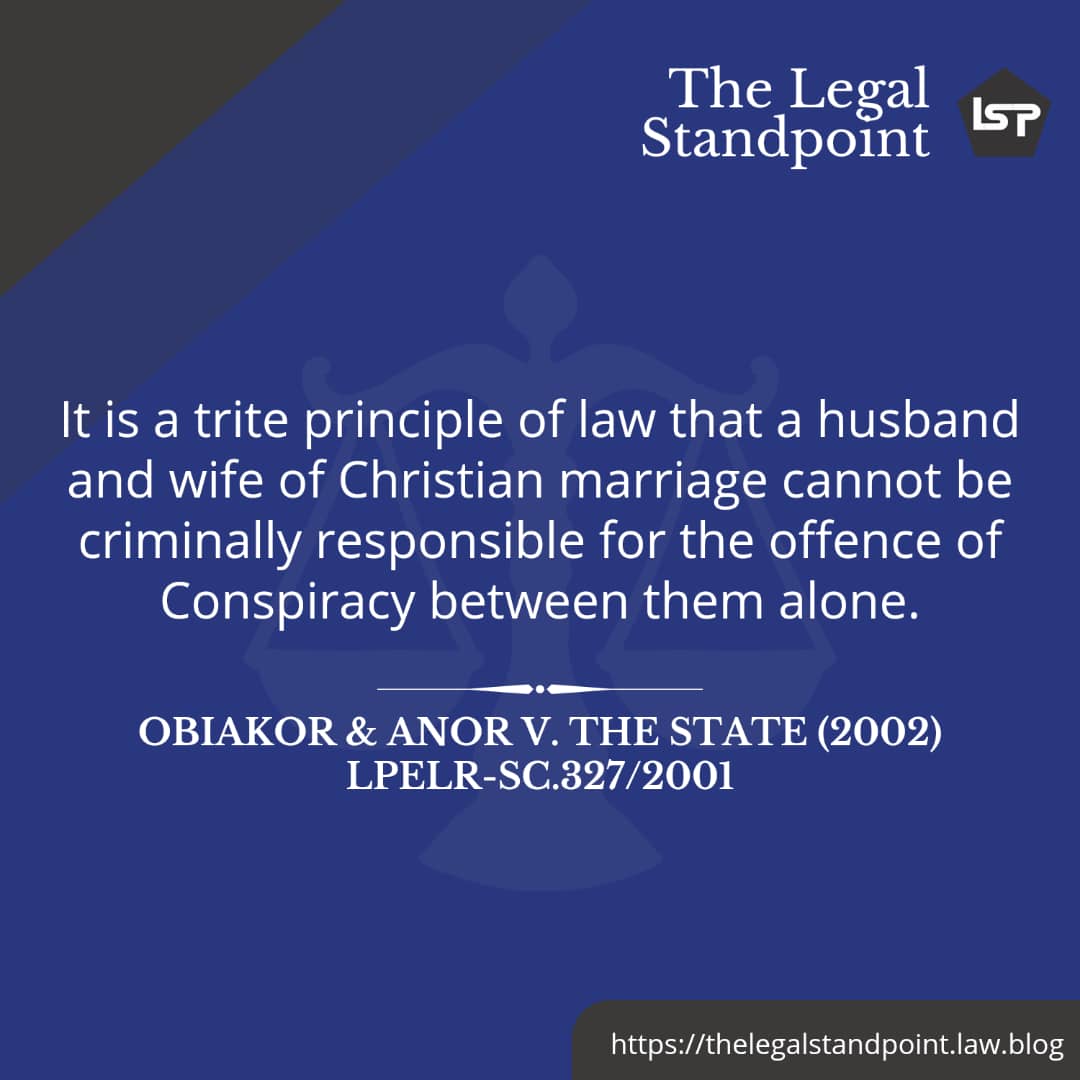
Section 34 of the Criminal Code states that “a husband and wife of Christian marriage are not criminally responsible for conspiracy between themselves alone”. It is pertinent to state that the type of marriage envisage by the law in that aforementioned section is statutory marriage which is the voluntary union for life of one man and one woman to the exclusion of all others. Hence, this defence does not apply to couples who are married under Islamic or customary marriage.
The principle that a husband and wife under a statutory marriage (Christian marriage) cannot be held guilty of conspiracy is based on the common law presumption that a husband and wife are one, each being part of the other and since conspiracy requires the agreement of at least two persons to commit an offence, such husband and wife cannot commit the offence.
This principle has received judicial pronouncements in Obiakor & Anor v State (2002) LPELR-SC.327/2001 and reiterated in the 2019 recent case of Nwabu v IGP (2019) LPELR-CA/C/67C/2018.
However, this principle will not apply if the couples conspire with a third party. Also, the evidential burden of proving the existence of a Christian marriage lies on the accused.
In conclusion, conspiracy is one of the types of an inchoate offence punishable by imprisonment which its duration of sentence depends on the offence charged.
Announcement: On Monday, we had our first-anniversary celebration of this blog. And it was massiveeeeeeeee. Thank you for all you do for LSP. May God continually bless you.
See you next week

 THELEGALSTANDPOINT
Beautiful this really helps me
LikeLiked by 1 person
I’m glad it does. Thank you.
LikeLike
This is a Wow. 🥺 Had to read over again, it’s such a masterpiece. Thanks Boss, more power to your elbow.
LikeLiked by 1 person
Amen. Thank you
LikeLike
This is a Wow 😲. Had to read it over again. Well Done Boss, more power to your elbow.
LikeLike
This is a Wow 😳. Had to read it over and over. Well Done Boss, more power to your elbow.
LikeLike
Waooo! this is great
LikeLiked by 1 person
Thank you.
LikeLike
This is just too amazing; it’s helping me here a lot. More grace to the team.
LikeLiked by 1 person
Amen. Thank you, sir.
LikeLike