
At one point in your lifetime, you would have or know someone who has employed the services of a photographer to capture an event. The big question is who would the law regard as the owner? You or the photographer?
The ownership of photographs is one of the major issues under copyright law. Copyright law is one of the branches of intellectual property law that gives the creator or author of a literary, artistic, musical, or other creative work the exclusive yet licensable right over that which he has created.
The Nigerian Copyright Act, 1988 (Cap C28 Laws of the Federation 2004) is the principal enactment that regulates issues relating to copyrights in Nigeria. Under the act, the owner of a photograph is the photographer who took the picture. Section 39 provides that “author” in the case of photographic work, means the person who took the photograph.
Similarly, section 9 of the Copyright Act provides that where a work (photography in our instance):
(a) is commissioned by a person who is not the authors employer under a contract of service or apprenticeship; or
(b) not having been so commissioned, is made in the course of the author’s employment,
the copyright shall belong in the first instance to the author unless otherwise stipulated in writing under contract.
For the first rule, if Mr. A contacts Miss B to take his birthday pictures, the copyright in those pictures belongs to Miss B unless there is a written agreement to displace the general rule. On the second rule, if Mr. C is Mrs. D’s employee and he took some pictures which were not commissioned by his boss, Mr. C would be regarded as the owner unless there is a contract to vest the copyright in Mrs. D.
However, section 9(c) states where a work is made by an author in the course of his employment by the owner of a newspaper, magazine, or similar periodical under a contract of service or apprenticeship and it is made for publication in a newspaper, magazine or similar periodical, then the owner of that newspaper, magazine or periodical is the first owner of copyright in the work so far the copyright relates to the publication of the work in the newspaper, magazine or similar periodical.
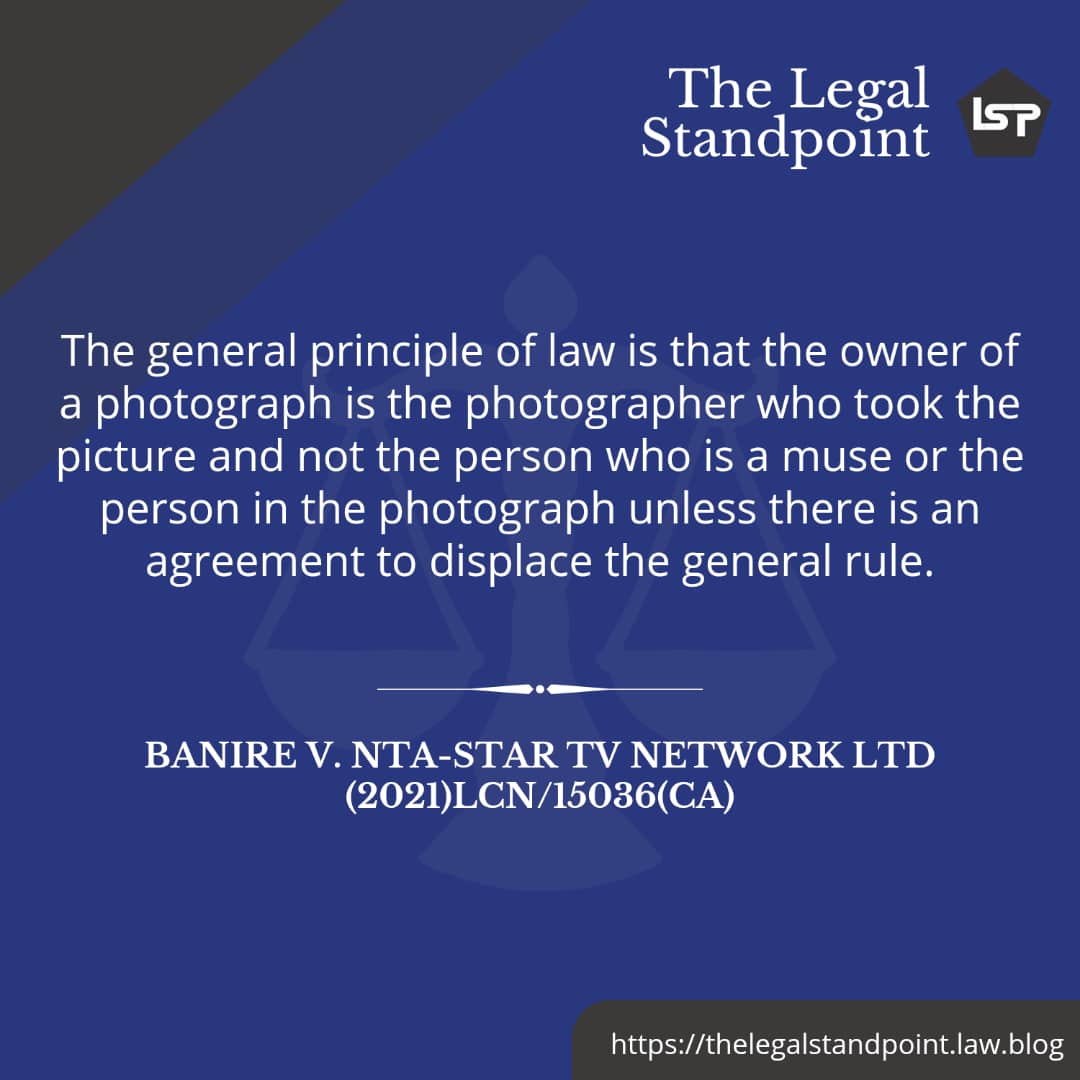
The statutory provision of sections 9 and 39 which vests the ownership of pictures on the photographer received judicial pronouncement in a recent 2021 court of Appeal case of BANIRE v. NTA-STAR TV NETWORK LTD (2021)LCN/15036(CA).
In that case, the appellant in 2012 had a photo session with Virtual Media Network Limited. Also, a Channel License Agreement(CLA) existed between the Virtual Media Network Limited and the Respondent(NTA) in which the former supplied the latter with the Appellant’s images to be used on the billboards. The respondent has now used the picture of the appellant in a billboard advertisement. In bringing a suit, the appellant argued that that the use of her images/photographs by the respondent on its billboards along the streets of Akure and Abeokuta without the express authorization of the appellant amounts to a violation or infringement of her image rights.
On the issue of ownership of the copyright, the court held that it was the Virtual Media Network Limited who took the pictures that is the owner. The Court held that: “What is evident from the above provision is that the person who is a muse or the person in the photograph is not in fact the author and therefore he/she does not own copyright in the photograph. Rather it is the person who took the photograph that is the author. The Appellant by her own evidence has stated that she had a photo session with Virtual Media Network and as such since Virtual Media Network took the photographs, then they have authorship and as a result, they have the copyright of the photograph, not the Appellant.”
Another error leading to the appellant’s loss at the Trial Court was that Virtual Media Network was not joined as a party to the suit. And based on the issue of privity of contract, the respondent has a defence because the respondent is a third party to the contract governing photo sessions between the Appellant and Virtual Media Network Limited. Based on this, if Virtual Media Network Limited breached the agreement between it and the Appellant, then the recourse should be against Virtual Media Network Limited and not the Respondent who was exercising its rights under an existing valid contract.
The appellant’s argument was initially hinged on image rights and the tort of passing off. Counsel to the appellant argued that the issue in contention was not on ownership of copyright but how her pictures were used which brought her claim under the tort of passing off and image rights.
In Nigeria, there is no specific legislation on image rights save from the general provision of section 37 of the Constitution. Recourse is then made to the foreign decision in Proactive Sports Management Ltd. v. Wayne Rooney &Ors [2010] EWHC 1807 (QB). Image rights are a person’s right to commercialize aspects of his personality such as physical appearance, pictures or caricatures, signature, personal logos, and slogans, and the right to prevent other people from commercially making use of them.
The Court held that to establish the tort of passing off of image rights, the individual must establish that:
1. his/her image has acquired sufficient goodwill such as quantifiable goodwill which can be leveraged on in consideration for money;
2. he/she must prove that the third party has misrepresented to the public by using the image, and
3. must be proved that this misrepresentation caused or is capable of causing damages such as a reduction in the value attached to their goodwill.
The Court, in disregarding this argument, held that the appellant did not establish any of these requirements. And as such, the claim is within the purview of copyright and not image rights.
In conclusion, the position of the Nigeria Copyright Act is that the ownership of copyright in a photograph lies with the photographer unless there is an agreement to the contrary. This principle has now received judicial pronouncement in the case under review which remains the law until and unless changed by the Supreme Court.
Thank you for reading. See you next week.❤.
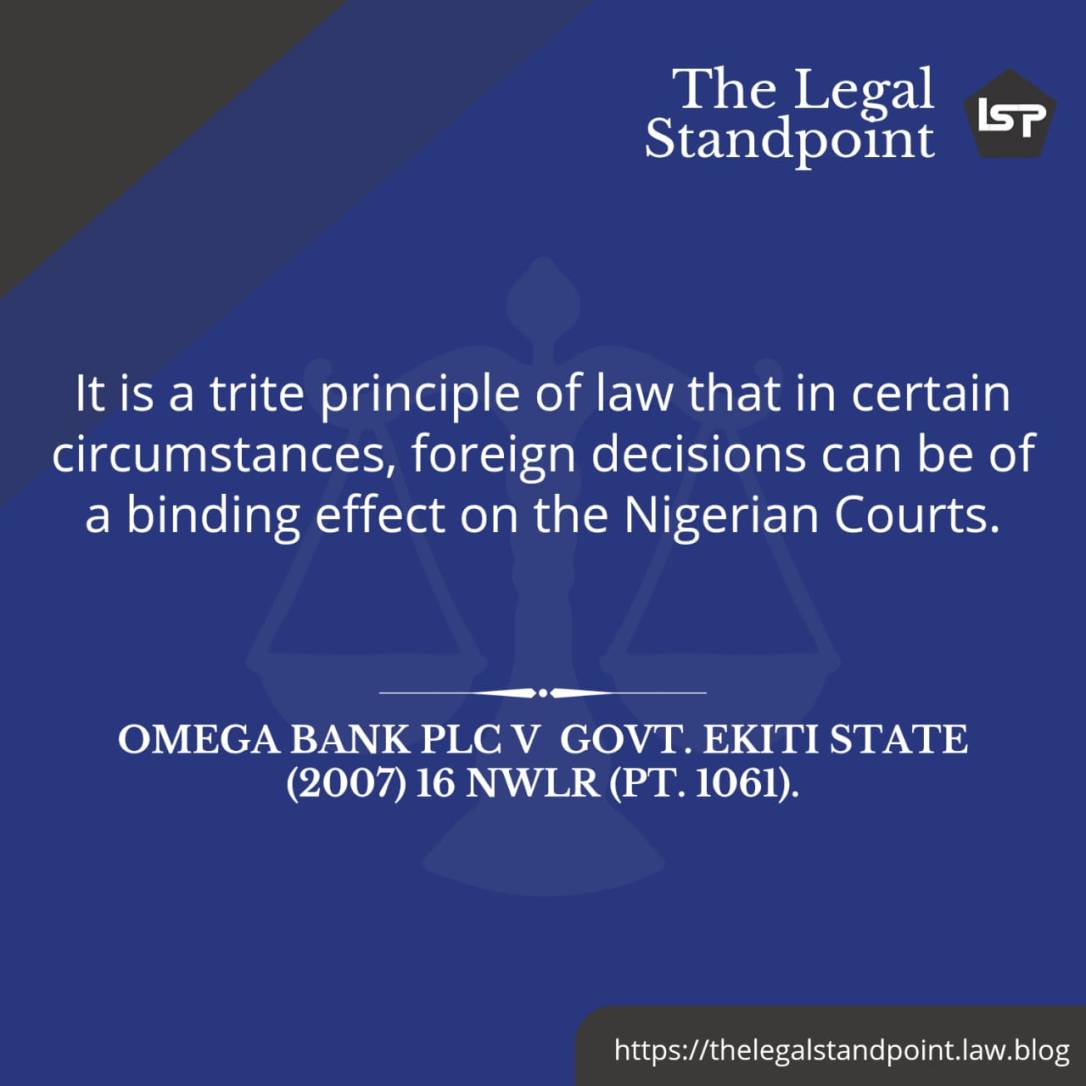 Irrespective of the mode of instituting an action, whether it is based on contention issues (Writ of Summons); interpretation of the Constitution (Originating Summons) etc, every counsel representing a litigant is always asking the Court to do something for his client.Before the court can dance to the counsel’s tune, he needs to present authorities before the Court. In Nigerian jurisprudence, authorities can either be primary or secondary. The main difference between them is the weight of influence attached to each of them.While primary authorities are binding upon the Nigerian court, secondary authorities, on the other hand, are persuasive as held in a plethora of cases such as Ladoja v. INEC (2007) 12 NWLR (Pt. 1047) 119 at 182. The general principle of law is that foreign precedents, that is, judgments gotten from other countries, are persuasive in Nigeria. However, there are two exceptions:1. The first exception is that where the principle adopted from a foreign decision has been applied by Nigerian courts over the years, such a principle cannot be regarded as a foreign decision. This exception was laid down by Akintan JSC in Adetoun Oladeji (Nig) LTD v Nigerian Breweries PLC (2007) LPELR-SC.91/2002 where he stated that: “the other point I will like to deal with is the controversy as to whether or not the principles of law laid down in Hadley v. Baxendale (1854) 9 Ex. 341 is applicable in Nigeria and binding on the courts in Nigeria. I agree with the view expressed in the lead judgment that generally speaking, decisions of English courts or any foreign courts are not binding on Nigerian courts but they are merely persuasive. I will, however, like to add that where Nigerian courts have followed a particular principle adopted from a foreign decision over the years, such as in the one in the Hadley v. Baxendale case, it will be totally erroneous to hold that such principle remains foreign in nature. I believe and hold that the said principles have ceased to be regarded as foreign in Nigeria. It has, no doubt, become part and parcel of our case law of contract. This is because the mere statement of the principles and citing any of the numerous decisions of this court where the principle had been adopted will be sufficient to make it binding on all courts in Nigeria”.2. The second exception is that Nigerian courts may resort to foreign decisions where there are no known Nigerian decisions on a principle of law. Thus, English authorities can be binding where the facts before a Nigerian Court are similar to the English case, and there are no known Nigerian decisions on the same set-out facts. Thus, in Omega Bank Plc. v. Govt. Ekiti State (2007) 16 NWLR (Pt. 1061), the Court relied on the foreign precedent of Derbyshire C.C. v. Times Newspapers in reaching its decision.Based on this second exception, if a case comes before the Nigerian Court on emerging areas of law such as Intellectual Property, Fintech, Competition Law, etc which its jurisprudence hasn’t fully been developed in Nigeria compared to other jurisdictions, the Court can rely on the foreign precedent to reach its decision provided the decided case and the case at hand are reasonably similar in fact.In conclusion, these are the two existing exceptions where foreign decisions can assume the binding nature on the Nigerian Courts.Thank you for reading. See you next week.❤
 THELEGALSTANDPOINT