
“In Africa, the dead do not rest because even in their death, they still watch over us”. Anon
Have you come across any tweet like this? I saw this tweet last year on Twitter. Despite being hilarious, it makes sense. At least, to me. It depicts how important the dead are to us in this particular part of the world. In Africa, the dead bodies, particularly of loved ones, are treasured.
In a bid to ensure a smooth and honourable transition, people give so much attention to where their dead are buried. Most people bury their loved ones in residential areas. There are several factors behind this such as cultural beliefs; religious sentiments, financial cost etc.
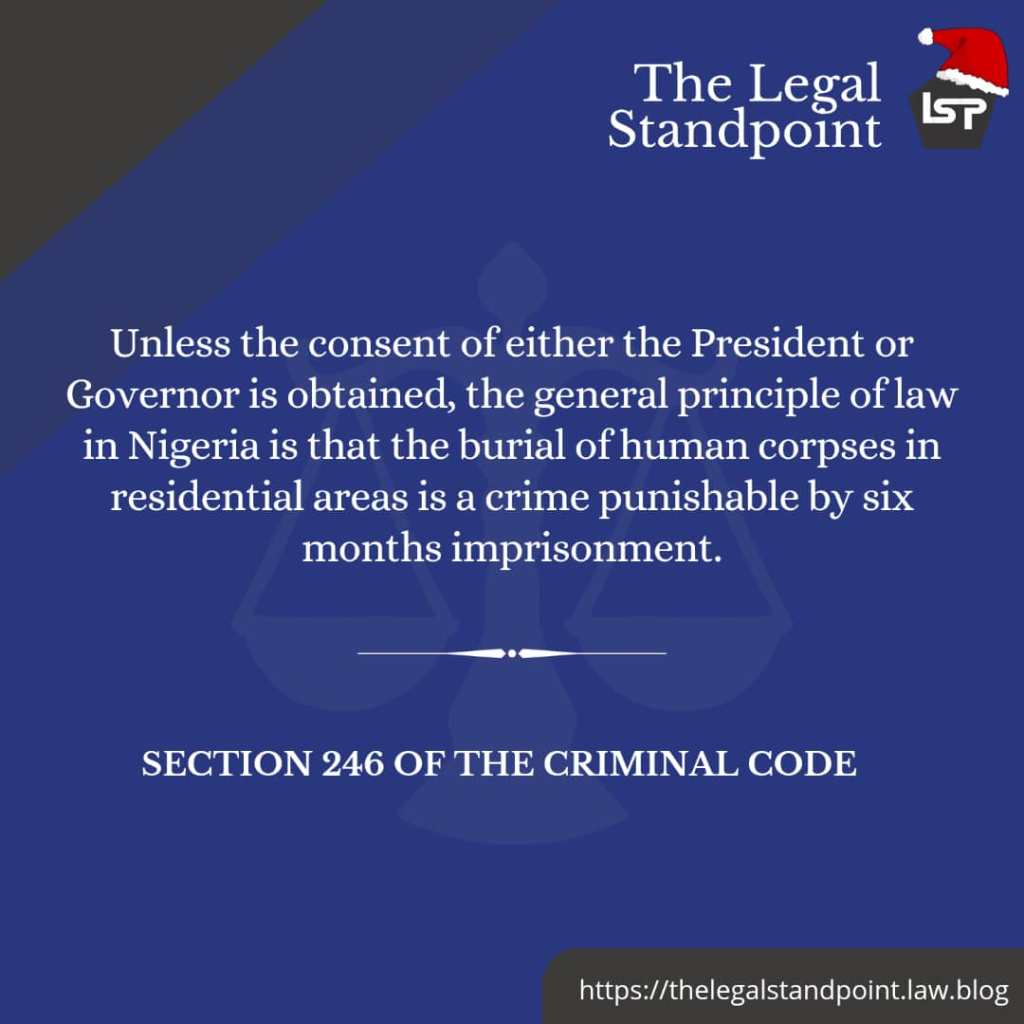
However, this practice is legally wrong. The principle of law is that home burial is an offence punishable with an imprisonment of six months. This has been statutorily provided for in section 246 of the Criminal code which states: “Any person who without the consent of the President or the Governor buries or attempts to bury any corpse in any house, building or premises, yard, garden, compound or within one hundred yards of any dwelling house or any open space situate within a township is guilty of a misdemeanor, and is liable to imprisonment for six months”.
The rationale behind the criminalization of this practice is that it poses a great risk to public health and also a major challenge to the government in relocating such corpses in the course of future road expansion and reconstruction projects.
While the general principle of law is that one cannot bury any human corpse in residential areas or any open space, the exception is that the only time one can engage in this practice is having obtained consent from the president or governor. In granting this, several factors are to be considered by the Ministry of Health. One of such factors is the cause of death of the deceased. The cause of death is relevant here because a person who died of a highly communicable disease like Ebola, Lassa fever, etc may still be a danger to people dwelling within the neighbourhood of his burial place.
Unfortunately, one has to mention that this is one of the ‘dead’ laws in Nigeria due to ignorance of the people and weak enforcement mechanism by the Government.
Thank you for reading. See you next week.
 THELEGALSTANDPOINT