
The concept of lion’s share was what I was well acquainted with while growing up. House chores were usually chunked out to me and my siblings. And the rule then at home was that the quantity of your food depends on how much you work. This rule also extends to the allotment of punishment at home.
While the concept of the lion’s share is well enshrined in most social spaces, the same doesn’t apply in an allotment of punishment in Criminal law provided there was a common intention to commit a crime.
In Adio v State (1986) NWLR (pt.24) 581, the Court defined common intention as one which will make the act of one accused the act of the other if the offence committed is in furtherance of the prosecution of their unlawful common purpose. Section 8 of the Criminal Code
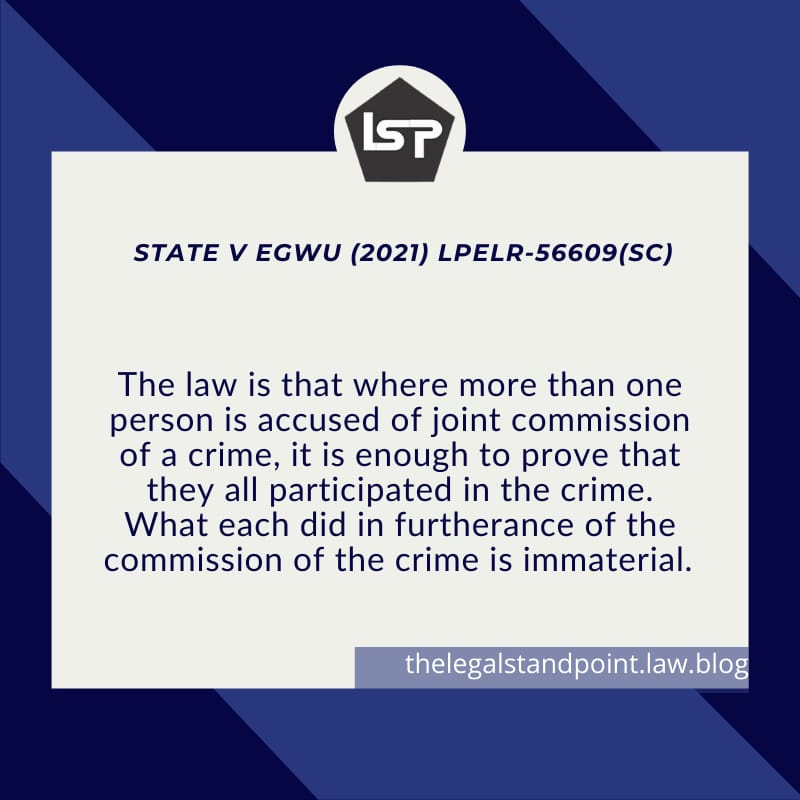
The principle of law as held in a plethora of cases such as Alarape v State (201) 2 SC 164 Mohammed v State (1980) 3-4 SC 56 is that in a concerted attack to prosecute an unlawful purpose, it is not the law to look for the person who struck the lethal blow. Everyone who partakes in the attack is equally guilty of the crime committed during prosecution of the unlawful purpose.
In other words, where common intention is established, a fatal blow or gunshot, though given by any of the parties, is deemed in the eyes of the law to have been given by all those present and participating. The person who actually delivered the fatal blow is, in that case, no more than the hand by which others also struck.
Putting it in context, if Ade, Bisi, and Yinka committed the offence of armed robbery and it was Yinka who drove the car, while Bisi and Ade were the ones who shot the gun and took the money. The law will consider the trio as guilty and given the same punishment. It’s no defence to say Yinka had lesser participation.
Hence in State v Egwu, the respondent, as President of Youths of Amorie Ozizza Community in Afikpo North L.G.A of Ebonyi State, directed members of the Task Force of the Youths Association of the Amaorie Ozziza to go out as a group to compel youths in the community to attend the meeting of the youths of the community to hold that day at the community playground concerning some development projects to be executed by the community. Armed with sticks, machetes, and axes, the youths invaded the home of one Ali Agha to compel him to attend the said meeting. In the process of compelling him to follow them, they killed him by inflicting multiple machete cuts on his body resulting in acute loss of blood.
The Supreme Court, reaffirming the judgment of the High Court, and reversing the Court of Appeal decision, held that the respondent was guilty of the offence of murder. And it was immaterial that he only gave the directives.
Thank you for reading. See you next week.
 THELEGALSTANDPOINT