
In law, suspension and termination of employment are two clear distinct terminologies. One cannot be a substitute or synonymous with the other. In Esiaga v University of Calabar (1999) 4 NWLR (502) 719, 723, the Court held that “the word suspension cannot be construed to mean “terminate”, “extinguish”, or “bring to an end”. It means, “To cause to abate for a while or halt midway but not to bring to an end”. It always connotes a state of affairs that should wait until a certain event takes place.“
Also in Longe vs. FBN Plc. (2006) 3 NWLR (Pt. 967)228, the court held that “the word “suspension” means a temporary privation or deprivation, cessation or stoppage of or from the privileges and rights of a person. The word carries or conveys a temporary or transient disciplinary procedure that keeps away the victim or person disciplined from his regular occupation or calling either for a fixed or terminal period or indefinitely. The disciplinary procedure gives the initiator of the discipline a period to make up his mind as to what should be done to the person facing the discipline.”
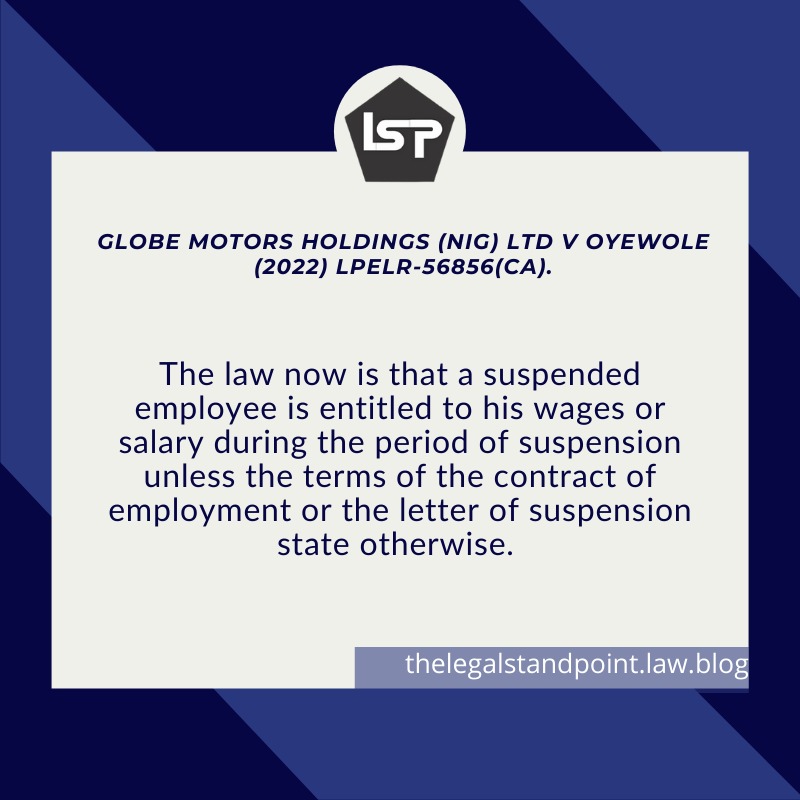
The legal question which arises is that, is a suspended employee entitled to wages during the period of suspension? This question is fundamental as it concerns the status of an employee who has been suspended from his employment either for a fixed term or indefinitely, as the Respondent in this appeal. This question came up for determination in a 2022 recent case of Globe Motors Holdings (NIG) LTD v Oyewole (2022) LPELR-56856(CA).
The fact of the cases are as follows:
The Respondent was employed by the Appellant on 2nd September 1999 as an auto mechanic and the appointment was confirmed on 19th January 2001. He was appointed as foreman of the Honda section of the Appellant on 1st March 2005 but was placed on indefinite suspension via a letter served on him on 11th September 2007. He was neither recalled from the indefinite suspension nor his appointment formally terminated by the Appellant.
He decided to approach the Citizens Mediation Centre of the Lagos State Ministry of Justice with his complaint on 25th October 2011. The Centre’s invitation to the Appellant was not responded to. Earlier on 5th September 2011, he sought the legal assistance of the Office of Public Defender where he sent a Petition against the indefinite suspension. On 1st March 2012, the Office of Public Defender invited the Managing Director of the Appellant for a meeting but the meeting did not yield any result.
This prompted the filing of the action at the lower Court by the Office of Public Defender in which the Respondent as Claimant sought the following reliefs:
1. Salary arrears for September 2007 – September 2011: N1,680,000.00 (One Million Six Hundred and Eighty Thousand Naira only).
2. General damages: N200,000.00 (Two Hundred Thousand Naira only).
Aggrieved by the decision of the lower court, the appellant appealed to the Court of Appeal.
On this issue, the Court of Appeal held that pending an employee’s recall or dismissal, a suspended employee is entitled to his wages or salary during the period of suspension unless the terms of the contract of employment or the letter of suspension itself are specific that the suspended employer will not be paid salaries during the period of suspension. The rationale behind this principle is that since suspension is not a termination of the employment contract nor a dismissal of the employee, then an employee is still in continuous employment of the employer until he is recalled or formally terminated or dismissed. As such, like every other worker, a suspended worker is entitled to his wages. See also Bamidele v NJC (2012) LPELR-8381(CA)
In addition, once the contract of employment is silent on the payment of salary during the period of suspension, the law would infer the presumption of emolument in favour of the worker. However, where such a clause exists, then, it takes preeminence. This is as a result of the fact that parties are prima facie bound by the terms of their agreement.
Furthermore, the right to wages is the most important right of an employee which should not be affected by the indefinite suspension. However, due to the disequilibrium of power between employers and employees in Nigeria, the former tend to deprive the latter of this right. In most instances, the former would intentionally choose not to get back to the affected workers. This has subsequently worked hardships on the workers.
In conclusion, this decision is in sync with rational thinking and it is a progressive one from the Court of Appeal which aims to limit the unequal power that an employer has over his employees and protect the dignity of workers in Nigeria. And it is pertinent to state that until and unless this principle is changed by the Supreme Court, this remains the law in Nigerian Labour Jurisprudence.
Thank you for reading. See you next week.🥰
 THELEGALSTANDPOINT