
It is a fundamental principle of law that there cannot be a charge for an offence not named in a written law. This principle received a statutory backing in section 36(12) of the Constitution of the Federal Republic of Nigeria 1999(as amended) which states thus: subject as otherwise provided by this Constitution, a person shall not be convicted of a criminal offence unless that offence is defined and the penalty, therefore, is prescribed in a written law: and in this section, a written law refers to an Act of the National Assembly or a law of a State any subsidiary legislation or instrument under the provisions of a law.”
In EFCC v Thomas (2018) LPELR-CA/L/1298/2017, the Appellant received the sum of $2,198,900.00 cash found in the possession of one Ibiteye John Bamidele from the National Drug Law Enforcement Agency with a covering letter alleging that the said man has arrested at the local wing of the Murtala Mohammed Airport while attempting to board a flight to Abuja.
On the commencement of investigations, the Respondent appeared to claim the money and said he gave the money to John Bamidele to take the same to Abuja. He made a statement and was granted administrative bail and asked to deposit his international passport. He initially reported to the Appellant’s Abuja office. Several days later, the Respondent filed an application before the Federal High Court seeking relief which range from a breach of fundamental human rights to injunctions and claim for damages.
The question then becomes, is there any legal provision against the keeping of money be it local or foreign currency in the house, on your person, and outside the bank? answering this question, the Court held that: The act of keeping money at home or other places of choice is not a named offence in any law in this country. The Anti-Money Laundering Act does not have such provision and the E.F.C.C. Act also has nothing in that direction. Furthermore, there is also no known offence for travelling with money legitimately earned within the country. The requirement of declaring sums beyond a threshold is only when you are travelling outside the country. Travelling from Lagos to Abuja is still within the territorial jurisdiction of the country known as Nigeria.
The court further went to distinguish this case from DAUDU v. F.R.N. (2018) LPELR-43637 (SC) where it held that unlike the situation in the case of DAUDU v. F.R.N where the accused person failed to give a satisfactory account of the monies which were lodged in his account during his tenure as a local government chairman, here, the Respondent was able to prove the sources of the money found in the possession of one Ibiteye John Bamidele and his ownership of same. The Appellant failed to put forward a clear case against the Respondent and was merely fishing for the twig to hang on.
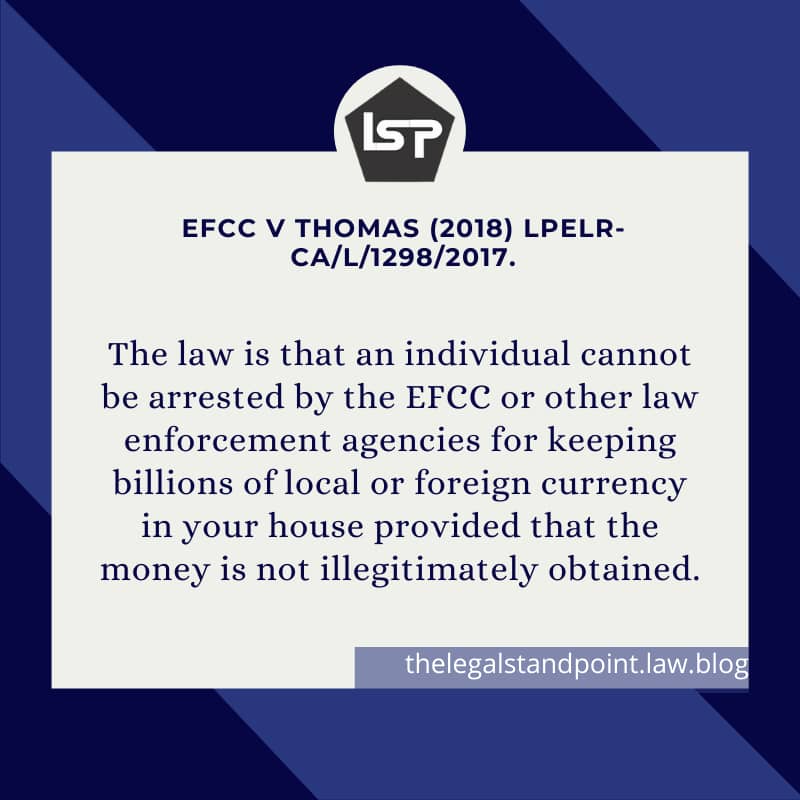
In conclusion, the import of this principle is that an individual cannot be arrested by the EFCC or other law enforcement agencies for keeping billions of local or foreign currency in your house provided that the money is not illegitimately obtained.
Thank you for reading. See you next week

 THELEGALSTANDPOINT