
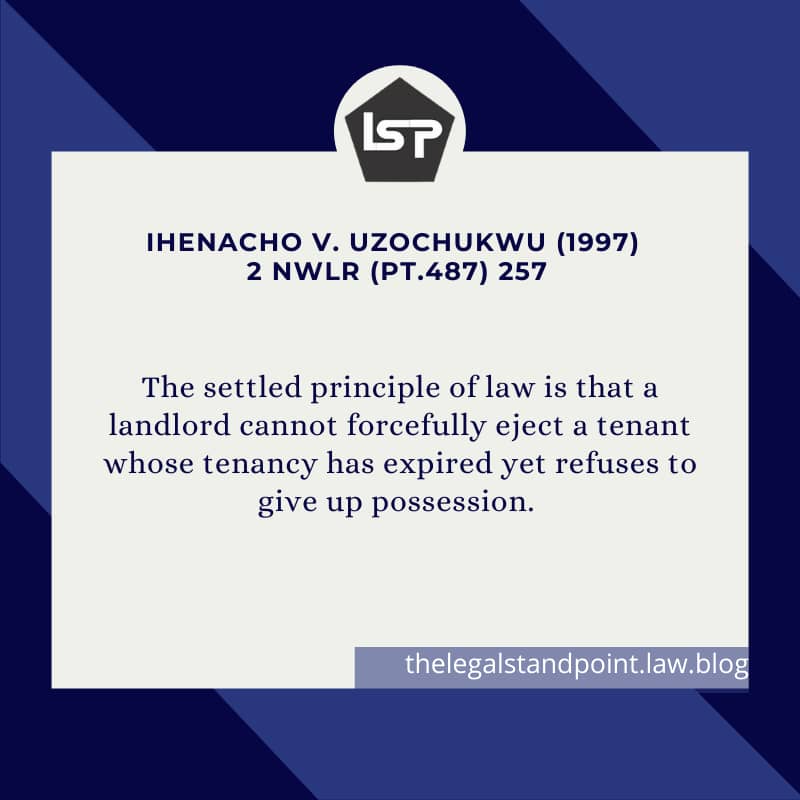
In Nigeria and around the world, it is not uncommon to find people entering into landlord and tenancy agreements. This is because shelter constitutes one of the tripartite composite needs of man. In fact, it is listed as a fundamental need in the pyramid of needs hierarchy by Abraham Maslow.
In every tenancy relationship, there is a disequilibrium of power between the landlord and the tenant. This has made the tenant be regarded as a weaker party. After all, he’s the one trying to find a roof over his head. In a situation where a tenant’s rent has been determined by effluxion of time and he refuses to give up the premises, some landlords resort to self-help by forcefully ejecting him.
Based on this, there is a need to protect the weaker party. And this is where the law comes in. The landlord and tenancy relationship is regulated by laws in Nigeria. This is evident in several tenancy laws of each state in Nigeria. While there are different laws in different states regulating landlord-tenant relationships, the procedures to be followed are basically the same.
THE PROCEDURES FOR RECOVERY OF POSSESSION
- Serve a Notice to Quit on the tenant: A notice to quit, as the name suggests, is a letter that is given to a tenant requesting him to vacate the premises of the landlord. The duration of a quit notice varies by the nature of the tenancy agreement. The formula used to determine the period of notice is:
- Tenancy at will or weekly tenancy- a week’s notice
- Monthly tenancy – a month’s notice
- Quarterly tenancy- a quarter’s notice (3 months)
- Yearly tenancy- a half year’s notice (6Months). However, a notice to quit would not be needed in case of a fixed tenancy. Odutola v Papersack Nig Ltd (2006) LPELR-2259(SC)
- Notice of Owner’s Intention to Recover Premises: Some tenants are actually stubborn that even after the expiration, they won’t still leave the premises. So if the tenant is still in occupation at the expiration of the Notice to Quit, the law states that he should be served a-7 day notice of the owner’s intention to recover possession of the premises
- Commencement of Legal Action: If the tenant is still in possession after the expiration of the notice of owner’s intention to recover premises, the law states that such an owner can commence legal action against such an erring tenant.
From the foregoing, the law doesn’t allow the use of force in recovery of possession irrespective of the circumstances. In the celebrated case of Military Gov. Lagos State V. Ojukwu (1986) 1 All NLR 233, 243, the Supreme Court per Obaseki, J.S.C., held thus: “In the area where rule of law operates, the rule of self-help by force is abandoned. Nigeria being one of the countries in the world, even in the third world, which proclaims loudly to follow the rule of law, there is no room for the rule of self-help by force to operate… If the government of Lagos State wants possession from Chief Odumegwu Ojukwu, it should apply for an order of possession from the competent Court of law….”
These aforementioned procedures are clear and must be complied with. The law is that when a particular way/method of doing a thing and unless such a law is altered or amended by a legitimate authority, then whatever is done in contravention of those provisions amounts to a nullity and of no effect whatsoever. MobilProducing Nig. Unltd. v. Johnson (2018) 14 NWLR(Pt.1639) 329.
CONSEQUENCES FOR A DISOBEDIENT LANDLORD?
In Akinkugbe v. Ewulum Holdings Nigeria Ltd. & Anor (2008) 12 NWLR (Pt. 1098) 375, the Court held that a landlord who resorts to self-help to recover property leased by him runs afoul of the law and is liable in damages.” Law is really interesting. Imagine a landlord going from “no be my house, send him out’ to paying of damages.😲 See also Ndieli & Anor v Eze (2016) LPELR-42122(CA), Derive & Anor v Abubakar (2021) LPELR-56154(CA) where the landlord in each case had to pay heavy damages.
THE FATE OF A WELL-INFORMED LANDLORD ?
What would be the fate of a tenant whose landlord didn’t resort to the use of self-help in evicting him?
The answer would be the basis of our next week’s analysis. Thank you for reading. See you next week.
 THELEGALSTANDPOINT