
Law

LSP072: The Legal Implication of a Refusal to Sign an Agreement

In 2019, the Nigerian Contract jurisprudence recorded a landmark principle in the case of  MTN (Nig.) Communications Ltd. v Corporate Communications Investment Ltd. (2019) LPELR-47042(SC). The fact of the case goes thus:

MTN (“the Appellant”) entered into a Trade Agreement (Exhibit A) with Corporate Communications Inv. Ltd. (“the Respondent”) who is one of MTN’s trade partners. The agreement was drafted by MTN and sent to the Respondent for its signatures. The Respondent signed but MTN did not, and kept it. There is a clause therein that the agreement took its effect from the date the Appellant appended its signature thereto.

Parties, however, transacted on the basis of the contract. MTN thereafter terminated the agreement without giving the required notice, relying on the relevant clause in the agreement. Despite the respondent’s solicitor letter challenging the termination of the agreement and requesting an amicable settlement, the appellant withdrew 27 SIM registration kits assigned to the respondent. 

The respondent pleaded that in compliance with previous Trade Partner Agreements between the parties, it had incurred expenses in procuring facilities and equipment which were of no more use to it, given the purported termination of Exhibit A. It also pleaded that the abrupt cancellation of orders without a formal and valid termination of their agreement has caused it a huge financial loss.

At the end of the trial at the High Court, the court Court found for the Respondent and awarded N25 Million as damages and costs of N20,000. The same decision was also upheld by the Court of Appeal. Aggrieved by the two decisions, MTN took the matter to the Supreme Court.

The legal question becomes, can an unsigned agreement constitute a valid contract? At first, none of the parties raised this issue. It was in the course of writing the judgment that the trial judge, observed that Exhibit A was not signed by the appellant. Upon discovery, he adjourned the delivery of the judgment, and invited the parties to address him on the evidential weight to be attached to it. (An intelligent judge in my book. I stan). A court of law has the enabling power to raise a new issue and invite the parties to address that issue. Ezeudu v John (2012) 7 NWLR (Pt. 1298) 1.

MTN saw this as an opportunity to escape liability. It argued that the agreement was worthless and that it was immaterial that MTN was the one who prepared it. The appellant’s rationale is that it was one of the terms of the agreement that the agreement would take effect from the date the last person signs and that since it did not sign the document after it was signed by the respondent, the document was inadmissible and could not be relied upon as a valid contract between the parties. 

This argument was rejected by the court on two grounds. First, on conduct of the parties. Second, on the equitable maxim that equity looks at the intent of the parties rather than the form of the contract. Rejecting the argument, the Court held that the appellant could not be allowed, by deliberately withholding its signature, to take advantage of its wrongdoing and use it as a weapon against the respondent. The Court further stated, relying on the case of Adedeji v. N.B.N Ltd. (1989) 1 NWLR (Pt. 96) 212 @ 226-227 E-A, that it is morally despicable for a person who has benefited from an agreement to turn around and say that the agreement is null and void, or unenforceable, as contended in this case.

In addition, His Lordship, Ejembi Eko, gave an elaborate dictum thus: “though not mutually executed, Exhibit A was regarded by the parties as their binding contract. Equity acts in personam and therefore takes as done that which ought to be done, if from the conduct of the parties such inference can be drawn. In the instant case, such facts abound on which the two Courts below concurrently found that the parties intended to be bound by Exhibit A and that Exhibit A would be the basis of their mutual transaction, whether or not the document was formally executed. Again, Equity acting in personam would look at the intent of the parties and the substance and not at the form. In the instant case, insistence on compliance with all formalities of executing a written agreement will be oppressive to the Respondent. The Appellant, in the Court of Justice, will not be allowed to take advantage of the Respondent on his own iniquity by his ingenious booby trap by which he deliberately withheld his signature while at the same time it made the Respondent go with the impression that the relationship is governed or regulated by Exhibit.

In conclusion, the principle of law is that an agreement, though not executed by one party, may be a valid contract. As such, if one party withholds execution but allowed the party who had executed to carry out any obligation under the agreement to the benefit of the party who did not execute, the agreement may still be deemed valid and enforceable notwithstanding that execution was by one party.

Thank you for reading. See you next week.
Law

LSP071: Police and Land Disputes

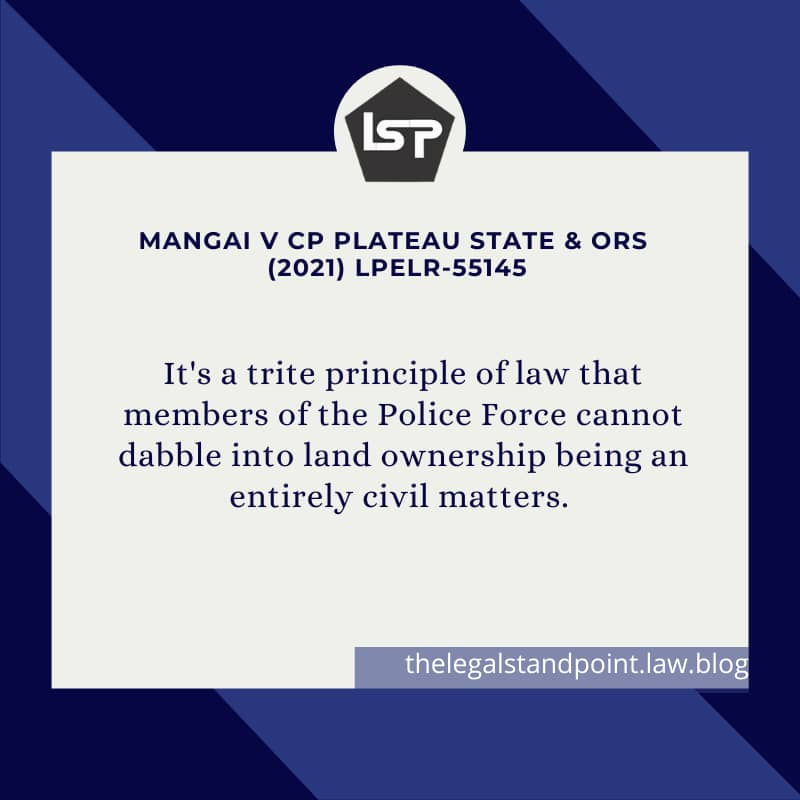
The general principle of law which has received judicial approvals in a plethora of cases is that the Police are not legally empowered to dabble in civil matters. Kure v Commissioner of Police (2020) 9 NWLR (Pt. 1729) 296, Nkapa v Nkume (2001) 6 NWLR (Pt. 710) 543. The primary duty of the Police as stated in Section 4 of the Police Act 2020 is the prevention of crime, investigation, and detection of crime, and the prosecution of offenders. 

One of the civil matters in which the police services have been ignorantly relied upon by Nigerians is land ownership. More often than not, there are proximate examples within us where one of the parties claiming ownership of a land resorts to using the Police to arrest the other party laying claim to the same land.  Furthermore, these people justify their actions based on quick resolutions of the Police because it takes the Court so long and in many cases brings a lot of bottlenecks. They chose the quicker version and the police are happy to assist, especially when properly motivated.

The most disappointing thing about this issue is not only the ignorance of the parties involved but also the sheer docility of the Police who are expected to know that they are not meant to dabble in civil matters. It then necessitates the question of whether the members of the Nigeria Police Force even know what they are employed to do? Or maybe they know, but the quest to enrich themselves through illegal means has made them act the way they do? 

Rather than seek the police intervention, the proper authority to determine a civil dispute is the Court of law. In Mangai v CP Plateau State & Ors (2021) LPELR-55145(CA), the Court held that: “the law has since been settled, that the Police does not and is not allowed to involve itself in purely civil disputes, especially one touching on land ownership… each time a party’s complaint to the Police involves such issues of land dispute… the standing instruction is for the Police to hands off and advises the parties to seek civil resolution of the dispute in a Civil Court.”

In Okafor & Ors Vs The A. I. G. P. & Ors (2019) LPELR 50980 CA, it was held thus: “there is no doubt that the powers of the police do not extend to the settlement of land disputes. The contents of the letter clearly show that the police allowed themselves to be used to settle scores and to display ego by both parties. If truly the 1st Appellant demolished houses on the land in dispute in disobedience of the Court order which restrained him from further entry into the land during the pendency of the suit, the proper forum to lay complaint is the Court which made the order in the first place.”

That is the law. And I can’t but emphasise the importance of its strict adherence. Failure to adhere often has heavy legal consequences for both the complainant and the Police. The rationale is that in executing the complainant’s request, the Police usually infringe on the fundamental human right of the other party through detention, beating, and several barbaric acts. In Kure v COP (SUPRA), the Court held that: “when a person reports a purely civil matter to the Police, such a person cannot go scot-free, as the report ought not to have been made at all since it is not within the purview of Police duties. It is a report made mala fide and he will be equally liable for the action taken by the Police irrespective of whether he actively instigated them or not since he had no business involving the Police in a purely civil matter in the first place.

However, a land dispute can degenerate into a criminal matter especially when there is a threat to one’s life. The occurrence of this – especially in land ownership matters – is high. When this happens, the threatened party may lay a complaint before the Police to seek the protection of his life. In such an instance, the officers in charge must display a high level of professionalism by only handling to criminal aspect alone. In Adebo v Omisola, (2005) 2 NWLR (Pt.909) P. 175, paras. F-G, the Court held that: “while it is true that the police are not vested with any jurisdiction to decide the rights of parties to land, once the complaint as to ownership of land touches on a threat to life, a law-abiding citizen who has nothing to hide and whose acts or deeds accord with the law would have heeded the invitation of that police man. Also, when a party reports to the police that his life is being threatened, that doesn’t stop him or her from engaging the services of a lawyer to handle the land matter.

Thank you for reading. See you next week.
Law

LSP070: The Position of Law on Resignation during the Period of Suspension

The right to suspend an employee when necessary, either as a punishment or to enable the investigation of an infraction, is an integral part of the employer’s right to discipline an employee. In fact, the Court of Appeal in Elizabeth v Ondo State Judicial Service Commission & Anor (2021) LPELR-55177(CA) held that an employer has the right to discipline any erring employee in the interest of the organization or establishment.

The nature of suspension of an employee is to ensure that the employer will have the opportunity to investigate the allegations against the employee unhindered and without undue interference from the employee being investigated.

In one of our previous articles, we informed our esteemed readers that during this period of suspension, an employer is expected to pay the suspended worker’s salary unless the contract of employment states otherwise. You can read it Here

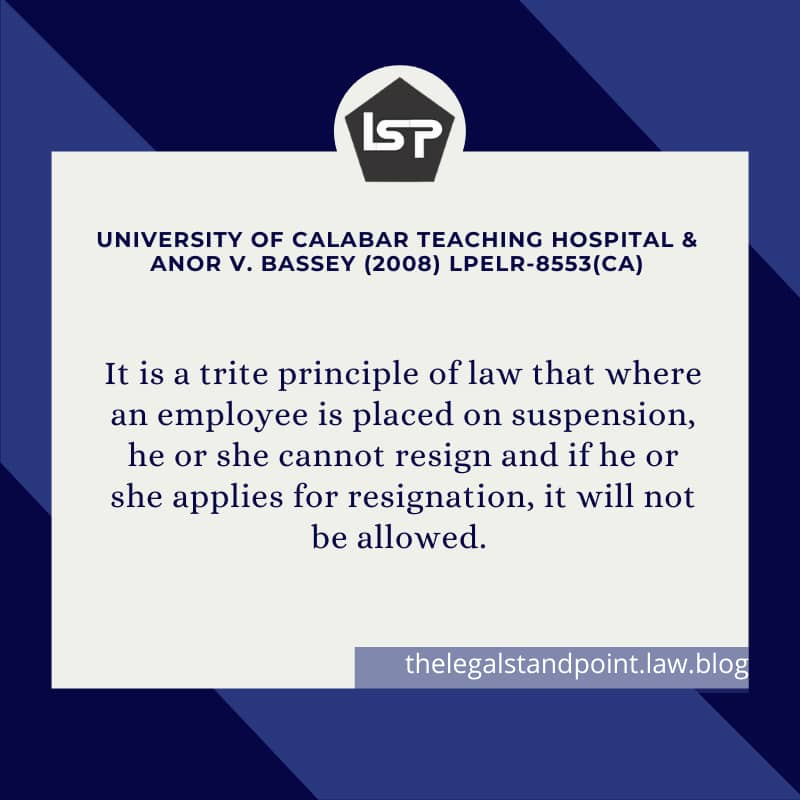
Today, the legal question is, can an employee who is suspended, during that period of suspension, resign from work? This question came up for consideration in University of Calabar Teaching Hospital & Anor v Bassey (2008) LPELR-8553(CA). 

In that case, the respondent, who was the plaintiff at the Court below, joined the employment of the 1st appellant on the 26/9/97. On 1/7/2002, she was suspended from work without pay on the ground of an alleged case of financial impropriety involving the sum of N2 million. She subsequently resigned from her appointment in March 2004. Apparently, the appellants did not accept the resignation of the respondent and on 3/5/04, she was given a letter of dismissal for an alleged act of financial impropriety involving the sum of N11 million. The respondent, unhappy with the turn of events, instituted proceedings against the appellants.

In answering the legal question, the court held that where an employee is placed on suspension, he or she cannot resign and if he or she applies for resignation, it will not be allowed. 

Thank you for reading. See you next week.