
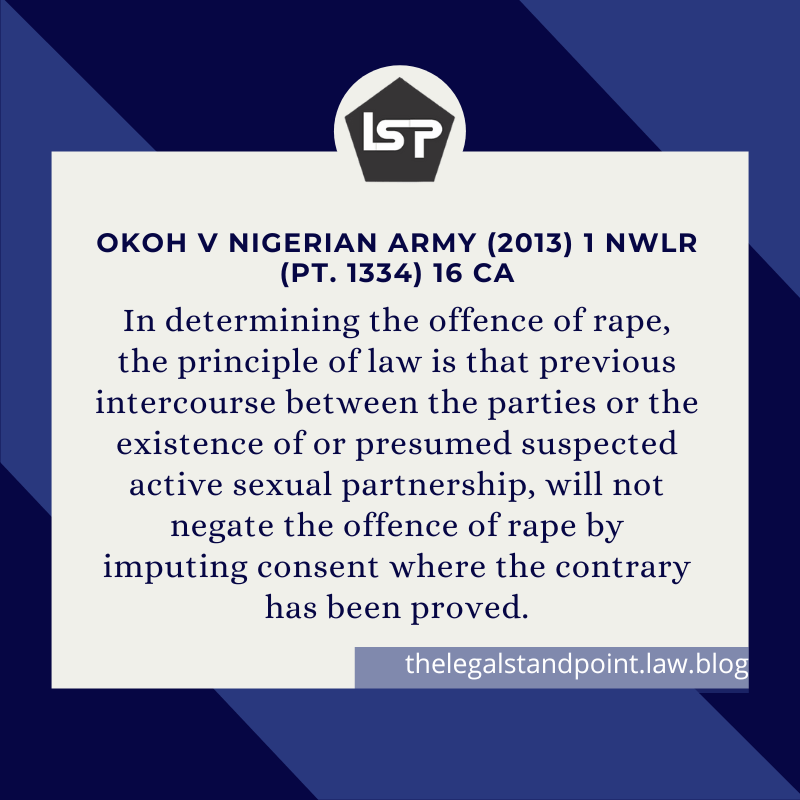
The legal question, which serves as the crux of today’s article, is whether evidence of previous sexual intercourse or the existence of sexual partnership between parties will negate the offence of rape.
The landmark principle of law is that In the offence of rape, consent is a complete defence. As such, if the victim of rape freely consented to sex and such consent was not obtained with force, duress, or intimidation, (he) or she cannot thereafter complain of being raped. Ogunbayo v State(2007) 8 NWLR (Pt. 1035) 157.
In as much as this is true, the questions then are: does consent exist in perpetuity? Is one consent; forever consent? Can an active sexual partner still be raped?
The case which gave rise to these questions is the 2013 Court of Appeal case of Okoh v Nigerian Army (2013) 1 NWLR (Pt. 1334) 16 CA. In that case, the appellant was – at all times material – military personnel attached to the 81 Division of the Nigerian Army and was a guard commander detailed to guard a house at No. 23 Cooper Road, Ikoyi, Lagos. The victim, Miss Member Joy Agagu, was a youth corper who at the time was doing her national service at 81 Division Education Of the Nigerian Army.
She approached one Sgt. Ores about her accommodation problem. Ores in turn took her to the appellant for help with accommodation on the said premises at No. 23, Cooper Road Ikoyi, Lagos. The appellant sought and obtained permission following which the victim then moved into the premises. About four or five days after she moved into the house, there was sexual intercourse between the appellant and victim, and the latter contracted HIV. While the appellant claimed that the sexual intercourse was done with the consent of the victim, the victim alleged that the appellant forcefully had carnal knowledge of her without her consent.
In his defence, the appellant alleged that there was an active sexual activity between them which could be construed as consent. Rejecting this argument, the court held that: “Rape is rape, once proved. The fact of previous intercourse or the existence of or presumed suspected active sexual partnership, will not negate the offence of rape by imputing consent where the contrary has been proved. In the instant case, even if the prosecutrix and the appellant were hitherto consensual lovers who were having sexual intercourse, the occasion of the fateful sex in the circumstances found at the trial court constituted the offence of rape nonetheless.“
At the end of the trial, the conviction and sentence of the appellant by the military court martial and the subsequent confirmation of the same by the Chief of Army Staff on 5th September 2007 was upheld. The 14 years imprisonment was affirmed.
By extension, this principle in Okoh’s case brings to the fore that a sex worker can be raped. It is immaterial that she had consented to sex in the past or that by virtue of her profession, she would always be available for sexual intercourse.
In conclusion, the principle of law is that previous sexual intercourse between parties would not negate the offence of rape where consent has not been freely given. It is pertinent to state that this principle does not apply to husband and wife since, under Nigerian criminal law, a husband cannot rape his wife. We already analyzed that. Do you remember?
Thank you for reading🙏. See you next week.
 THELEGALSTANDPOINT