
As a way of introduction, a sentence is a punishment for a crime ordered by a trial court after conviction in a criminal proceeding. There are different types of punishment depending on the nature of the offence convicted.
By virtue of Section 3 of the Criminal Code, offences in Nigeria can be classified into three. To wit: felony, misdemeanor, and simple offences. A felony is an offence punishable without previous conviction, with death, or with imprisonment of three years or more. A misdemeanour is punishable by imprisonment for 6 months but less than 3 years. Simple offences are others apart from felonies and misdemeanours and are usually punishable by a mere fine, caution, and very rarely, imprisonment not exceeding 6 months.
In Nigeria, the offence of murder, as well as armed robbery, carries the maximum capital punishment. Section 402 of the Criminal Code prescribes death penalty for the offence of Armed Robbery. Today’s legal question is whether a court can impose a lesser sentence where a mandatory death sentence is prescribed by law?
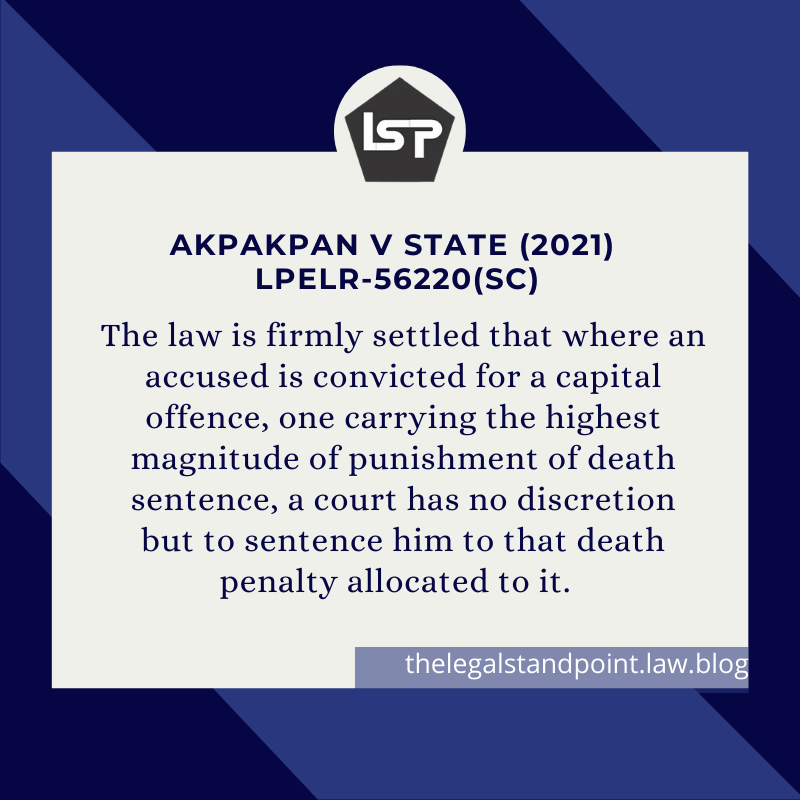
The answer is no. This answer has received judicial authority in a plethora of cases. In a 2021 supreme court case of Akpakpan v State (2021) LPELR-56220(SC), the court per Kudirat Kekere-Ekun, JSC (Pp 39 – 39 Paras E – G) held that: “there is no discretion in sentencing where the law has made specific provisions for the sentence to be imposed, as in a capital offence. The only sentence pronounceable, where all the ingredients have been established, is death. In that case, the appellant was charged with the offence of murder.”
Furthermore, in DANSO v. FRN (2013) LPELR-20165(CA), the court held that: “the law is firmly settled that where an accused is convicted for a capital offence, one carrying the highest magnitude of punishment of death sentence, a court has no discretion than to sentence him to that death penalty allocated to it”. Also, in Sunday v State (2013) LPELR-22889(CA), the court held that: “in a capital offence, where the law prescribes a mandatory Death penalty, the court cannot impose a lesser sentence…. this is such that neither life imprisonment nor a sentence of ten years can be regarded as sufficient punishment for murder, notwithstanding the fact that the accused had remained in prison custody for ten years awaiting trial.” Other cases which reinforced this principle are Balogun V. A-G, Ogun State (2002) 6 NWLR (Pt.1029), Amoshima v State (2008) LPELR-4369(CA), etc.
However, it is pertinent to state that where the offence is not a capital offence, a Court is at liberty to impose a punishment lesser than the one allotted for that offence.
In conclusion, the courts cannot exercise their discretionary power to impose a lesser penalty for capital offences. Inasmuch as there are growing activisms around the world towards the abolishment of death penalty, the punishment is still constitutionally recognized in Nigeria. See the powerful erudition of IGUH JSC in Kalu v State (1998) 13 NWLR (Pt.583) 531.
Thank you for reading. See you next week.🙏

 THELEGALSTANDPOINT
Death punishment is still constitutionally recognized in Nigeria.✍️✍️
This is insightful!
LikeLike