
Law

LSP081: Contempt of Court

On a personal disposition, no one reasonably likes to be disparaged especially in the public. This stance also extends to judges in the administration of justice. In AG v Leveller Magazine Ltd. [1979] AC 440, Lord Diplock opined that “it is justice itself that is flouted by contempt of court, not the individual court or judge who is attempting to administer it.”

Contempt of court is any act or conduct which interferes with the course of justice and tends to bring the authority and administration of law into disrespect. Statutorily, it is a simple offence under Section 133 and 6 of both Criminal and Penal Codes respectively. Under the Criminal Code, it is an offence punishable by imprisonment not exceeding three months.

In Ezenwankwo v State 2015 2 NWLR (Pt. 1443) 265, the court held that the twin elements of contempt of court are interference and disrespect. In the same vein, in Odu v Jolaoso (2005) 16 NWLR (pt.950) 178, contempt was said to: “embrace such invidious acts as an insult or unsavory comments with very sinister motives against a Court with a view to denigrating the Court and smear, besmirch its nobility, its majesty, its aura, its responsibility, or indulging in an expressive sinister and offensive act or words that would lower the esteem of the Court in the eyes of the public.”

Furthermore, contempt of court is usually classified as either criminal or civil. While criminal contempt consists of words or acts which obstruct or tend to interfere with the administration of justice, civil contempt consists of disobedience to judgment, orders, or other processes of the court. The catalogue of conducts that are contemptuous in and out of the court is not exhaustive.

In addition, the modes of contempt can, basically, be divided into two categories namely:

  1. contempt in facie curiae otherwise known as contempt in the face of the court.
  2. contempt ex facie curiae otherwise known as contempt outside the court.

Contempt in facie curiae 

This is contempt in the face of the Court and it is punishable summarily for the sake of maintaining the dignity and the authority of the Court. Under this category, there is no need to call for evidence of what transpired, because it happened in the immediate view of the Court. 

As to the procedure, several judicial authorities such as Agbachom v State (1970)1 All NLR 69 and Atake v AG Federation (1981) 3 NCLR 66 have enunciated the steps in which the court must follow before it can hold an accused guilty for the offence of contempt in facie curiae. These are:

  1. the court should put the accused in the dock; 
  2. the court should state the accused’s offence specifically and distinctly, and
  3.  the Court should ask the accused to show cause why he should not be committed for contempt. 

It is pertinent to state that the alleged contemnor must not be put in the witness box, for putting him in the witness box is tantamount to compelling him to give evidence and this clearly offends against the provisions of Section 36(11) of the 1999 Constitution of the Federal Republic of Nigeria (as amended) which states that no person who is tried for a criminal offence shall be compelled to give evidence at the trial. 

Contempt ex facie curiae 

As earlier mentioned, this is a type of contempt committed outside the court. Unlike contempt in facie curiae where the offender can be apprehended and punished right there in the court without the necessity of framing any charge, taking plea, or calling any witness, in ex facie curiae, the normal procedure of issue of warrant, arrest, drafting of charge, taking of plea, calling of witnesses, etc. must be followed.

In both categories, failure to follow the laid down procedures will lead to the nullity of the proceeding. The rationale behind this is that where a man’s liberty is at stake, every requirement of the law must be strictly complied with. Lee v. Walker (1985)1 All ER 781 at 786, Dibia v Igwe(1998) 9 NWLR (Pt. 564) 78.

The procedure for this category is statutorily governed by the provisions of Section 72 of the Sheriffs and Civil Process Act, LFN 2004 which states that “if any person refuses or neglects to comply with an order made against him, other than for payment of money, the court, instead of dealing with him as a judgment debtor guilty of the misconduct defined in Paragraph (f) of section 66 of this Act, may order that he be committed to prison and detained in custody until he has obeyed the order in all things that are to be immediately performed.”

At this juncture, it is noteworthy that the power of the court to punish the contemnor must be reasonably exercised. It shouldn’t be used as an instrument of vendetta. In Deduwa v. State (1975) 1 All NLR, the Supreme Court held that: “the power to commit is not retained for the personal aggrandisement of a judge or whoever mans the court. The powers are created, maintained, and retained for the purpose of preserving the honour and dignity of the court and so the judge holds the power on behalf of the court and by the tradition of his office, he should eschew any type of temperamental outburst as would let him lose his own control of the situation and his own appreciation of the correct method of procedure.”

Moving on, the position of the law is that when an alleged contempt is committed ex-facie curiae, a judge who is personally involved should not hear the case but another judge. This is to upload one of the principles of fair hearing which is that no one can be a judge in his own case. 

The Effiong’s Case

As narrated by the lawyer on his Twitter page, the Chief Judge of Akwa Ibom State, Justice Ekaette Obot on Wednesday, July 27, 2022 committed him to the state correctional centre for one month over what she described as contemptuous behaviour in the court. 

Several questions are up here:

  1. Did the lawyer actually give us the full story of what transpired in Court? Was his action contemptuous or not? Ascertaining this is germane because more often than not, the first person who rushes to social media to report a wrong is not always the innocent.
  2. Since the contempt was in face of the court, did Milord follow the requirements of the law or was this power arbitrarily exercised?

These are the questions that I don’t have answers to because I wasn’t in Court. As such, since we are not privy to the full story, we must refrain from passing a verdict. Nevertheless, what we are certain of is that the law won’t excuse a wrong without a remedy. As such, if upon the effluxion of the one-month imprisonment, the concerned lawyer can always seek available remedy at his disposal. Till then, we would be watching. 

In conclusion, the rationale for contempt is the need to vindicate the dignity of the Court and thereby protect the due administration of justice. The doctrine places a duty on everyone including legal practitioners not to act in ways as to bring disrepute to the court and justices of law. 

Thank you for reading. See you next week. 

Law

LSP080: Unlawful Possession of Firearms

Perhaps the best way to start this article is to remind our readers of the fundamental principle of criminal liability which states that for an act to count as an offence, it must have both physical and mental elements. The physical element of a crime is regarded as the guilty act, that is, the overt act which the law forbids while the mental element refers to the guilty mind of the accused. Legally, these elements are called Actus Reus and Mens Rea. This principle is expressed in the Latin maxim “actus non facit reum, nisi mens sit rea’, which literally means an act does not make one guilty unless the mind is also guilty. 

Putting it in context, the actus reus of the offence of stealing is the taking or moving of the property while the mental element is the accused’s fraudulent intent to deprive the owner of that property permanently.

However, for every general principle of law, there is always an exception. And the exception to this principle is strict liability offences. Strict liability offences are offences where a defendant can be convicted notwithstanding that he did not have any mens rea. One of the strict liability offences which we would be considering today is illegal possession of firearms.

In Kelly v State (2022) LPELR-57325(SC) (not the Kelly on Tiktok😂), the appellant was charged with the offence of unlawful possession of firearms contrary to Section 3(1) of the robbery and firearms (Special Provisions) Act, Laws of the Federation of Nigeria, 2004. He was sentenced to ten years imprisonment. Dissatisfied with both the decisions of the Trial Court and the Court of Appeal, the appellant appealed to the Supreme Court.

As a starting point, the Supreme Court held that to succeed against an accused person in a charge of unlawful possession of firearms, the prosecution is duty bound to prove the following essential elements beyond reasonable doubt:

  1. that the accused person was found in possession of a firearm:
  2. that the firearm is within the meaning of the Act; and
  3. that the accused person has no licence to possess a firearm. See Bille v. State (2016) LPELR – 40832 (SC).

Dismissing the appeal, the Court held that the intent of the legislature in Section 3(1) of the Robbery and Firearms (Special Provisions) Act is, that once a person is shown to be in possession of firearms and has no licence permitting him to be in possession, he is liable. Adamu Jauro, J.S.C held that: “the law punishes unlawful possession simpliciter. In other words, as long as the accused person is found in possession of a firearm, it is immaterial whether he intends to use it or whether it belongs to someone else. In the case at hand, assuming the Appellant was truly unaware of the contents of the black nylon in which the gun was found, the lack of knowledge would not have availed him. The offence is a strict liability offence. As long as the accused person is found in possession of a firearm and the three aforementioned ingredients are present, he is guilty of the offence of unlawful possession of firearms.”

In State v. Oladotun (2011) LPELR-3226(SC), the provisions of Section 3(1) of the Robbery and Firearms (Special Provision) Act, supra, were considered; and, the Supreme Court, Per Mukhtar JSC (as he then was) said: “it is palpably clear that the presence and recovery of the gun suggest that the respondent had guilty knowledge. I say so because no person can ordinarily be seen with such dangerous objects with cartridges without an ill motive to perform acts that are contrary to the law. Moving around with a dangerous weapon when he is not a law enforcement agent definitely raises the presumption of guilt. The provision of the Firearms Act supra is simply on possession, no more no less. That is to say that the intent of the legislature lays emphasis on possession, which represents the mere fact that a firearm is found in possession of a person, once the three ingredients stated above have been established, that provision has been met.”

In conclusion, unlawful possession of firearms is a strict liability offence under Nigerian Criminal law. The only exception that the law recognises is the use of a licence and the burden is on the accused to prove his lawful possession by producing the licence that allowed him to have possession of the firearms.

Thank you for reading. See you next week.
Law

LSP079: Diplomatic Immunity and Municipal Courts

Diplomatic immunity is a principle of international law by which foreign government officials are shielded from lawsuits under the host country’s laws for their official activities.

Commenting on the nature of and scope of diplomatic immunity, Sunday JSC (as he then was) in AFRICAN REINSURANCE CORPORATION v J.D.P. CONSTRUCTION (NIG) LTD(2007) LPELR-216(SC) held thus: “the idea of diplomatic immunity was developed from one of the consequences of State equality rule which is expressed in the Latin maxim: par in parem non habet imperium – meaning: no State can claim jurisdiction over another. In practice, although, States can sue in foreign courts, they cannot as a rule be sued there unless they voluntarily submit to the jurisdiction of the court concerned…. the practice of granting diplomatic immunity to States has in practice, been extended to government naval ships, properties, and government servants acting in their official capacities. But such immunity is no longer granted to a foreign State in respect of acts that are non-governmental, which means in most cases, the acts of a foreign state as a trader.”

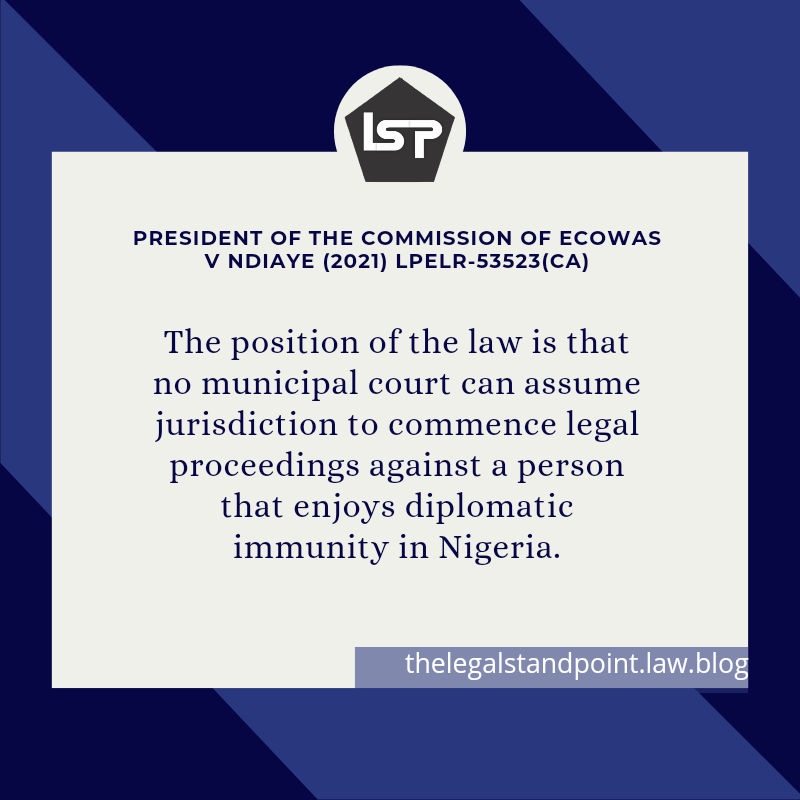
In PRESIDENT OF THE COMMISSION OF ECOWAS v NDIAYE (2021) LPELR-53523(CA), the Respondent, a staff of the Economic Community of West African States (ECOWAS), instituted an action against the President of ECOWAS at the National Industrial Court (NIC) of Nigeria, Abuja Judicial Division for unlawful suspension of employment and damages for libelous suspension letter.

On the matter of jurisdiction, which is the crux of the suit, respondent, who was the plaintiff at the NIC, contended that the court had the jurisdiction to adjudicate on the matter. He supported his assertion with Section 254C(2) of the 1999 Constitution of the Federal Republic of Nigeria which states that: Notwithstanding anything to the contrary in this Constitution, the National Industrial Court shall have the jurisdiction and power to deal with any matter connected with or pertaining to the application of any international convention, treaty or protocol of which Nigeria has ratified relating to labour, employment, workplace, industrial relations or matters connected therewith. 

At the end of the trial, judgment was given in favour of the employee. Dissatisfied, the appellant sued at the Court of Appeal. And the fundamental issue for determination is whether diplomats are susceptible to the jurisdiction of local courts in the host country. Since the issue of jurisdiction is so pivotal, it means that once the NIC has no jurisdiction,  then the judgment given in the plaintiff’s favour becomes null, void, and ineffective. 

In addressing and allowing the appeal, the upper court held that the NIC did not have the jurisdiction to adjudicate the suit. Their ratio decidendi was hinged on three things: first, Section 18 of the Diplomatic Immunities and Privileges Act, the judicial authority of African Reinsurance Corporation v Abate Fantaye (1986) 3 NWLR (PT 32) 811, and the Certificate of Immunity written by the Minister of Foreign Affairs of Nigeria on the ECOWAS Revised Treaty of 1993 which Nigeria has ratified. The letter reads: “the ministry of Foreign Affairs wishes to reaffirm the status of the ECOWAS Commission as an international organization and the immunity and privileges of the Commission and its staff members with exception of Nigerians and holders of Nigeria permanent residency from Criminal, Civil and Administrative proceedings by virtue of ECOWAS Revised Treaty by of 1993, which was ratified by the Federal Republic of Nigeria on 1st July, 1994.”

As such, the court held that all these factors are conclusive evidence affirming the appellant’s immunity from prosecution in the municipal Courts of Nigeria.

Moving on, it is pertinent to state that the fact that the appellant’s base of operation is in Nigeria or that Nigeria is the Host Country does not make the appellant subservient to the jurisdiction of Nigerian Courts. 

Addressing the respondent’s argument in favour of NIC jurisdiction, the Court held that, Section 254C(2) of the Constitution only confers on the National Industrial Court power to apply international conventions, protocols and treaties ratified by Nigeria relating to labour, employment, workplace, industrial relations and matters connected therewith while exercising its jurisdiction over persons subject to its jurisdiction. Diplomats who enjoy immunity from Court processes from municipal Courts in Nigeria like the Respondent are not such persons.

In conclusion, the Court of Appeal restated the aged principle of law that a State enjoys immunity from the jurisdiction of municipal courts, in respect of itself and its persons. 

Thank you for reading. See you next week.🙏