
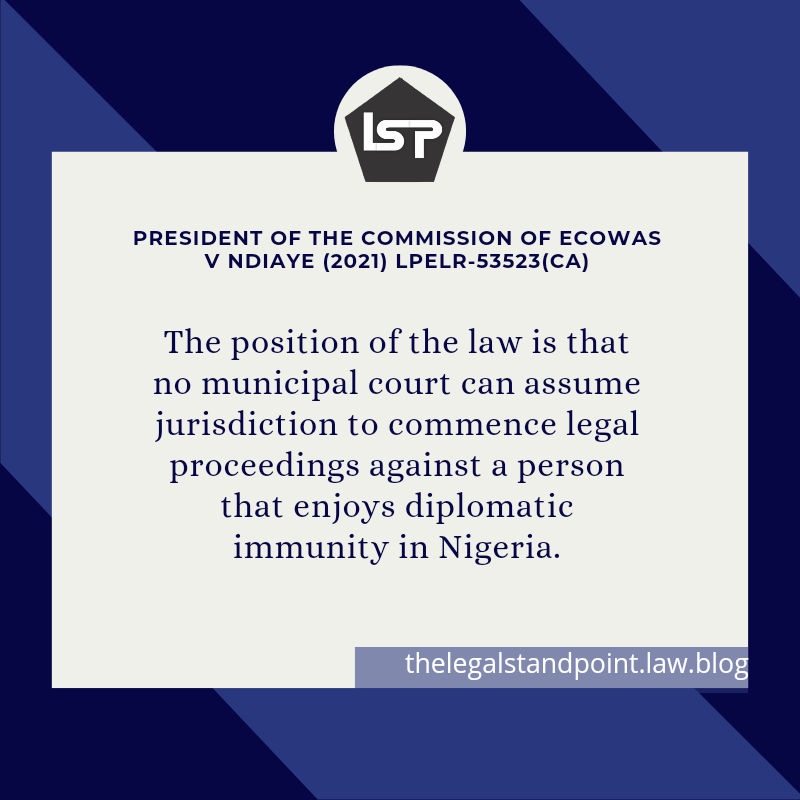
Diplomatic immunity is a principle of international law by which foreign government officials are shielded from lawsuits under the host country’s laws for their official activities.
Commenting on the nature of and scope of diplomatic immunity, Sunday JSC (as he then was) in AFRICAN REINSURANCE CORPORATION v J.D.P. CONSTRUCTION (NIG) LTD(2007) LPELR-216(SC) held thus: “the idea of diplomatic immunity was developed from one of the consequences of State equality rule which is expressed in the Latin maxim: par in parem non habet imperium – meaning: no State can claim jurisdiction over another. In practice, although, States can sue in foreign courts, they cannot as a rule be sued there unless they voluntarily submit to the jurisdiction of the court concerned…. the practice of granting diplomatic immunity to States has in practice, been extended to government naval ships, properties, and government servants acting in their official capacities. But such immunity is no longer granted to a foreign State in respect of acts that are non-governmental, which means in most cases, the acts of a foreign state as a trader.”
In PRESIDENT OF THE COMMISSION OF ECOWAS v NDIAYE (2021) LPELR-53523(CA), the Respondent, a staff of the Economic Community of West African States (ECOWAS), instituted an action against the President of ECOWAS at the National Industrial Court (NIC) of Nigeria, Abuja Judicial Division for unlawful suspension of employment and damages for libelous suspension letter.
On the matter of jurisdiction, which is the crux of the suit, respondent, who was the plaintiff at the NIC, contended that the court had the jurisdiction to adjudicate on the matter. He supported his assertion with Section 254C(2) of the 1999 Constitution of the Federal Republic of Nigeria which states that: Notwithstanding anything to the contrary in this Constitution, the National Industrial Court shall have the jurisdiction and power to deal with any matter connected with or pertaining to the application of any international convention, treaty or protocol of which Nigeria has ratified relating to labour, employment, workplace, industrial relations or matters connected therewith.
At the end of the trial, judgment was given in favour of the employee. Dissatisfied, the appellant sued at the Court of Appeal. And the fundamental issue for determination is whether diplomats are susceptible to the jurisdiction of local courts in the host country. Since the issue of jurisdiction is so pivotal, it means that once the NIC has no jurisdiction, then the judgment given in the plaintiff’s favour becomes null, void, and ineffective.
In addressing and allowing the appeal, the upper court held that the NIC did not have the jurisdiction to adjudicate the suit. Their ratio decidendi was hinged on three things: first, Section 18 of the Diplomatic Immunities and Privileges Act, the judicial authority of African Reinsurance Corporation v Abate Fantaye (1986) 3 NWLR (PT 32) 811, and the Certificate of Immunity written by the Minister of Foreign Affairs of Nigeria on the ECOWAS Revised Treaty of 1993 which Nigeria has ratified. The letter reads: “the ministry of Foreign Affairs wishes to reaffirm the status of the ECOWAS Commission as an international organization and the immunity and privileges of the Commission and its staff members with exception of Nigerians and holders of Nigeria permanent residency from Criminal, Civil and Administrative proceedings by virtue of ECOWAS Revised Treaty by of 1993, which was ratified by the Federal Republic of Nigeria on 1st July, 1994.”
As such, the court held that all these factors are conclusive evidence affirming the appellant’s immunity from prosecution in the municipal Courts of Nigeria.
Moving on, it is pertinent to state that the fact that the appellant’s base of operation is in Nigeria or that Nigeria is the Host Country does not make the appellant subservient to the jurisdiction of Nigerian Courts.
Addressing the respondent’s argument in favour of NIC jurisdiction, the Court held that, Section 254C(2) of the Constitution only confers on the National Industrial Court power to apply international conventions, protocols and treaties ratified by Nigeria relating to labour, employment, workplace, industrial relations and matters connected therewith while exercising its jurisdiction over persons subject to its jurisdiction. Diplomats who enjoy immunity from Court processes from municipal Courts in Nigeria like the Respondent are not such persons.
In conclusion, the Court of Appeal restated the aged principle of law that a State enjoys immunity from the jurisdiction of municipal courts, in respect of itself and its persons.
Thank you for reading. See you next week.🙏
 THELEGALSTANDPOINT