
Perhaps the best way to start this article is to remind our readers of the fundamental principle of criminal liability which states that for an act to count as an offence, it must have both physical and mental elements. The physical element of a crime is regarded as the guilty act, that is, the overt act which the law forbids while the mental element refers to the guilty mind of the accused. Legally, these elements are called Actus Reus and Mens Rea. This principle is expressed in the Latin maxim “actus non facit reum, nisi mens sit rea’, which literally means an act does not make one guilty unless the mind is also guilty.
Putting it in context, the actus reus of the offence of stealing is the taking or moving of the property while the mental element is the accused’s fraudulent intent to deprive the owner of that property permanently.
However, for every general principle of law, there is always an exception. And the exception to this principle is strict liability offences. Strict liability offences are offences where a defendant can be convicted notwithstanding that he did not have any mens rea. One of the strict liability offences which we would be considering today is illegal possession of firearms.
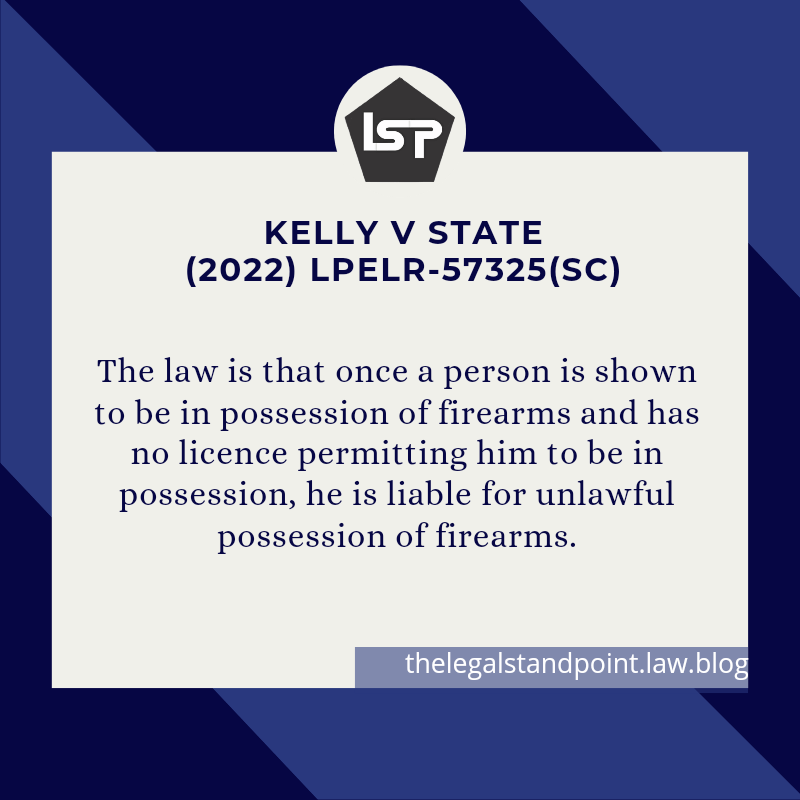
In Kelly v State (2022) LPELR-57325(SC) (not the Kelly on Tiktok😂), the appellant was charged with the offence of unlawful possession of firearms contrary to Section 3(1) of the robbery and firearms (Special Provisions) Act, Laws of the Federation of Nigeria, 2004. He was sentenced to ten years imprisonment. Dissatisfied with both the decisions of the Trial Court and the Court of Appeal, the appellant appealed to the Supreme Court.
As a starting point, the Supreme Court held that to succeed against an accused person in a charge of unlawful possession of firearms, the prosecution is duty bound to prove the following essential elements beyond reasonable doubt:
- that the accused person was found in possession of a firearm:
- that the firearm is within the meaning of the Act; and
- that the accused person has no licence to possess a firearm. See Bille v. State (2016) LPELR – 40832 (SC).
Dismissing the appeal, the Court held that the intent of the legislature in Section 3(1) of the Robbery and Firearms (Special Provisions) Act is, that once a person is shown to be in possession of firearms and has no licence permitting him to be in possession, he is liable. Adamu Jauro, J.S.C held that: “the law punishes unlawful possession simpliciter. In other words, as long as the accused person is found in possession of a firearm, it is immaterial whether he intends to use it or whether it belongs to someone else. In the case at hand, assuming the Appellant was truly unaware of the contents of the black nylon in which the gun was found, the lack of knowledge would not have availed him. The offence is a strict liability offence. As long as the accused person is found in possession of a firearm and the three aforementioned ingredients are present, he is guilty of the offence of unlawful possession of firearms.”
In State v. Oladotun (2011) LPELR-3226(SC), the provisions of Section 3(1) of the Robbery and Firearms (Special Provision) Act, supra, were considered; and, the Supreme Court, Per Mukhtar JSC (as he then was) said: “it is palpably clear that the presence and recovery of the gun suggest that the respondent had guilty knowledge. I say so because no person can ordinarily be seen with such dangerous objects with cartridges without an ill motive to perform acts that are contrary to the law. Moving around with a dangerous weapon when he is not a law enforcement agent definitely raises the presumption of guilt. The provision of the Firearms Act supra is simply on possession, no more no less. That is to say that the intent of the legislature lays emphasis on possession, which represents the mere fact that a firearm is found in possession of a person, once the three ingredients stated above have been established, that provision has been met.”
In conclusion, unlawful possession of firearms is a strict liability offence under Nigerian Criminal law. The only exception that the law recognises is the use of a licence and the burden is on the accused to prove his lawful possession by producing the licence that allowed him to have possession of the firearms.
Thank you for reading. See you next week.
 THELEGALSTANDPOINT