
Today’s analysis centers on the compulsory acquisition of property by the Government. This analysis would take the form of a Q&A.
Question 1: Can Nigerians own immovable property?
Answer: Yes, they can. This right has been statutorily provided for in Section 43 of the Constitution.
Question 2: Is this right absolute?
Answer: No, it is not. It’s a qualified right which means there is an exception. The exception is that the Government can take someone’s land for the benefit of the public interest.
Question 3: Is this exception provided under the law?
Answer: Yes. It is provided under Section 44(1) of the Constitution and Section 28(1) of the Land Use Act.
Question 4: What amounts to Public Interest?
Answer: Though the law empowers the acquisition of land by the Government when it is required for the public interest, neither the Constitution nor the Land Use Act defines public interest. As such, recourse is made to judicial authorities. In Goldmark Nigeria Limited v Ibafon Company Limited [2012]10 NWLR(Pt 1308), it was suggested that for a particular purpose to qualify as public purpose or public interest, it must not be vague and the way it benefits the public at large must be capable of proof. The test is whether or not the purpose is meant to benefit the public and not just to aid the commercial transaction of a company or a group of people for their own selfish or financial purpose. (P. 356, paras. A-C).
Question 5: What are the conditions precedent?
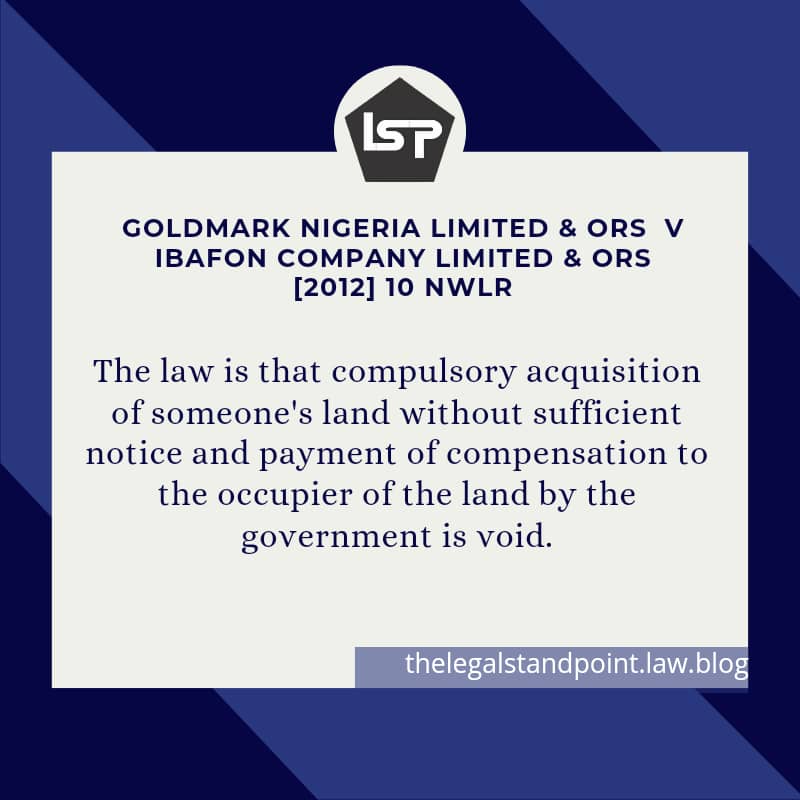
Answer: Before they can be an effective acquisition, there must be sufficient notice given to the occupier of the land and swift payment of a reasonable compensation. So the two conditions precedent are sufficient notice and payment of reasonable compensation. Where the Government disobeys the law by not complying with the laid down procedures for the acquisition of property, such acquisition is void and it is the duty of the courts to intervene between the Government and the private citizen. Goldmark Nigeria Limited v Ibafon Company Limited [2012]10 NWLR(Pt 1308)
Question 6: Will Notice in the gazette or newspaper suffice as sufficient notice?
Answer: Publication in the gazette does not constitute sufficient notice. There must be personal service served to the affected person. See the cases of Ononuju v A.G Anambra State (2009) 10 NWLR (Pt. 1148) 182; A.G Bendel State v Aideyan (1989) 4 NWLR (Pt. 118)646; Provost, Lagos State College of Education v Edun (2004) 6 NWLR (Pt. 870) 476; Okeowo v A.G Ogun State (2010) 16 NWLR (Pt. 1219) 327(P. (356, paras. C-E).
Question 7: How is the compensation computed?
Answer: There are no exhaustive parameters for which the Courts’ compensatory order could be made as each case must be determined on its own strength. Nonetheless, the principles for computation of compensation that have guarded the Court are the location of the land and the actual cost of the land.
Case Law 1: Amale v Sokoto State Government [2012]5 NWLR (Pt1292)
In that case, the appellant’s land and movable properties situated at KoferKade, Kama Market in Sokoto metropolis were compulsorily acquired by the then Military Governor of Sokoto State for the purpose of expanding the Cattle (Kara) Market by the Sokoto Local Government. The appellant was offered compensation for the acquired land but he refused to collect it. He then brought up action for infringement of his fundamental human right. On appeal, the court held that the revocation of the appellant’s statutory right of occupancy was legal, and could not constitute an encroachment on his fundamental right. Delivering the lead judgment, Fabiyi JSC held that: The provisions of section44(1) and (2) are very clear and unambiguous. It gave a right of action to an aggrieved party whose property was compulsorily acquired without compliance with the provisions of the section. Where, however, the acquisition complied with the provisions of the section, no cause of action accrued to the aggrieved party as such action would be legal in the eyes of the law. (Pp. 201, paras. B-E 205-206, paras. E-B).
Case Law 2: Goldmark Nigeria Limited & Ors v Ibafon Company Limited & Ors[2012]10 NWLR(Pt 1308)
The 1st and 2nd respondents in this appeal were the plaintiffs at the High Court of Lagos State. The case of the 1st and 2nd respondents was that by two separate Deeds dated 6th of January 1978 and 20th of January 1976 and registered as No. 999 on page 99 in volume 1794, and No. 16 in volume 1806 at the Lands Registry in Lagos, the 1st and 2nd respondents respectively became leaseholders for 99 years each of the parcels of land being, lying and situate at Ibafon Off Apapa-Oshodi Expressway, Araromi.
The respondents were in possession of the said parcels of land and were exercising ownership rights including fencing them until when by Government Notice No. 601 of 22nd of June 1976, the Federal Military Government purportedly acquire the said parcels of land for a public purpose and in particular for the use of the Nigerian Ports Authority. No notice of the acquisitions was ever served on the 1st and 2nd respondents.
To the 1st and 2nd respondents’ total shock, they discovered that rather than use the said lands for its own purposes, the Nigerian Ports Authority Had leased out the said lands to private individuals and companies particularly the 1st, 2nd, and 4th appellants who used the parcels of land for their businesses such as the selling of sand and other businesses which were totally private and which had nothing to do with the purpose for which the lands were purportedly acquired.
Displeased by this flagrant act, they instituted an action for unlawful acquisition of land and the Courts found in their favour. The Court held that such acquisition was illegal, unlawful, null, and void. It further held that “where a statute specifically provides for a particular way in which Government or any party can obtain title, the Government or the party can only acquire title by strict compliance with the statute, unless the statute or its.”
In conclusion, every citizen of Nigeria has the right to acquire and own immovable property anywhere in Nigeria. Despite this, the law allows the Government to acquire the land for the sake of public interest provided that the conditions precedent have been fulfilled.
Announcement: THE LEGALSTANDPOINT turns two on August 13th, 2022. It has been a nice ride with you all. Thank you for all you do for the blog. We need comments. Please do well to drop them in the comment box. Thank you for reading See you next week.
 THELEGALSTANDPOINT