
Today’s analysis centers on the principle of Resulting Trust and Presumption of Advancement. A resulting trust arises where one person transfers property to another without gaining anything in return. The effect of a resulting trust is that the recipient of the property holds the property in trust for the donor who is still the owner.
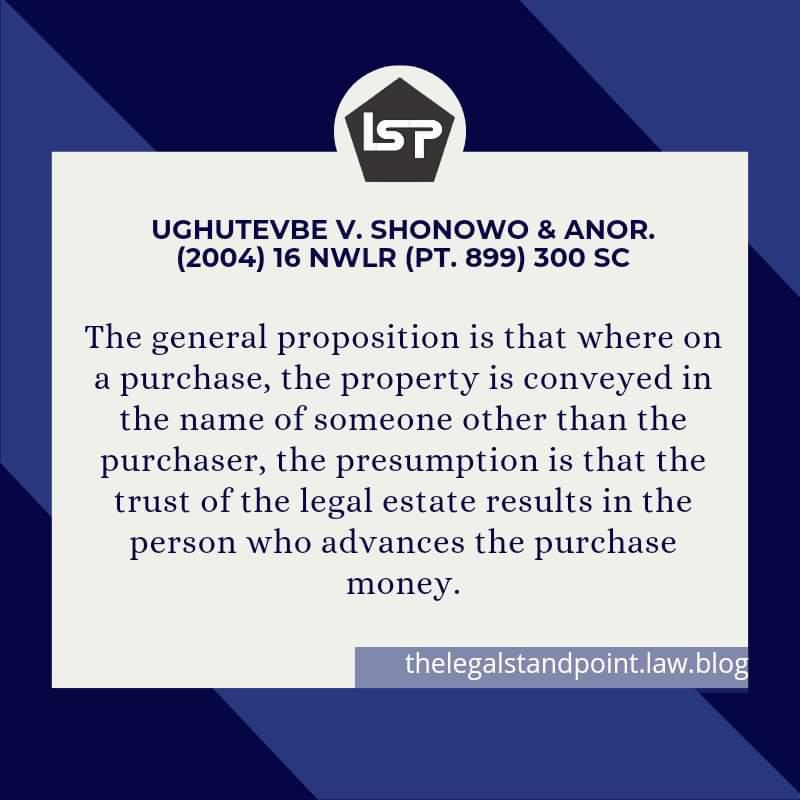
Using an example, if I purchase land for my friend in his name, he is holding the land in Trust( probably to maintain and watch over) for me and the law will not deem him as the owner. As held in Ughutevbe v. Shonowo & Anor. (2004) 16 NWLR (Pt. 899) 300 SC “the general proposition is that where on a purchase, property is conveyed in the name of someone other than the purchaser, the presumption is that the trust of the legal estate results in the person who advances the purchase money.”
However, in some instances, the relationship of the parties can suggest that a presumption of advancement applies, and in turn, the recipient is assumed to be the full legal owner of the property rather than simply a trustee. Instances where this presumption arises are cases in which the person providing the purchase money is under an equitable obligation to support, or make provision for, the person to whom the property is conveyed.
Hence, when a person puts property in the name of his/her spouse, child, or a person to whom he/she stands in loco parentis, the intention is to transfer the beneficial interest as well as the legal title to that recipient. It is pertinent to say that both the presumption of a resulting trust and the presumption of advancement can be rebutted by evidence of the actual intention of the purchaser.
So in Ughutevbe v. Shonowo & Anor. (2004) 16 NWLR (Pt. 899) 300 SC, Chief M.A.K. Shonowo bought the property at No 1 Omode Lane, Apapa for his son (the 1st respondent) who was a schoolboy of about 15 years of age. It was a gift for him because he was the first member of the family to be admitted into a secondary school and the property was purchased to finance his further education and to serve as a residence for him in the future.
The land was bought at the price of £4,000 in the name of the 1st respondent who it was alleged signed the Deed of Transfer in favour of himself. Ten years later, that is, in 1969, the 1st respondent’s father Chief M.A.K. Shonowo using the name of the 1st respondent, as per, the Deed of Transfer dated 7/1/70 exhibit B sold the property in dispute for £10,000 to the appellant’s late father who thereupon started to put tenants therein. Meanwhile, the 1st respondent proceeded to the United States of America where he qualified as a medical practitioner.
In 1971, his father Chief M.A.K. Shonowo died but although the 1st respondent returned briefly for the burial, upon his final return from the U.S.A., he discovered that the property in dispute had been purportedly sold. By reason of the foregoing premises, the 1st respondent commenced an action against the appellant’s father and the 2nd respondent as defendants seeking inter alia a declaration that the Deed of Transfer (exhibit B) was null and void contending that his father had indeed purchased the property as a gift for him because he was the first member of the family to be admitted into a secondary school and that the property was purchased to finance his further education and to serve as a residence for him in future.
The Supreme Court reaffirmed the decision of the Court of Appeal and held that the father of the 1st respondent lacked the legal capacity to sell the property in dispute to the appellant’s father because the property belongs to his son. Consequently, the Deed of Transfer made in that regard was null and void. In giving an elaborate view, the Court further opined that: “where any specie of property was allotted to and signed for by the children of a father who of his own volition caused the property to be so assigned to his children, it must be presumed that such property was given as a gift of advancement to the children by their father. It is for the father or those who wished to challenge that presumption who have the onus of providing credible evidence to prove that the property was not meant as a gift or advancement to the children. In this case, there was no evidence by the appellant to rebut the presumption of advancement or gift in favour of the 1st respondent.“
Moving on, there is a slight modification to the presumption of advancement. The modification is that where a wife buys a property in the name of her husband, it does not belong to him. Rather, the husband is holding the property in trust (as a guardian, to help her keep the property) for his wife.
However, when a husband buys a property in the name of his wife, the property belongs to the wife, and it is seen as a gift from him to her. In Jolugbo v Aina (2016)LPELR-4035(CA), the court makes a distinction on the presumption of advancement and held that: “the law also makes a distinction between the husband and the wife – when a wife buys a property and conveys it in the name of her husband, there is no presumption of advancement in favour of her husband; he holds in trust for his wife. However, if the husband purchases a property in his wife’s name, this is prima facie a gift to her – see Silver v. Silver (1958) 1 All E. R.523.”
Thank you for reading. See you nextweek

 THELEGALSTANDPOINT