
Three legal terminologies are relevant to a court’s judgment. These are ratio decidendi, obiter dictum, and per incuriam. Though today’s article centers on the obiter dictum of the Supreme Court, attention will quickly be given to the status of these aforementioned terms in order to aid a proper understanding of this article.
On the first one, ratio decidendi is the reason behind a court’s decision. It is the principle or rule of law on which a court’s decision is founded. For instance, if Mr. A kills Mr. B in a provocation that wasn’t done in the heat of passion, Mr. A will be liable for Murder and sentenced to death penalty. The reason behind the Court’s decision in this hypothetical example will be the statutory provision of Section 319 of the Criminal Code and several judicial precedents that have prescribed death as the punishment for unlawful homicide.
Moving on, an obiter dictum is a statement made in passing that does not reflect the ratio decidendi, that is, the reasoning or ground upon which a case is decided. It is an expression of opinion made in giving a judgment by the Judge but not necessary to his decision and, accordingly, cannot form part of the ratio decidendi of the judgment.
On per incuriam, the Latin word “incuria” or “incuriae,” means carelessness or neglect. The legal connotation is that when a case is decided Per incuriam, it denotes the idea that it is decided through inadvertence and or in ignorance of the relevant law. Per incuriam in law means the Judge gave a judgment in ignorance or forgetfulness of an enabling statute or some binding authority on the court. As a general rule, the only cases in which decisions should be held to have been reached Per incuriam are those decisions: – (a) given in ignorance or forgetfulness of some inconsistent statutory provisions, or (b) given in ignorance of some authorities or statute binding on the court concerned; so that in such cases, some part of the decision or some step in the reasoning on which it is based is found, on that account, to be demonstrably wrong. Rossek v A.C.B LTD (1993) 8 NWLR (Pt. 312) 382.
In the Nigerian legal system, courts are hierarchically structured with the Supreme Court occupying the apogee position followed by the Court of Appeal, and then Courts of coordinate jurisdiction such as the State High Court, Federal High Court, The National Industrial Court, etc. The list goes on and on.
Having laid the foundation, the question then becomes: is the obiter dictum of the Supreme Court binding on itself and other lower courts?
While it’s true that the ratio decidendi and per incuriam decisions of the Supreme Court have a binding effect on all other courts, the same privilege is not enjoyed when it comes to Obiter Dictum. The general principle of law is that an obiter dictum of the Supreme Court is not binding on the supreme court itself or indeed on the lower courts, for obiter dicta, though they may have considerable weight, are not rationes decidendi and are therefore not conclusive authority. And it is immaterial the justice who gave the dictum, even if it’s the Chief Justice.
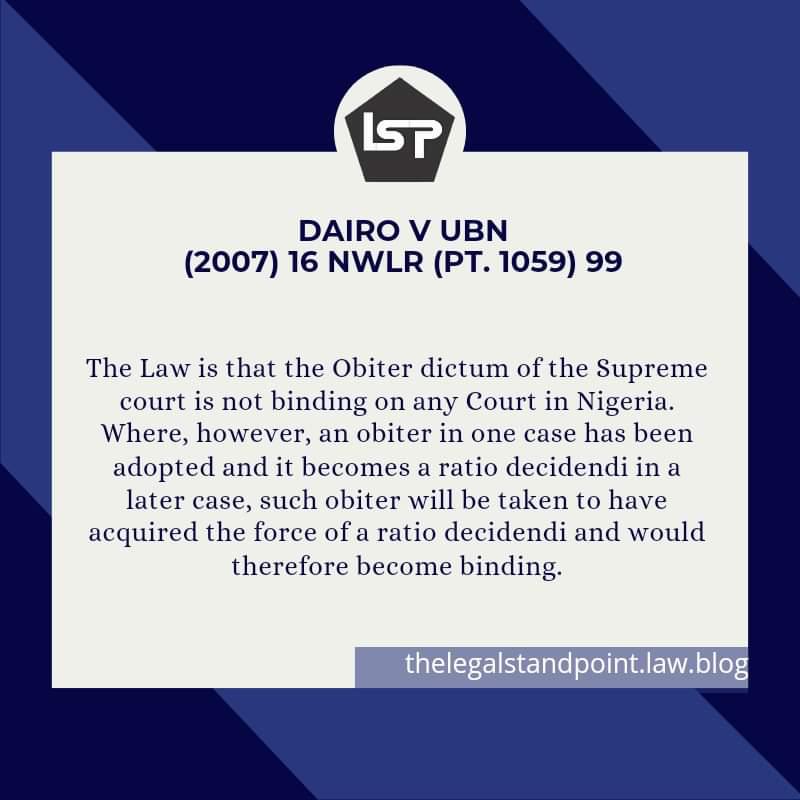
However, there is leeway. I knew you anticipated that. The exception is that, if an obiter dictum in one case has been adopted and becomes a ratio decidendi in a latter case, such an obiter dictum will be taken to have acquired the force of a ratio decidendi and would therefore become binding.
At this juncture, it is noteworthy that supreme court decisions reached per incuriam are binding on all courts. As held in State v Alli,(2020) 18 NWLR (Pt. 1755) 69, “the Court of Appeal does not have the power to review the decision of the supreme court and proceed to declare it as given per incuriam. Instead, by the doctrine of stare decisis, the Court of Appeal is bound by the decisions of the supreme court until and unless the supreme court itself is presented with an opportunity to review its own decision and in its discretion, decide whether or not to reverse itself.”
In Dairo v UBN (2007) 16 NWLR (Pt. 1059) 99, the Court held that: “the question of whether a decision or pronouncement of the Supreme Court is binding on the Court of Appeal depends on whether that decision or pronouncement is an obiter dictum or was made per incuriam. If the pronouncement is a mere obiter dictum then, of course, it cannot be binding, but if it was made per incuriam, it will nevertheless be binding on the Court of Appeal in accordance with the principle of stare decisis until the error in the judgment has been corrected.” See also 7Up Bottling Co. Ltd. v Abiola & Sons (Nig.) Ltd. (1995) 3 NWLR (Pt. 383) 257; Afro- Continental Nig. Ltd. v Ayantuyi (1995) 9 NWLR (Pt. 420) 411.
In conclusion, the dicta of the Supreme Court have persuasive effects. And until they have been adopted as ratio decidendi in a latter case, they can’t be binding on the Supreme Court itself and any other lower courts.
Thank you for reading. See you next week.
 THELEGALSTANDPOINT