
Let’s paint a hypothetical scenario.
Daemon had a scuffle with Viserys during a friendly match. The former head butts the latter on his ribcage. His ribcage didn’t break because of the headbutt but it broke because Viserys had an accident in the past which made his ribcage weak. This weakened ribcage led to Visery’s death.
If a normal person whose ribcage wasn’t damaged was hit in the same way and with the same intensity, that person wouldn’t have sustained any injuries and death wouldn’t have occurred.
Although Deamon was unaware of the fragility of Visery’s condition, can he be held liable for his death?
This scenario centers on the Thin-skull principle relating to the offence of Murder under Nigerian Criminal Law. It is a trite principle of law that for the prosecution to secure a conviction against the accused in a murder case, he must prove the three elements of the offence beyond a reasonable doubt. Asuquo v State (2016) 14 NWLR (Pt. 1532) 309 SC.
These elements are: (a)that the deceased died; (b) that the death of the deceased was caused by the accused; [c]and that the accused intended to either kill or cause the deceased grievous bodily harm. The three elements(death, causation, and intention) must co-exist at the time, if not, the accused is entitled to be acquitted of the offence .
Today’s analysis centers on the Thin-skull or Eggshell principle which is pivotal in proving causation which is the second element in the offence of Murder. The principle means that one must take his victim as he finds him.
Popular in Tort and then extended to Criminal law, the doctrine holds that the accused cannot use the frailty of the victim as a defence to escape liability. The doctrine seeks to protect the rights of a person with a pre-existing condition that makes him more susceptible to injury than another person.
The classic case that gave rise to this doctrine is Dulieu v. White & Sons (1901) 2 KB 669 at 679 (called the“thin-skull” case), where the Judge opined: “If a man is negligently run over or otherwise negligently injured in his body, it is no answer to the sufferer’s claim for damages that he would have suffered less injury, or no injury at all, if he had not had an unusually thin skull or an unusually weak heart.”
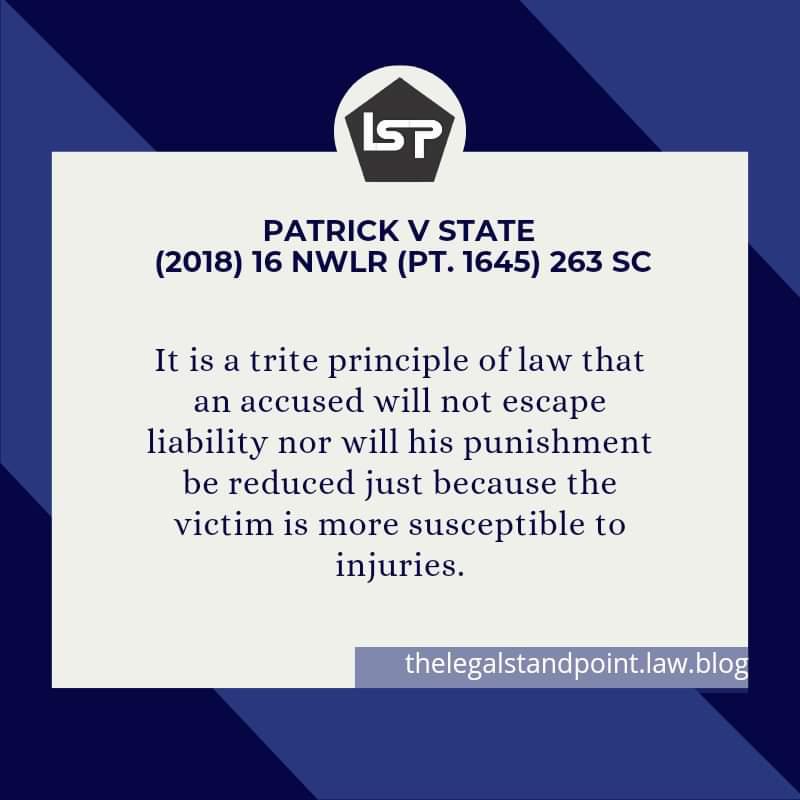
In Patrick v State (2018) 16 NWLR (Pt. 1645) 263 SC, the appellant bought a motorcycle for the deceased(Sule) and it was agreed that he would remit a certain sum of money daily to the appellant and park the motorcycle daily at an agreed place for safety. The deceased adhered to this agreement until 30/7/2008 when the appellant did not see the motorcycle where it should have been, and he went along with the second defendant to find the deceased.
They met up with him between 12.30am and 1am on 1/8/2008, and without waiting to hear what happened to the said motorcycle, they beat up the deceased and left him in the gutter, where he was discovered dead in the morning hours of that same day.
On trial, the appellant testified in his defence that when he came into the scene to allegedly beat Sule, Sule had been so badly and fatally wounded that he could no longer talk and was clearly on the verge of kicking the bucket. In other words, though he was alive, he was as good as dead since he could no longer talk, and even when people spoke to him he could not respond. Hence his beating couldn’t have caused his death.
In rejecting this defence, the Supreme Court held that the defendant is not entitled to make assumptions about the victim. Any characteristics, which the victim happens to have, must be taken into account in the judgment, whether or not, the defendant could reasonably have known about them. In the words of Augie J.S.C, “in this instant case, the appellant’s defence that the deceased was already injured that night could not avail him. The sequence from the beating of the deceased by the appellant to his death immediately afterwards and arrest of the appellant at the scene of the crime indicates that it was the assault by the appellant that caused the death of the deceased.”
In addition, since the matter happened in Lagos State, the court’s decision was further strengthened by the provision of Section 311 of the Criminal Code Law of Lagos State. The said provision has a statutory provision for the eggshell principle which states that a person who does any act which hastens the death of a person who has a disorder or disease arising from another cause is deemed to have killed that other person.
It’s pertinent to note that this principle has been extended to beliefs. Hence in R v Blaue (1975) Cr App R 271, the defendant stabbed a woman who was a Jehovah’s Witness. As a result of her religious belief, she refused a blood transfusion that would have saved her life. This led to her death. The court, based on the doctrine of the thin skull principle, rejected the defendant’s argument that her refusal to accept blood transfusion broke the chain of causation and held him liable for the victim’s death.
In conclusion, the doctrine of thin-skull protects people with pre-existing vulnerabilities so that the accused would not escape liability on the ground of existing weakness.
Stay safe and act gently. Thank you for reading. See you next week
 THELEGALSTANDPOINT