
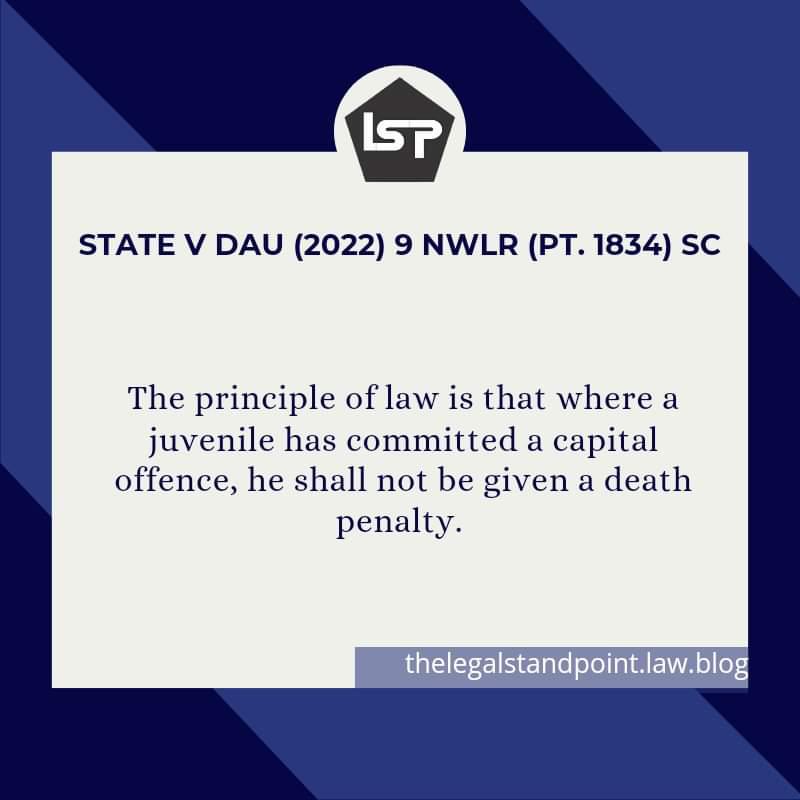
Generally, capital offences are offences punishable by death. It could be committed by both adults and young persons. Where an accused person in a criminal trial is considered an adult, there is no duty on the court to inquire into his age.
However, the duty to make an inquiry into the Age of the accused only arises when he appears to the trial court to be a juvenile. Okoro v State 1998) 4 NWLR (Pt. 544) 115 C.A. For the purpose of criminal responsibility, a juvenile person in this context is someone less than Seventeen (17) years old.
The law, as statutorily provided for in Section 272 (1)of the Criminal Procedure Code, is that where a person is convicted of an offence punishable with death and it appears to the court by which he is convicted that he was under the age of seventeen years when he committed the offence, the court shall order that he be detained during the Governor’s pleasure.
A juvenile detained by virtue of this provision must be placed in legal custody and may be discharged by the Governor on license provided that certain requirements are met. Section 303 of the CPC.
In State v Dau (2022) 9 NWLR (Pt. 1834) SC, the respondent in this appeal had been convicted for culpable homicide punishable with death and sentenced to fifty years imprisonment after conviction by the trial court. The respondent had hit the deceased on the head with the axe belonging to the deceased during a quarrel provoked by the said deceased. The respondent was Fourteen (14) years old at that time. He had also been imprisoned since that time spanning over Sixteen (16) years.
On appeal, the Appeal court quashed the decision of the trial Court and held that it was wrong and illegal for the trial court to have sentenced the respondent to Fifty (50) years imprisonment since he was a minor at the time of commission. To make up for the years he had lost as a result of this injustice, the court ordered that he be discharged and released from custody.
Stating the rationale, the Supreme Court per Ariwoola JSC (now CJN) opined thus: “the draftsmen of section 272(2) of the Criminal Procedure Code and section 12 of the Children and Young Persons Act had a good reason for absolving children and young persons from criminal liability. One of the reasons is that a child lacks the power of self-control and to understand the full import of a criminal act. If a sudden temper can cause an adult to lose control of his mind temporarily, how much more is a child? In the instant case, the respondent committed the offence whilst yet at the Age of criminal irresponsibility provided under section 272(2) of the criminal Procedure Code and section 12 of the Children and Young Persons Act. Therefore, it would amount to grave injustice on the respondent to either pronounce capital punishment on him or incarcerate him for life for an offence which he committed whilst under seventeen years of Age and whilst temporarily deprived of the power of his self-control. (Pp. 82-83, paras. H-C).”
 THELEGALSTANDPOINT