
Law

LSP101: Can Women post bail in Nigeria?

Sometime last year, a friend of mine informed me about her experience at a Police Station where she was refused to serve as a surety for a bail application. In her words, “the Police officers told me women cannot post for bail“. In this week’s article, we would examine the standpoint of law regarding women and bail applications in Nigeria.

In criminal law jurisprudence, bail is the conditional release of the accused with the promise that he or she would appear in court when required. In a bail application, a surety is a person who undertakes to take responsibility for the accused not violating the terms of their bail. The responsibility can include an obligation to pay a sum of money or provide for an individual in the case of the disappearance of such an individual or any other responsibility. 

It is pertinent to state that the principle of law is that both males and females can post bail. That is, a woman, just like a man, has the right to serve as a surety and apply for bail. This principle of law has received statutorily and judicial authority. On statutory authorities, Section 167 of the Administration of Criminal Justice Act (ACJA) 2015 specifically states that “A person shall not be denied, prevented, or restricted from entering into a recognizance or standing as surety for any defendant or applicant on the ground only that the person is a woman.” A similar provision is also found in Section 135 of the Police Act 2020.

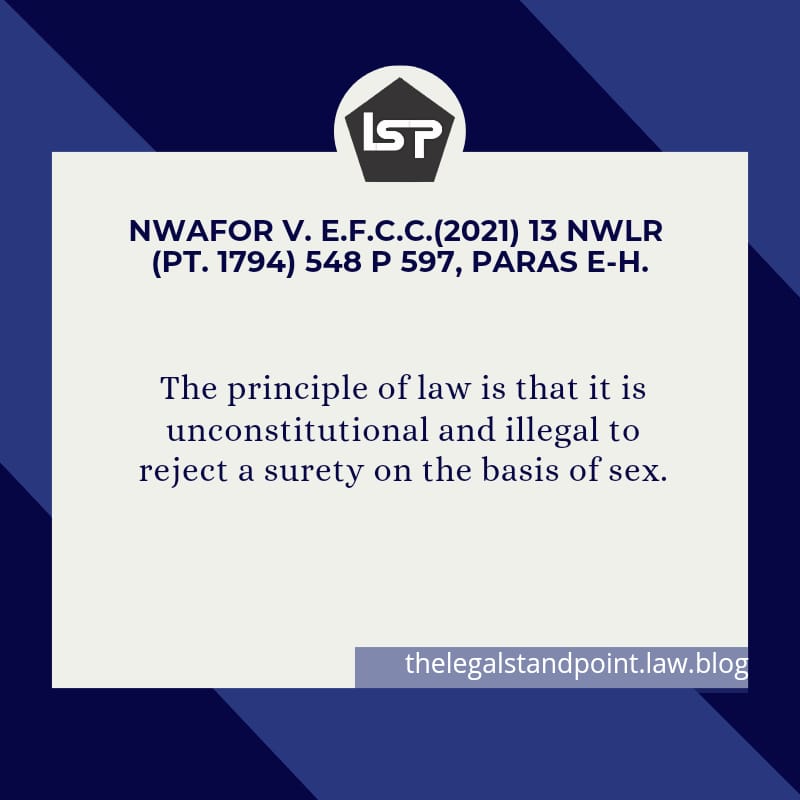
On judicial authority, in Nwafor v. E.F.C.C.(2021) 13 NWLR (Pt. 1794) 548 P 597, paras E-H, the respondent refused to allow the wife of the appellant to serve as one of his two sureties. Commenting on this act, GeorgeWill JCA opined that: There should be no discrimination between the male and female sexes as to the legal capacity to stand and act as surety to a suspect or an accused person granted bail either by the law enforcement agencies or by the court. Thus, any proven act of discrimination by way of rejection of a surety merely on account of her sex, being a female, will be unconstitutional and such rejection must be set aside while any such act of discrimination should be shut down and condemned. This is so because, there is no legal basis for denying a female, on account of her being a female only, from standing or acting as surety to a suspect under detention by any law enforcement agencies or an accused person under trial in Nigeria, and any such practice is illegal and unconstitutional. It has no place in our laws.

Moving on, what could have made the Police say such a thing to my friend? One of the reasons flows from the cultural belief that women are incapable of owning personal properties, which is often a condition for guaranteeing bail and as such, they are barred from applying for bail. 

At this juncture,it is noteworthy that whether it is bail or any other human endeavour, such a belief has been jettisoned by several legal activism which have found provisions in several authorities such the Constitution, international conventions, judicial authorities, etc. The settled principle of law as laid down in Section 42 of the Constitution of the Federal Republic of Nigeria is that no citizen of Nigeria shall be discriminated against on the basis of sex. This is the overarching generic provision that supports the specific provisions found in the ACJA and the Police Act.

In conclusion, the trite principle of law is that women can post bail in Nigeria and any practice that states otherwise is unconstitutional and illegal.

Law

LSP100: Time Frame for Criminal Appeals

Good afternoon, readers. We are back from the hiatus. How are you doing? Miss me? I also do. Now I am back and let’s go. Today’s article centers on the time limit for an appeal of a criminal case decided by the Court of Appeal.

The chain and hierarchy of courts and appeals in Nigeria are constitutional and jurisdictional. The Supreme Court does not have the power and jurisdiction to entertain an appeal or issue directly from a trial court. An appeal to the Supreme Court must spring from the Court of Appeal.

Having laid the background, the question then becomes what is the time limit required for the appeal of a criminal case from the Court of Appeal to the Supreme Court and what is the effect when such a period is not complied with?

The Supreme Court Act, Cap. S15, Laws of the Federation of Nigeria, 2004 regulates the filing of appeals from the Court of Appeal to the Supreme Court. By Section 27(2)(b) of the Act, the period prescribed for the giving of notice of appeal is thirty (30) days from the date of the decision appealed against. 

However, Section 27(4) of the Act grants a window for enlargement or extension of time within which an appellant who failed to file within the statutory period may file his appeal out of time, albeit, subject to the discretion of the Supreme Court. Failure to comply with the statutory requirements, which are conditions precedent to filing a competent appeal, is fatal to the appeal, such that the Supreme Court cannot entertain the appeal no matter how well argued.

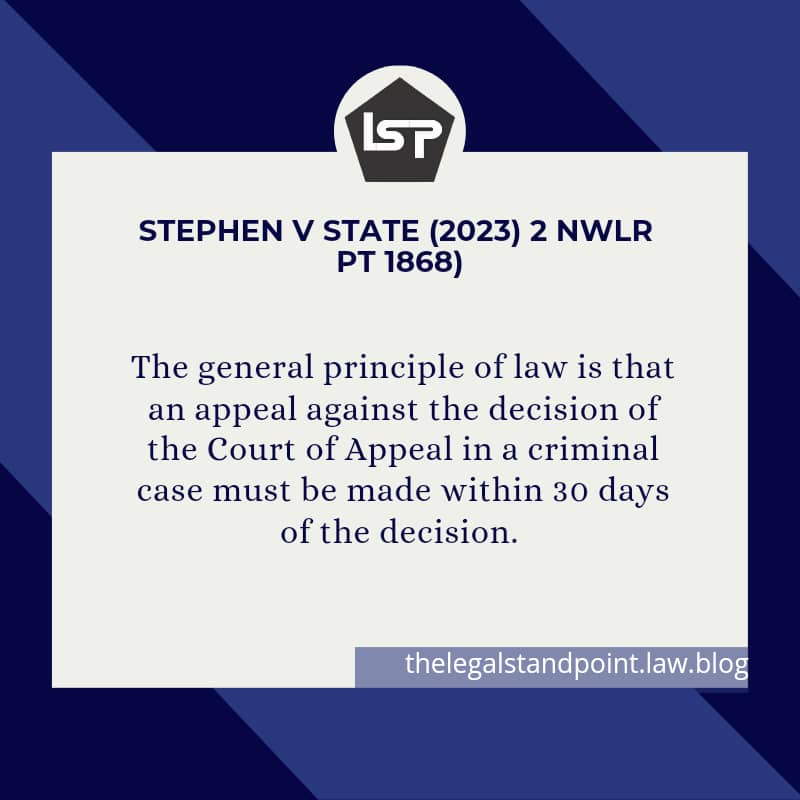
In Stephen v State (2023) 2 NWLR (Pt 1868), the appellant and another accused person were at the High Court of Bayelsa State charged with the offences of conspiracy and armed robbery. Upon arraignment, they pleaded not guilty to each of the counts. At the close of the trial, the trial court found them guilty of the offences of conspiracy to commit robbery and robbery and sentenced them to twenty-one years imprisonment

Dissatisfied with the judgment of the trial court, the appellant appealed to the Court of Appeal which affirmed the judgment of the trial court and dismissed the appeal. The judgment of the Court of Appeal was delivered on 7-12-2018. Still dissatisfied, the appellant appealed to the Supreme Court by a notice of appeal filed on 21-1-2019, fifty-three days from the date of the judgment of the Court of Appeal

In this instant case, the judgment of the Court of Appeal was delivered on 7-12-2018. The notice of appeal was filed on 21-1-2019. Thus, the notice of appeal was filed after fifty-three (53) days from the date of the judgment of the Court of Appeal. It was not filed within the prescribed thirty days. 

Explaining the consequence of such an act, the Court per Agim JSC held that: An appeal cannot be sustained on an incompetent notice of appeal. The court will be robbed of jurisdiction to entertain and determine it by the absence of a competent notice of appeal. In such a situation, the notice of the appeal and the appeal are liable to be struck out. See also Ibrahim v. State (2021) 11 NWLR (Pt. 1786) 152

In conclusion, the principle of law is that an appeal against a criminal case must be made within 30 days of the decision to the Supreme Court or it could be extended subject to the discretion of the Court. In an instance where there is no extension and the process was filled outside the statutory period, such a process would be considered deflective, rob the court of its jurisdiction, and consequently struck out.

Thank you for reading.

Can you please nominate the blog for the second category?

https://docs.google.com/forms/d/e/1FAIpQLSclqOYgr-oWFvkN2OuMKFtJvuzm_dVZuJPFTxWREnu0Mv1nFQ/already responses 

Step 1: Click on the link. Page 1 (put your email)

Step 2: when you get to page 2, scroll down and click next. 

Step 3: When you get to the Selfless Contribution to a worthy cause category (PAGE 3), fill in my details.

Click next till you get to the last page and submit.

Name: The Legal StandPoint

Alias: LSP

Department and level: Law 400 level

The reason: write something true based on what LSP does.

Thank you.