
Sometime last year, a friend of mine informed me about her experience at a Police Station where she was refused to serve as a surety for a bail application. In her words, “the Police officers told me women cannot post for bail“. In this week’s article, we would examine the standpoint of law regarding women and bail applications in Nigeria.
In criminal law jurisprudence, bail is the conditional release of the accused with the promise that he or she would appear in court when required. In a bail application, a surety is a person who undertakes to take responsibility for the accused not violating the terms of their bail. The responsibility can include an obligation to pay a sum of money or provide for an individual in the case of the disappearance of such an individual or any other responsibility.
It is pertinent to state that the principle of law is that both males and females can post bail. That is, a woman, just like a man, has the right to serve as a surety and apply for bail. This principle of law has received statutorily and judicial authority. On statutory authorities, Section 167 of the Administration of Criminal Justice Act (ACJA) 2015 specifically states that “A person shall not be denied, prevented, or restricted from entering into a recognizance or standing as surety for any defendant or applicant on the ground only that the person is a woman.” A similar provision is also found in Section 135 of the Police Act 2020.
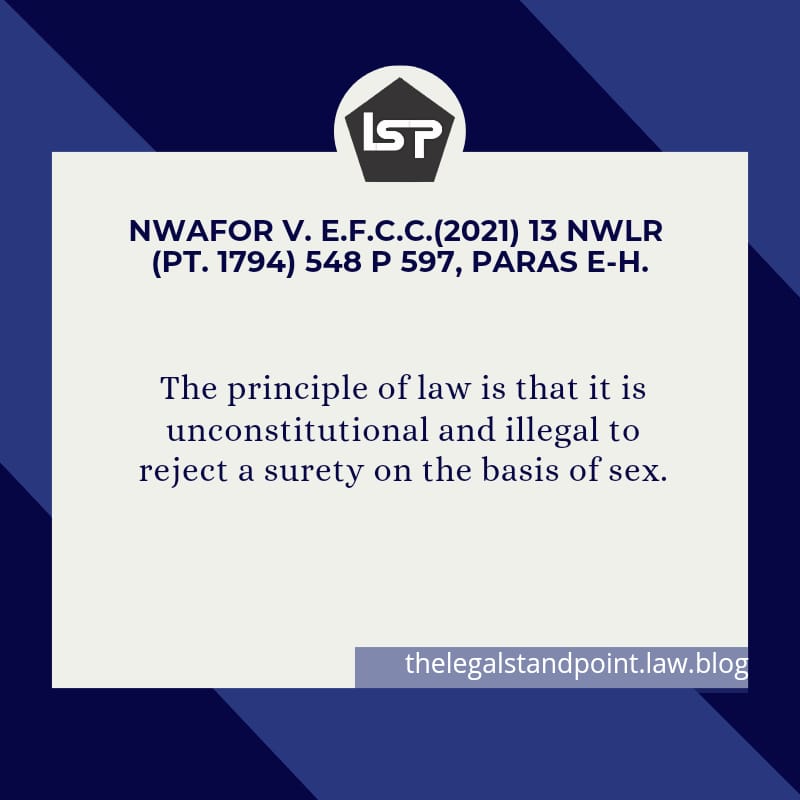
On judicial authority, in Nwafor v. E.F.C.C.(2021) 13 NWLR (Pt. 1794) 548 P 597, paras E-H, the respondent refused to allow the wife of the appellant to serve as one of his two sureties. Commenting on this act, GeorgeWill JCA opined that: There should be no discrimination between the male and female sexes as to the legal capacity to stand and act as surety to a suspect or an accused person granted bail either by the law enforcement agencies or by the court. Thus, any proven act of discrimination by way of rejection of a surety merely on account of her sex, being a female, will be unconstitutional and such rejection must be set aside while any such act of discrimination should be shut down and condemned. This is so because, there is no legal basis for denying a female, on account of her being a female only, from standing or acting as surety to a suspect under detention by any law enforcement agencies or an accused person under trial in Nigeria, and any such practice is illegal and unconstitutional. It has no place in our laws.“
Moving on, what could have made the Police say such a thing to my friend? One of the reasons flows from the cultural belief that women are incapable of owning personal properties, which is often a condition for guaranteeing bail and as such, they are barred from applying for bail.
At this juncture,it is noteworthy that whether it is bail or any other human endeavour, such a belief has been jettisoned by several legal activism which have found provisions in several authorities such the Constitution, international conventions, judicial authorities, etc. The settled principle of law as laid down in Section 42 of the Constitution of the Federal Republic of Nigeria is that no citizen of Nigeria shall be discriminated against on the basis of sex. This is the overarching generic provision that supports the specific provisions found in the ACJA and the Police Act.
In conclusion, the trite principle of law is that women can post bail in Nigeria and any practice that states otherwise is unconstitutional and illegal.

 THELEGALSTANDPOINT
Thank you very much for this information.✍️
LikeLike
You’re welcome.
LikeLike
This is beautiful and highly educative again! Keep the fire burning.
LikeLike