
Trespass is an unlawful interference with possession over land. Trespass to land is actionable in a suit filed by the person who is in possession of the land. Apena v. Aileru (2014) 14 NWLR (Pt. 1426) 111
Possession is the physical control a person exercises in relation to land. In law, possession can either be lawful or unlawful. It is lawful where it is exercised as a right of ownership of land or exercised by virtue of a grant from the owner of the land. The right of possession is unlawful where it is exercised neither by virtue of ownership nor by a grant of any description. Moving on, unlawful possession is also known as adverse possession and the two prominent examples are trespassers and Squatters.
The question of law then becomes can a trespasser maintain an action in trespass against another trespasser? A rough example is illustrative here. Amadi saw a piece of land belonging to Ola, moved into it and started using it as his mechanic workshop without permission from Ola. Now, Ebira has trespassed into the land. Even though Amadi is himself a trespasser, in the eyes of the law, he has a right to maintain an action of trespass against Ebira. The rationale behind this is that possession is the bedrock of a claim of trespass and not ownership. As such, a trespasser can maintain an action against other trespassers except the true owner even if the person in possession is neither the owner nor a privy of the owner.
This principle of law has received judicial blessings in a cornucopia of court decisions. In Dogo v. Adamu (1998) 3 NWLR (Pt. 540) 159, the Court held that: “an original Trespasser who is in exclusive possession of land can maintain an action in trespass against a later Trespasser whose possession whether taken by force or not would be clearly adverse to that of the original Trespasser. In effect, a plaintiff in possession would be able to maintain an action in trespass against the whole world except the true owner.”
Also in Iseru v. Catholic Bishop, Warri Diocese(1997) 3 NWLR (Pt.495) 517, the Court held that “in a claim for trespass to land, once the plaintiff is shown to be in possession, the defendant, in order to defeat the plaintiff’s claim must show a better title to the land. This is so since a trespasser or Squatter can maintain an action in trespass against the whole world except the true owner or the one with a better title.” See also Amakor v. Obiefuna (1974) 1 All NLR 119.
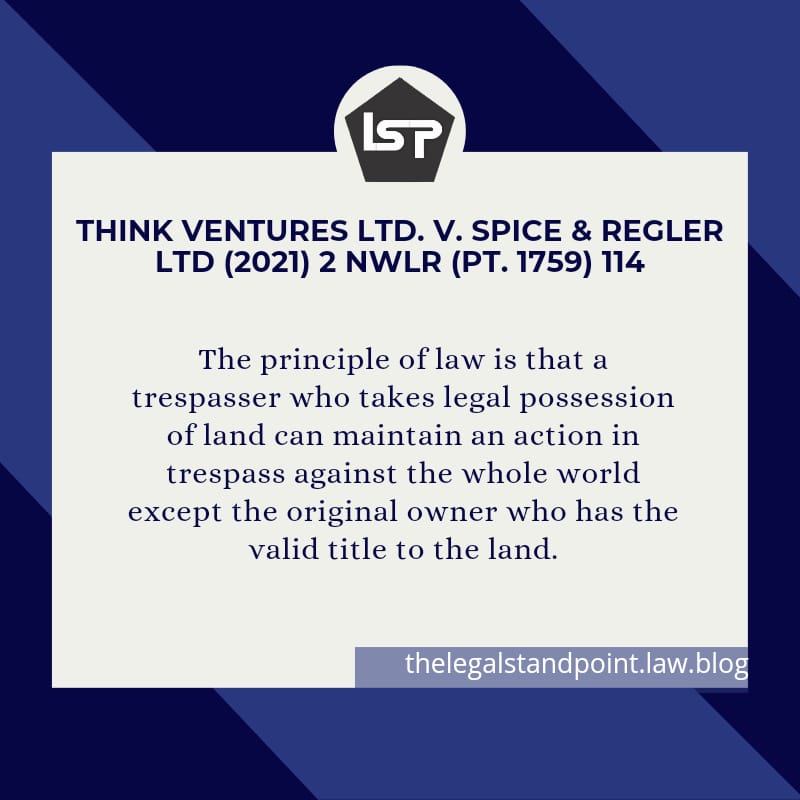
Aside from this aforementioned common instance of trespassing, a trespass could also arise when a document evincing ownership does not emanate from a proper authority. In Think Ventures Ltd. v. Spice & Regler Ltd (2021) 2 NWLR (Pt. 1759) 114, the respondent’s title documents did not emanate from the proper authority, so they did not confer any valid title on the respondents. But because of their evidence of possession, having constructed a fence and gate that were demolished by the appellants, and in view of the fact that the appellants did not have any better title to the land, the respondents, who though were also trespassers in law, were legally grounded to be protected.
In conclusion, the law is that an original trespasser, as against everyone but the true owner, can, if he is in exclusive possession of the land in dispute, maintain an action in trespass against a subsequent trespasser. For, in such a situation, the subsequent trespasser’s possession would clearly be adverse to that of the original trespasser.
Thank you for reading. See you next week

 THELEGALSTANDPOINT
This is interesting.🤩
LikeLike