
Termination of employment is the cessation of the contractual relationship between an employer and an employee. Generally, either the employee or employer is expected to give notice of termination. The employer can’t just wake up and terminate the employment. This is not a typical Nigerian relationship breakfast story. Employers shouldn’t move like this.
The law is that the length of notice required for termination of employment depends on the intention of the parties as can or may be gathered from their contract; and, in the absence of any express provision, the court will always imply a term that the employment may be terminated upon reasonable notice. What is reasonable notice varies with facts of each case as held in Nwaubani v. Golden Guinea Breweries Plc (1995) 6 NWLR (Pt. 400) 184 CA. As such, in Iloabachie v. Philips (2002) 14 NWLR (Pt. 787) 264, the court held that three months’ notice given to the appellant was reasonable.
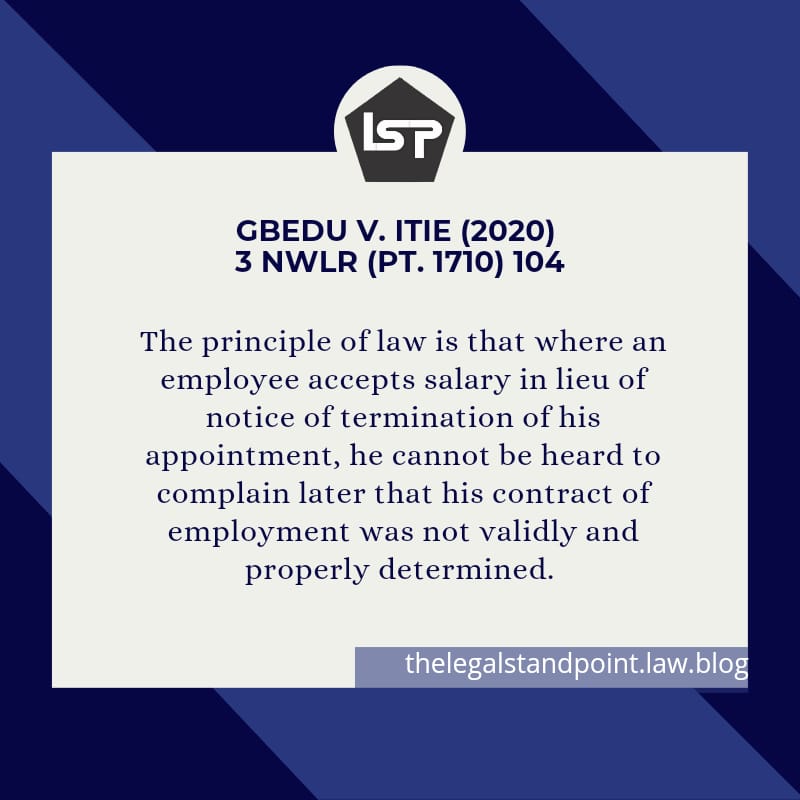
Moving on, what then is the effect where an employee accepts salary in lieu of (instead of) notice of termination of his appointment? The principle of law is that where an employee accepts salary in lieu of notice of termination of his appointment, he cannot be heard to complain later that his contract of employment was not validly and properly determined. Gbedu v. Itie (2020) 3 NWLR (Pt. 1710) 104
Hence, in Iloabachie v. Philips (supra), three months’ salary in lieu of notice plus the appellant’s retirement benefits was paid into the appellant’s bank account. There is also evidence that the appellant has been drawing his monthly pension without any protest other than the filing of his suit within two months of the Termination of his employment. In the circumstance, the Court of Appeal held that the trial court was right when it held that the appellant had acquiesced in the termination of his employment and cannot thereafter be heard to challenge the termination of his employment because the collection of his entitlement has laid to rest any contract between the parties.
However, it is pertinent to state that the party seeking to put an end to the contract must pay to the other party the salary in lieu of notice at the time of Termination of the contract. It is not enough that in the letter of termination, he or she offers to pay salary in lieu of notice. As an offer to pay speaks infuturo, so payment must be immediate. As such, where such salary is not offered contemporaneously with the letter of termination, the remedy of the aggrieved employee is in damages and the measure of damages is what he would be entitled to in the amount of money in lieu of notice.
Thus in Chukwumah v. Shell Petroleum (1993) 4 NWLR (Pt. 289) 512 at 536 ,the appellant’s appointment was terminated without notice on 18th August, 1981. That was the date salary in lieu of the notice ought to have been paid either directly to him or through his designated bank, and for which he must be informed promptly. Therefore the payment into the appellant’s bank of his salary on 25th November, 1981 was not in compliance with the contract of service and was thus void.
Thank you for reading. See you next week.
 THELEGALSTANDPOINT