

Law

LSP118: Duty to report cases


Generally, it is the duty of citizens to report cases of commission of crime to the Police for their investigation and what happens after such a report is entirely the responsibility of the Police.

The principle of law is that where a citizen reports a matter to the Police and leaves it to them to investigate and conclude, and such conclusion results in the arrest of a party, an action against such a complainant will not lie. This principle has received judicial blessings in the following cases: [Isheno v. Julius Berger (Nig) Plc. (2008) 6 NWLR (Pt. 1084) 582; Arab Contractors (O.A.O.) Nigeria Ltd. v. Umanah (2013) 4 NWLR (Pt. 1344) 323


So in Udo v Essien (2005) 5 NWLR (Pt. 1451) 83, a 6-week temporary embargo was placed on oil palm fruits grown in the village as a means of generating funds for the development project in the village. In that case, the respondents breached the embargo placed on the whole village. They even threatened the 1st appellant. The court held that the 1st appellant was within his constitutional right to report all these to the Police. It is this report that culminated in the respondents being arrested and detained.

However, there is an exception. A citizen will be held culpable in this civic duty if it is shown that it is done mala fide(in bad faith). Nigeria’s celebrated case that exemplified this exception is the case of Balogun v. Amubikahan (1989) 3 NWLR (Pt. 107) under the tort of Malicious Prosecution.

The tort of malicious prosecution is committed where the defendant maliciously and without probable cause, initiates against the plaintiff a criminal prosecution which terminates in the plaintiff’s favor and which results in damage to the plaintiff’s reputation. In this instance, the defamed person would now institute a civil matter against the person who made the report in bad faith.

So in that case, The defendant/appellant(Balogun), a legal practitioner, had a case which was at all material times pending in court against the respondent, who was a meat seller in Ibadan. All feelings appeared to be high and the respondent stated that the appellant had promised to deal severely with him. According to the respondent, on the 6th March 1979, the appellant lodged a report at the Challenge Police Station, Ibadan against him. The allegation was that the respondent conspired with one Madam Olufunmilayo Adekunle to kill him (the appellant) with juju and steal his properties.


The woman and the respondent were arrested on the active instigation of the appellant. The appellant tried to stop people from standing surety for the respondent when the latter was being detained at the Police station. The respondent and Madam Adekunle were prosecuted before the Magistrate but were both discharged and acquitted. At their joint trial, Madam Adekunle had confessed that she was tutored into the act of implicating the respondent by the appellant and that she was paid N300.00 by the appellant for that purpose.


Following the acquittal of the respondent, he commenced an action in the High Court against the appellant claiming damages for malicious prosecution. The action was successful and was upheld by the Court of Appeal consequent upon which this appeal was lodged to the Supreme Court.


From this case, it was apparent that the appellant, who surprisingly was a legal practitioner, in a bid to get the land in dispute for himself made a false criminal statement against the respondent. The Court held that: it is true the police arrested the respondent and locked him up like any other criminal in their cell and was released on bail the second day. It is also evident that the police charged the respondent before a Magistrate Court. But the real force behind the whole matter is the appellant. He knew very well that the whole criminal complaint was a fabrication and that the arrest, remand in police custody and subsequent trial of the respondent was an unmitigated abuse of the judicial process. He was the one that technically set the whole prosecution in motion.

In conclusion, while it is the civil duty of the citizens to aid the law enforcement agencies in crime prevention through reports of crime, the law places another burden on them not to make a report in bad faith as this would attract monetary damages.

Law

LSP117: Criminal Investigation and Right of Personal Liberty

The police have the primary duty to prevent the commission of crime and the apprehension of alleged criminals. Emonena & Anor. v. IGP & Ors. (2016) LPELR-41489. The duties and powers of the Police are not in doubt. The issue that often raises questions is the manner in which the duties are performed or the powers exercised.

This duty is statutorily provided in Sections 4 and 24 of the Police Act. By virtue of section 4 of the Police Act, the Police Shall be employed for the prevention and detection of crime, the apprehension of offenders, the preservation of law and order, the protection of life and property, and the due enforcement of all laws and regulations with which they are directly charged. Thus, the general powers invested in the Police to effect the arrest of suspected offenders and to detain them is statutory. [Fawehinmi v. I.G.P. (2000) 7 NWLR (Pt. 665) 481

In discharge of this primary duty, what happens if they violate the personal liberty of an individual? Should it be actionable bearing in mind that personal liberty is a fundamental human rights entrenched in section 35 of the Constitution? By virtue of section 35(1) of the 1999 Constitution(as amended), every person is entitled to his personal liberty and no person shall be deprived of such liberty save for the purpose of bringing him before a court in execution of the order of a court or upon reasonable suspicion of his having committed a criminal offence, or to such extent as may be reasonably necessary to prevent his committing a criminal offence.

In answering this question, attention is given to the case of Mitin v. Commissioner of Police Bayelsa State & Ors [2023] 12 NWLR 259. The case reinforces the known principle of law that some rights in the Constitution are not absolute and in deserving circumstances, they could be violated.

The fact of the case goes thus: In June 2015, the ‘A’ Division of Nigeria Police in Bayelsa State received reports of criminal incidents involving a black Toyota Camry car. The first incident was a robbery, followed by reports of criminal activities associated with the same car. Additionally, a petition claimed that unknown individuals were threatening the lives of specific respondents. The police received a call about the suspicious movement of the same car, which led them to the appellant’s residence. The Police acted on the information disclosed to them, which led to the arrest of the appellant, who incidentally had a black Camry car. They arrested and searched him but found nothing incriminating. After realizing he wasn’t the suspect they were looking for, he was released on bail, and his vehicle was returned later. Feeling aggrieved, the appellant filed a lawsuit against the respondents, alleging illegal arrest, torture, and detention, as well as violations of his constitutional rights. He sought declarations of rights violations, damages, compensation, and a public apology.

In this case, having regard to the series of reports received by the 1st and 2nd respondents and the peculiarity of the involvement of a black Toyota Camry car in suspected nefarious activities in and around Yenagoa, the court held that the 1st and 2nd respondents were doing no more than their duty to investigate the complaints. Therefore, the appellant’s arrest fell within the exception provided in section 35(1)(c) of the Constitution.

Furthermore, the court per Per OKORO, J.S.C. opined that: In this case, the appellant was arrested following repeated complaints received by the Police about criminal activities involving occupants of a certain black Toyota Camry carat several locations within Yenagoa. The Police swung into action and arrested the appellant on Bay Bridge Road, Yenagoa in a black Toyota Camry car which fits the description of the car in the several reports. Upon being satisfied that the appellant was not the suspect they were looking for, he was released on bail the same day. I therefore do not see how the action of the Police in the circumstance amounts to a breach of the appellant’s fundamental right.

In conclusion, the Police cannot be said to violate the fundamental right of a citizen where such right is necessarily curtailed to investigate criminal complaints upon reasonable belief that the citizen has committed a criminal offence or is likely to commit a criminal offence.

Thank you for reading. See you next week

Law

LSP116: Marriage in Iddah Period


Under Islamic law, iddah means “waiting period,” and it is the term of probation incumbent upon a woman as a consequence of a dissolution of marriage, either by divorce or the death of her husband. It is a well-established principle in Islamic law that after either party has obtained a judicial divorce, it becomes mandatory for the wife to observe a waiting period of three months (also known as the period of Iddah) before the final severance of the marital tie between the parties. This requirement is provided for by Almighty Allah in the Holy Quran, Chapter 65, verse 1. See Setto v. Motsibbe (2002) 6 NWLR (Pt. 762) 121.

The waiting period is three months in the case of divorce and four months and ten days in the case of the death of the husband. If the divorced woman was pregnant at the time of the divorce, her iddah ends with the birth of the child, not three months after the termination of the marriage, as established in Mayaki v. Nda (1992) LPELR-14659(CA).

It is noteworthy that during this period, the marriage is considered to be dormant but not terminated, as there is room for reconciliation between the parties. The concept of the Iddah as a post-divorce reconciliatory measure is clearly stated by Almighty Allah in the Holy Quran, Chapter 2, verse 288: “Their husbands are best entitled to take them back as their wives during this waiting period if they desire reconciliation.”

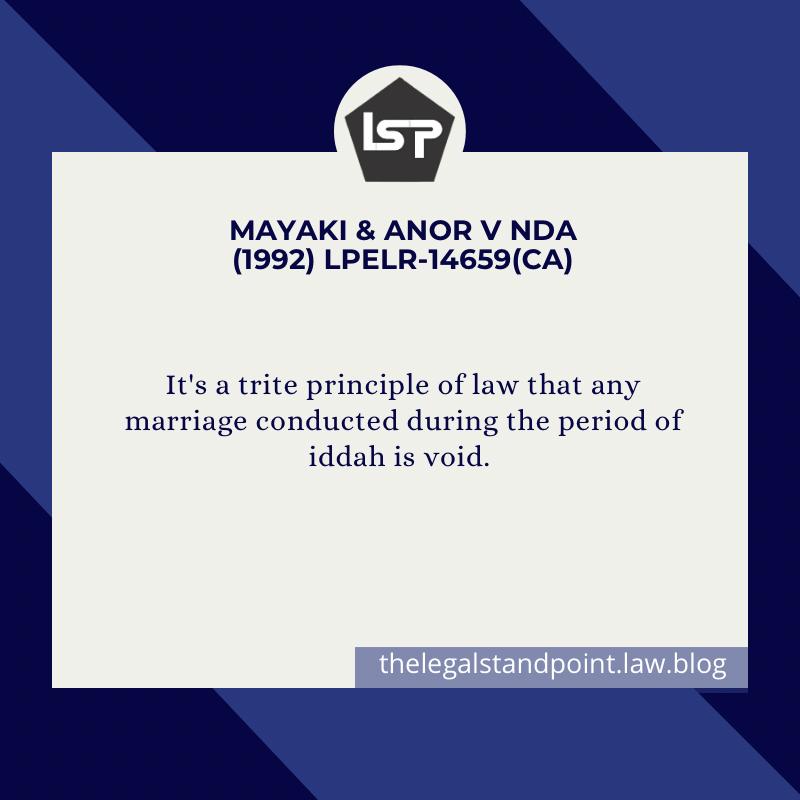
Regarding the effect of marriage on a woman observing Iddah, the Holy Quran prohibits a woman in her Iddah from remarrying during that period. As mentioned earlier, this is because, during the Iddah, the marriage is understood to be dormant but not ended, as there is room for reconciliation between the husband and wife. Since Islam forbids polyandry, a man is forbidden to marry a woman who is observing Iddah, for the law still considers her as married. Any marriage contracted within the Iddah period is therefore null and void.

In the case of Mayaki & Anor v Nda (1992) LPELR-14659(CA), the marriage between the first appellant, Aishetu Mayaki, and the respondent, Alhaji Nda, was dissolved on 28/2/1984. Subsequently, the marriage between the first appellant and the second appellant (Muhammed Ndagi) was solemnized on 3/5/1984, with a span of 64 days in between.

According to Islamic law, the Iddah period for the first respondent should be three months from 28/2/84. Consequently, the Court held that the marriage between the first and second appellants, occurring within the Iddah period of the first appellant, was void under Islamic law. This is because it was contracted during her Iddah period, rendering the marriage null and of no effect.

In conclusion, the settled principle of law, flowing from the Islamic tenet, is that every marriage contracted during the waiting period is null and void.

Thank you for reading. See you next week.