
Under Islamic law, iddah means “waiting period,” and it is the term of probation incumbent upon a woman as a consequence of a dissolution of marriage, either by divorce or the death of her husband. It is a well-established principle in Islamic law that after either party has obtained a judicial divorce, it becomes mandatory for the wife to observe a waiting period of three months (also known as the period of Iddah) before the final severance of the marital tie between the parties. This requirement is provided for by Almighty Allah in the Holy Quran, Chapter 65, verse 1. See Setto v. Motsibbe (2002) 6 NWLR (Pt. 762) 121.
The waiting period is three months in the case of divorce and four months and ten days in the case of the death of the husband. If the divorced woman was pregnant at the time of the divorce, her iddah ends with the birth of the child, not three months after the termination of the marriage, as established in Mayaki v. Nda (1992) LPELR-14659(CA).
It is noteworthy that during this period, the marriage is considered to be dormant but not terminated, as there is room for reconciliation between the parties. The concept of the Iddah as a post-divorce reconciliatory measure is clearly stated by Almighty Allah in the Holy Quran, Chapter 2, verse 288: “Their husbands are best entitled to take them back as their wives during this waiting period if they desire reconciliation.”
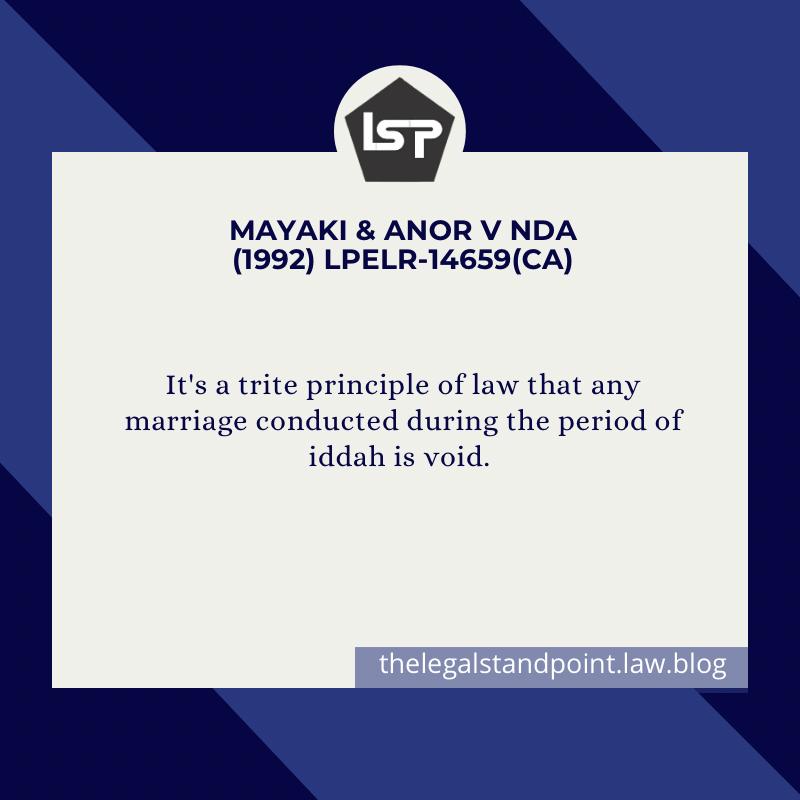
Regarding the effect of marriage on a woman observing Iddah, the Holy Quran prohibits a woman in her Iddah from remarrying during that period. As mentioned earlier, this is because, during the Iddah, the marriage is understood to be dormant but not ended, as there is room for reconciliation between the husband and wife. Since Islam forbids polyandry, a man is forbidden to marry a woman who is observing Iddah, for the law still considers her as married. Any marriage contracted within the Iddah period is therefore null and void.
In the case of Mayaki & Anor v Nda (1992) LPELR-14659(CA), the marriage between the first appellant, Aishetu Mayaki, and the respondent, Alhaji Nda, was dissolved on 28/2/1984. Subsequently, the marriage between the first appellant and the second appellant (Muhammed Ndagi) was solemnized on 3/5/1984, with a span of 64 days in between.
According to Islamic law, the Iddah period for the first respondent should be three months from 28/2/84. Consequently, the Court held that the marriage between the first and second appellants, occurring within the Iddah period of the first appellant, was void under Islamic law. This is because it was contracted during her Iddah period, rendering the marriage null and of no effect.
In conclusion, the settled principle of law, flowing from the Islamic tenet, is that every marriage contracted during the waiting period is null and void.
Thank you for reading. See you next week.

 THELEGALSTANDPOINT
What if the marriage has already been consummated by the couples? What’s the position of the law in such situation?
LikeLike
Consummation doesn’t stop a judicial divorce. So once the decree for divorce has been made, the wife still has to observe the waiting period.
LikeLike
Wow! Thank you, LSP.
LikeLike