
The police have the primary duty to prevent the commission of crime and the apprehension of alleged criminals. Emonena & Anor. v. IGP & Ors. (2016) LPELR-41489. The duties and powers of the Police are not in doubt. The issue that often raises questions is the manner in which the duties are performed or the powers exercised.
This duty is statutorily provided in Sections 4 and 24 of the Police Act. By virtue of section 4 of the Police Act, the Police Shall be employed for the prevention and detection of crime, the apprehension of offenders, the preservation of law and order, the protection of life and property, and the due enforcement of all laws and regulations with which they are directly charged. Thus, the general powers invested in the Police to effect the arrest of suspected offenders and to detain them is statutory. [Fawehinmi v. I.G.P. (2000) 7 NWLR (Pt. 665) 481
In discharge of this primary duty, what happens if they violate the personal liberty of an individual? Should it be actionable bearing in mind that personal liberty is a fundamental human rights entrenched in section 35 of the Constitution? By virtue of section 35(1) of the 1999 Constitution(as amended), every person is entitled to his personal liberty and no person shall be deprived of such liberty save for the purpose of bringing him before a court in execution of the order of a court or upon reasonable suspicion of his having committed a criminal offence, or to such extent as may be reasonably necessary to prevent his committing a criminal offence.
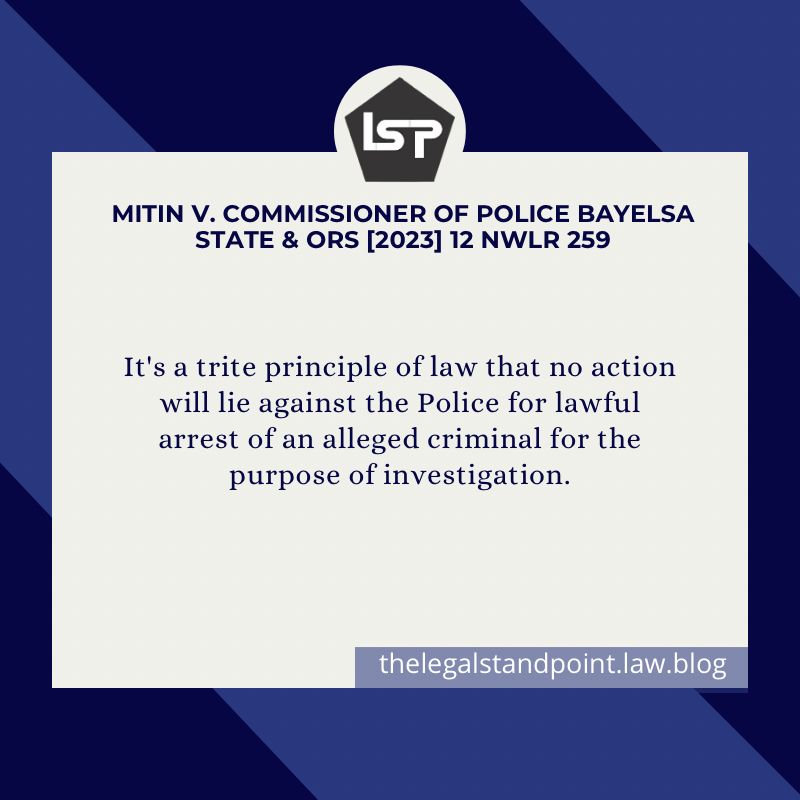
In answering this question, attention is given to the case of Mitin v. Commissioner of Police Bayelsa State & Ors [2023] 12 NWLR 259. The case reinforces the known principle of law that some rights in the Constitution are not absolute and in deserving circumstances, they could be violated.
The fact of the case goes thus: In June 2015, the ‘A’ Division of Nigeria Police in Bayelsa State received reports of criminal incidents involving a black Toyota Camry car. The first incident was a robbery, followed by reports of criminal activities associated with the same car. Additionally, a petition claimed that unknown individuals were threatening the lives of specific respondents. The police received a call about the suspicious movement of the same car, which led them to the appellant’s residence. The Police acted on the information disclosed to them, which led to the arrest of the appellant, who incidentally had a black Camry car. They arrested and searched him but found nothing incriminating. After realizing he wasn’t the suspect they were looking for, he was released on bail, and his vehicle was returned later. Feeling aggrieved, the appellant filed a lawsuit against the respondents, alleging illegal arrest, torture, and detention, as well as violations of his constitutional rights. He sought declarations of rights violations, damages, compensation, and a public apology.
In this case, having regard to the series of reports received by the 1st and 2nd respondents and the peculiarity of the involvement of a black Toyota Camry car in suspected nefarious activities in and around Yenagoa, the court held that the 1st and 2nd respondents were doing no more than their duty to investigate the complaints. Therefore, the appellant’s arrest fell within the exception provided in section 35(1)(c) of the Constitution.
Furthermore, the court per Per OKORO, J.S.C. opined that: In this case, the appellant was arrested following repeated complaints received by the Police about criminal activities involving occupants of a certain black Toyota Camry carat several locations within Yenagoa. The Police swung into action and arrested the appellant on Bay Bridge Road, Yenagoa in a black Toyota Camry car which fits the description of the car in the several reports. Upon being satisfied that the appellant was not the suspect they were looking for, he was released on bail the same day. I therefore do not see how the action of the Police in the circumstance amounts to a breach of the appellant’s fundamental right.
In conclusion, the Police cannot be said to violate the fundamental right of a citizen where such right is necessarily curtailed to investigate criminal complaints upon reasonable belief that the citizen has committed a criminal offence or is likely to commit a criminal offence.
Thank you for reading. See you next week

 THELEGALSTANDPOINT
Pristine!
LikeLike
This is clear-cut explanation. What if in the process of the police investigation, the appellant is tortured and manhandled, can the appellant sue the police?
LikeLike
Yes, he can. But the onus is on him to adduce congent evidence to back up his allegations. In this case, the appellant alleged torture but couldn’t give a clear evidence of it.
LikeLike
Interesting! Thank you, LSP.
LikeLike
Completely concise and adequately included recently reported relevant decided case. Keep it up
LikeLike