
Generally, it is the duty of citizens to report cases of commission of crime to the Police for their investigation and what happens after such a report is entirely the responsibility of the Police.
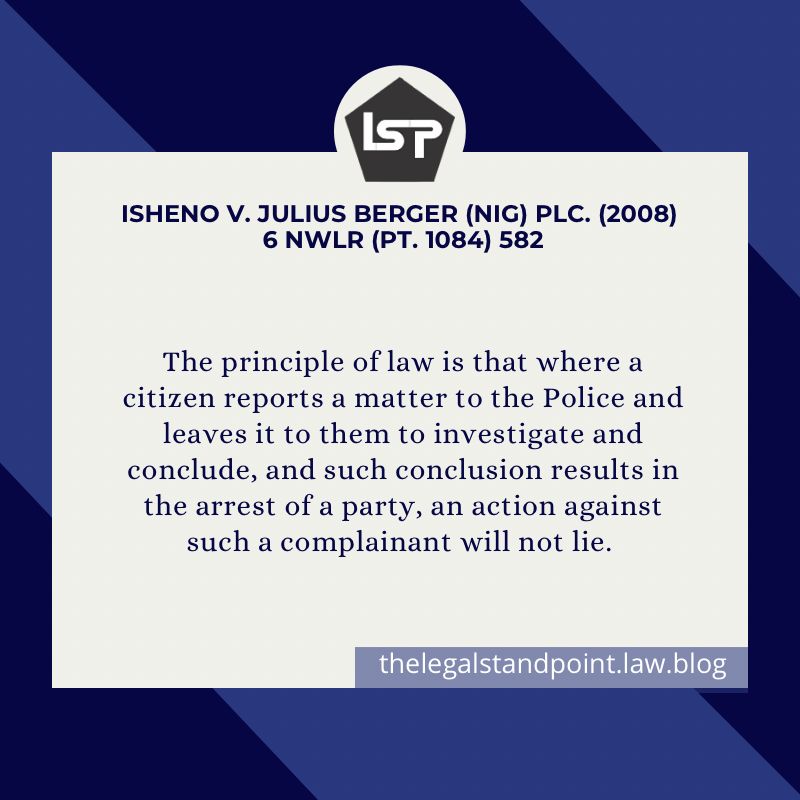
The principle of law is that where a citizen reports a matter to the Police and leaves it to them to investigate and conclude, and such conclusion results in the arrest of a party, an action against such a complainant will not lie. This principle has received judicial blessings in the following cases: [Isheno v. Julius Berger (Nig) Plc. (2008) 6 NWLR (Pt. 1084) 582; Arab Contractors (O.A.O.) Nigeria Ltd. v. Umanah (2013) 4 NWLR (Pt. 1344) 323
So in Udo v Essien (2005) 5 NWLR (Pt. 1451) 83, a 6-week temporary embargo was placed on oil palm fruits grown in the village as a means of generating funds for the development project in the village. In that case, the respondents breached the embargo placed on the whole village. They even threatened the 1st appellant. The court held that the 1st appellant was within his constitutional right to report all these to the Police. It is this report that culminated in the respondents being arrested and detained.
However, there is an exception. A citizen will be held culpable in this civic duty if it is shown that it is done mala fide(in bad faith). Nigeria’s celebrated case that exemplified this exception is the case of Balogun v. Amubikahan (1989) 3 NWLR (Pt. 107) under the tort of Malicious Prosecution.
The tort of malicious prosecution is committed where the defendant maliciously and without probable cause, initiates against the plaintiff a criminal prosecution which terminates in the plaintiff’s favor and which results in damage to the plaintiff’s reputation. In this instance, the defamed person would now institute a civil matter against the person who made the report in bad faith.
So in that case, The defendant/appellant(Balogun), a legal practitioner, had a case which was at all material times pending in court against the respondent, who was a meat seller in Ibadan. All feelings appeared to be high and the respondent stated that the appellant had promised to deal severely with him. According to the respondent, on the 6th March 1979, the appellant lodged a report at the Challenge Police Station, Ibadan against him. The allegation was that the respondent conspired with one Madam Olufunmilayo Adekunle to kill him (the appellant) with juju and steal his properties.
The woman and the respondent were arrested on the active instigation of the appellant. The appellant tried to stop people from standing surety for the respondent when the latter was being detained at the Police station. The respondent and Madam Adekunle were prosecuted before the Magistrate but were both discharged and acquitted. At their joint trial, Madam Adekunle had confessed that she was tutored into the act of implicating the respondent by the appellant and that she was paid N300.00 by the appellant for that purpose.
Following the acquittal of the respondent, he commenced an action in the High Court against the appellant claiming damages for malicious prosecution. The action was successful and was upheld by the Court of Appeal consequent upon which this appeal was lodged to the Supreme Court.
From this case, it was apparent that the appellant, who surprisingly was a legal practitioner, in a bid to get the land in dispute for himself made a false criminal statement against the respondent. The Court held that: it is true the police arrested the respondent and locked him up like any other criminal in their cell and was released on bail the second day. It is also evident that the police charged the respondent before a Magistrate Court. But the real force behind the whole matter is the appellant. He knew very well that the whole criminal complaint was a fabrication and that the arrest, remand in police custody and subsequent trial of the respondent was an unmitigated abuse of the judicial process. He was the one that technically set the whole prosecution in motion.
In conclusion, while it is the civil duty of the citizens to aid the law enforcement agencies in crime prevention through reports of crime, the law places another burden on them not to make a report in bad faith as this would attract monetary damages.
 THELEGALSTANDPOINT