
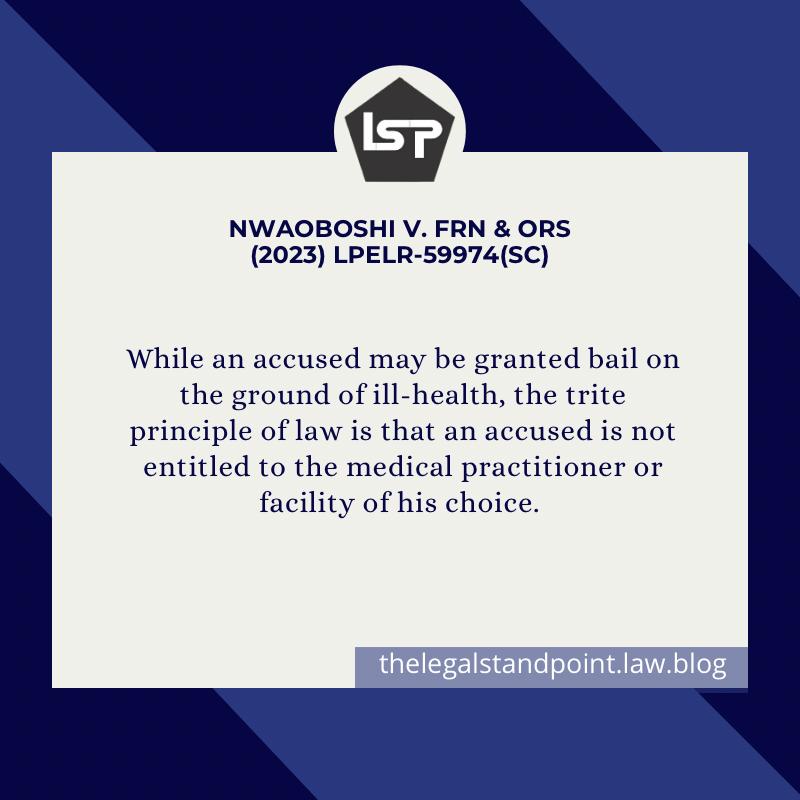
Today’s article seeks to answer the question of whether a fugitive convict seeking bail is entitled to a medical practitioner or facility of his choice. To answer this question, the 2023 case of Nwaoboshi v FRN & Ors (2023) LPELR-59974(SC).
As a way of consequential arrangement, after being sentenced to imprisonment, the next bus stop is correctional home. The principle of law is that convicts must make themselves available to law enforcement agencies or Correctional Services officials for the commencement of their prison confinement, regardless of their physical location.
Moving on, the general principle of law is that everyone is entitled to be offered access to good medical care whether he is being tried for a crime or has been convicted or simply in detention. When in detention or custody, the responsibility of affording him access to proper medical facilities rests with those in whose custody he is, invariably the authorities. But it ought to be understood that the mere fact that a person in custody is ill does not entitle him to be released from custody or allowed one bail unless there are really compelling grounds for doing so.
In the case under review, the appellant(a Nigerian senator) was convicted for money laundering and sundry offences, and sentenced to 7 years imprisonment. However, from 1/7/2022 to date, the applicant has not submitted himself to the Nigerian Correctional Services [NCS], which by the order of the Court of Appeal, is the legal custodian/jailer of the applicant from the aforesaid date of 1/7/2022.
After becoming a convict on July 1, 2022, the applicant went on frolics on his own. He sought medical treatment at different hospitals, starting with the National Hospital in Abuja and later at the Police Hospital in Lekki, Lagos. Despite being sentenced to a custodial sentence, the applicant continued to exercise his right to liberty and freedom of movement, traveling from Abuja to Lagos.
In this particular case, the applicant refused to adhere to the court’s judgment, obstructing the execution of the custodial sentence handed down by the Court of Appeal. Instead of being taken into prison custody, the applicant sought bail from the court on health grounds while awaiting the outcome of their appeal.
Giving the judgment, the court started by saying after a conviction and sentencing, courts exercise extreme caution when considering bail applications pending appeal. This is because, at this point, the applicant, now a convict, can no longer be presumed innocent, as his guilt has been established, and there is a trial court order for him to be in prison custody. Over time, the judicial precedent has been to refrain from granting such bail unless there are specific features or circumstances indicating that a denial of bail would result in irreversible injustice that cannot be rectified through legal relief.
Applying this general principle, the Supreme Court per Agim JCS held that “The duty of the State to ensure that the medical needs of persons in custody are met does not create such extravagant rights as claimed that a person in custody is entitled to be treated by a doctor of his own choice”
On the need for a judicial process of court not to be toyed with by those, who wield political power and for a convict to submit himself to the custody of Nigerian Correctional Services, the Court in an elaborated erudition held that: The applicant, who has continued to enjoy his right to personal liberty, now seeks an order of this court admitting him to bail pending the hearing and determination of his appeal. To my mind, this application is outrageous and cannot be entertained by this court when the applicant himself is not subject to any form of confinement. The appellant, by his conviction and sentence, has lost his right to presumption of innocence and liberty, and the continued exercise of his right to liberty and freedom of movement, as if he is not a convict, subject to a custodial sentence, is an affront to the judicial process. So, not only has he refused to submit himself to confinement or custody, but the applicant is seeking release from custody, which he has avoided.
The judicial process of court is not one to be toyed with by those who wield political power. The applicant has presented himself as a serving Senator and Distinguished member of the legal profession. Unfortunately, the facts of this application suggest that the applicant has little or no regard for the judicial process of the court. While stating that he is suffering from a serious medical condition, the applicant also informed this court that he has an upcoming election to contest.
As it is, the applicant as a convict subject to a custodial sentence, has no right whatsoever to refuse or fail to submit himself to custody of the NCS on grounds of ill health. A sick convict, who is also subject to custodial sentence, must first submit himself to custody as ordered, and upon his conviction, his right to movement in and out of the hospital must be at the direction and supervision of the NCS. He did not even notify NCS of his whereabouts; rather, he continued to enjoy his liberty and freedom of movement as if it had not been taken away lawfully.”
Thank you for reading. See you next week

 THELEGALSTANDPOINT
Thank you! ✍️
LikeLike