
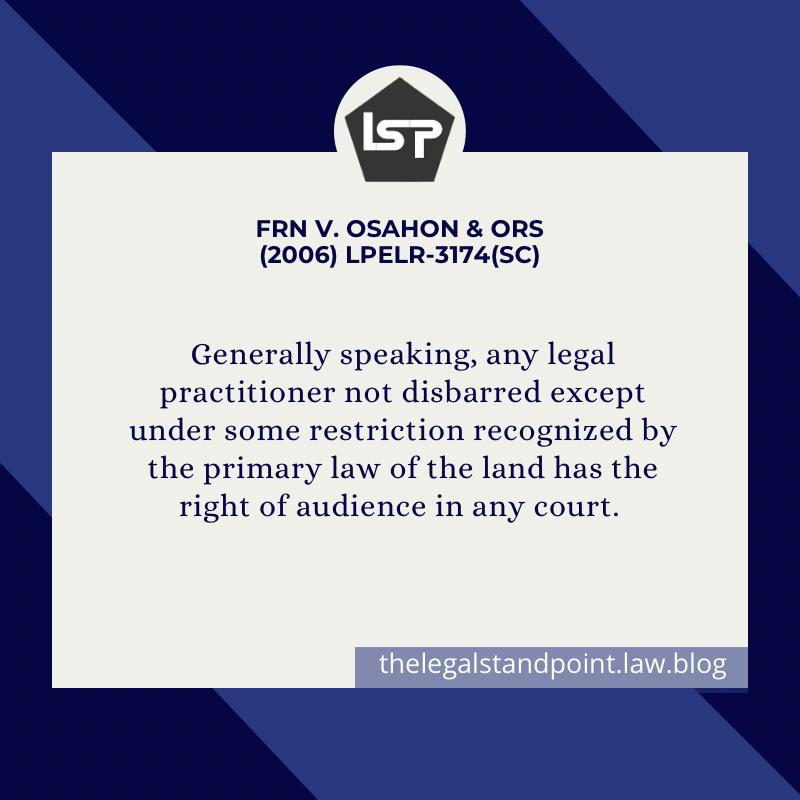
This week’s article focuses on the right of audience of legal practitioners in Nigeria. Upon admission to the Nigerian bar, one becomes a barrister and solicitor of the Supreme Court. The question that arises next is whether they are entitled to appear before any court, including the Supreme Court.
The foremost Nigerian authority in this area is the Supreme Court’s decision in F.R.N v Osahon (2006) LPELR-3174(SC). In that case, the apex court held that ‘When any person is called to the Bar and enrolled to practice, they have the right of audience, and unless the Constitution explicitly forbids such a person or provides qualifications for appearance in court, any act prescribing provisions contrary to the spirit of the Constitution should be regarded as meaningless.’ Therefore, in that case, the court allowed a police officer to prosecute a criminal matter and held that it did not contravene Section 174 of the Constitution, which empowers the Attorney General of the Federation on public prosecution.
Thus, the law is settled that legal practitioners, as long as they are not under any legal disability, can appear before any court in Nigeria. With that said, the next question is: can an untried allegation be considered a legal disability that deprives a legal practitioner of the right of audience before the court? An important judicial authority in this regard is the intriguing 2015 Court of Appeal case of Francis v State (2015) LPELR-25802 (CA). This case is particularly interesting due to its unique circumstances.
This legal case resembles a tug-of-war between the appellant, who faces serious charges, and the prosecution, who is dissatisfied with the appellant’s lawyer. It turns out that the lawyer also works for the government, and the prosecution argues that representing the appellant conflicts with his government job.
The appellant argues that the Constitution grants them the right to choose their own lawyer, and any law that prevents a lawyer from appearing in court is unconstitutional. He cites Section 36(6)(C) of the Constitution, Section 211 of the Criminal Procedure Code, as well as the case of Awolowo & Ors. v. Minister of Internal Affairs and Ors (1962) L. L. R. 177, amongst others.
On the other hand, the prosecution points out that Sectione Section 36 of the Constitution is not absolute and can have exceptions. The counsel refers to a code of conduct for public officers as outlined in the Fifth Schedule of the 1999 Constitution, which states that government employees, especially lawyers, should not engage in private legal work if it conflicts with their government duties.
Regarding this issue, the court, while accepting the legal principle established in F. R. N. V. Osahon (Supra) and rejecting the one in Awolowo v Minister of Internal Affairs & Ors (supra), held that ‘in this particular case, I reiterate that an allegation of a breach of professional conduct ethics and/or conflict of interest, in and of itself, cannot disqualify a legal practitioner from representing an accused person in a criminal trial.”
In conclusion, the trite principle of law is that a lawyer has the right of audience before any court in Nigeria and an allegation of a breach of professional conduct doesn’t stop the enjoyment of this right. Thank you for reading. See you next week.
 THELEGALSTANDPOINT