
If you have interned at a litigation firm before, there is a higher probability that you have been sent to file a court process. Filing of a court process in Nigeria refers to the submission and registration of legal documents or pleadings with the appropriate court, initiating a legal action, or responding to a lawsuit. Filing fees are generally set out by the Rules of Court and paid to the registrar of the appropriate Court.
In our Court administration system, it is imperative that litigants cannot initiate a lawsuit without paying the requisite fees. These fees serve the primary purpose of generating revenue for the public coffers and are not intended as punitive measures against litigants exercising their right of access to the court under Section 6 (6) of the 1999 Constitution. The fact that the fees payable are increased in certain categories of cases does not render the charging of the increased fees unconstitutional. See the case of Atolagbe & Anor v Awuni & Ors (1997) LPELR-593(SC).
Moving forward, does non-payment of filing fees rob the court of its jurisdiction to hear a matter? What happens if an inadequate fee was paid, and is there any remedy for such?
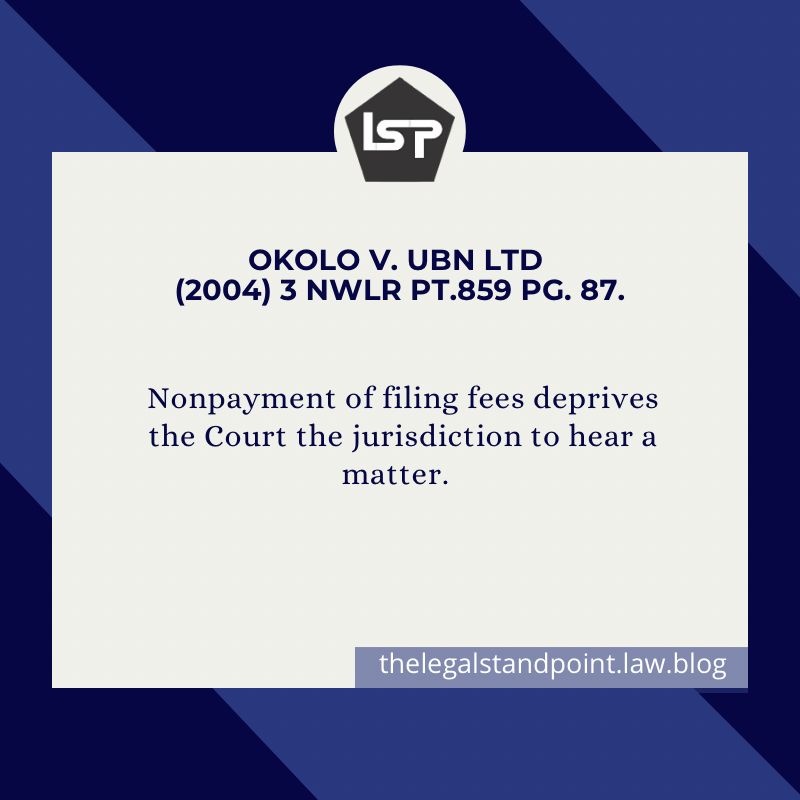
On the first question, the principle of law is that non-payment of filing fees deprives the court of its jurisdiction. In Okolo & Anor v Union Bank of Nigeria Ltd (2004) LPELR-2465(SC), Niki Tobi JSC (as he then was) opined that: Payment of filing fees is a precondition to the court’s assumption of jurisdiction. Where filing fees are not paid, a court of law will have no jurisdiction to entertain the matter before it. This is because the rules of court make it mandatory for a party to pay filing fees.
On the second question, the law is that the payment of inadequate fees does not bar the court from exercising jurisdiction as it is a mere irregularity which could be cured by payment of the appropriate fees. In Ogew & Anor v IGP & Ors (2015) LPELR-24322(SC), the Court, per Fabiyi JSC (as he then was), reinstated the law and opined that: “It is basic to say it without any form of hesitation that, based on the position of this court in the case of Akpaji v. Udemba (supra), payment of inadequate filing fees is a mere irregularity. So, in the case of Lawal & Anor v. Odejimi & Anor (1963) WNLR 23; (1963) ANLR 569 @ 570, where inadequate fees were paid for a writ of summons, the trial court allowed the plaintiff time to pay the balance of the fees.“
Similarly, in Igoin & Ors v Ajoko (2021) LPELR-58334(SC, the Supreme Court held that filing fees are fixed by the Court and collected by the registry. If the registry gives a wrong figure to pay to a litigant, it’s not the litigant’s fault. In any case, it can easily be cured by payment of the correct fees and cannot be used suo motu to strike out an appeal.
On the distinction between the non-payment and inadequate payment of filing fees, Moronkeji Ogunwumiju JSC in Igoin’s case held that “it is trite law that non-payment of filing fees is different from inadequate payment. While the former is the fault of counsel, the latter can be the fault of the Registry. Nonpayment of filing fees is a serious omission by the Appellant which, in effect, deprives the Court of jurisdiction to hear the appeal. See Okolo v. UBN Ltd (2004) 3 NWLR Pt.859 Pg. 87. On the other hand, inadequate payment of filing fees is usually the fault of the Registrar who made a mistake when he/she told the Appellant the amount to be paid. In cases where the fees paid by the Appellant are inadequate, it is the duty of the presiding Judge to order the erring Appellant or party to pay the correct filing fees instead of striking out the appeal or process.”
In conclusion, the legal principle is that non-payment of a filing fee goes to the root of the case and deprives the court of jurisdiction to entertain the matter, while the payment of inadequate fees is considered a mere irregularity that can be rectified by paying the appropriate sums.”

 THELEGALSTANDPOINT
👏👏👏
LikeLike