

Law

LSP125:Court Appeal over an arbitral Award

In Nigeria, disputes can be resolved through two primary methods: litigation, which involves taking legal matters to the courts, and Alternative Dispute Resolution (ADR). ADR serves as an alternative means of settling conflicts. Unlike the often lengthy and adversarial process of litigation, ADR offers a swifter and more amicable resolution. It preserves the relationships between the involved parties, which is a significant contrast to litigation, as the Yoruba proverb provides “A ò kí n ti ilé ejó dé, kí á bá ara wa se òré which literally translates to mean m: we don’t come back from court to become friends.”

As such, arbitration and litigation or court suits are worlds apart. They are governed by different rules and have different legal bases. While the jurisdiction of a court is conferred by the Constitution or statutes, the jurisdiction of an arbitral tribunal has its roots in the agreement of parties.

This week’s article is on an interesting arbitration case, and our focus is on whether a court of law can sit on appeal over an arbitral award. Before answering this question, let’s run through the facts of the case:

The appellant and respondent had a contractual relationship that involved payments in both Naira and US Dollars. When a dispute arose, they turned to an arbitral tribunal, composed of arbitrators chosen by both parties, in accordance with their contractual agreement.

After the tribunal’s hearing, it issued an award in favor of the respondent, which included a 17% interest rate on the awarded sum, as per the parties’ agreement. However, the appellant refused to comply with the arbitral award. Instead, they offered a reduced amount to settle the debt, which the financially distressed respondent initially accepted but later rescinded, insisting on the full award amount. At the time of this disagreement, the appellant had not yet made the payment they had offered.

Subsequently, the appellant sought to have the arbitral award set aside by applying to the Federal High Court in Lagos through an originating summons. In response, the respondent filed an originating motion to have the award recognized and enforced. Both cases were consolidated and heard jointly. After hearing both parties, the trial court issued a judgment that recognized and ordered the enforcement of the arbitral award while dismissing the appellant’s application to set it aside. Unsatisfied with the outcome, the appellant pursued an appeal to the Court of Appeal, which also dismissed their case. Still dissatisfied, the appellant proceeded to appeal to the Supreme Court.

Several issues were distilled for determination in the case. The first is on jurisdiction. First off, the principle of law is that the Federal High Court lacks the requisite jurisdiction to adjudicate over claims arising from or primarily founded on simple contracts. Onuorah v. K.R. & P.C. Ltd. (2005) 6 NWLR (Pt. 921) 391; Tukur v. Government of Gongola State (1989) 4 NWLR (Pt. 117) 517. In this instant case, the matter is on a simple contract. Can we consider the enforcement of an arbitral award, which was the respondent’s primary concern, as a form of adjudication in a case? No. Why? Follow me.

The National Assembly holds the constitutional authority to grant the Federal High Court additional jurisdiction beyond the specific categories outlined in Section 251 of the 1999 Constitution, as amended, through the Arbitration and Conciliation Act, a law it has duly passed for this purpose. This granted jurisdiction, explicitly detailed in Sections 31 and 57 of the Act, empowers the Federal High Court to recognize and enforce arbitral awards or decisions made by arbitrators designated by the involved parties to settle contractual disputes. This constitutes a distinct, supplementary jurisdiction alongside the court’s exclusive jurisdiction defined in Section 251(1) of the 1999 Constitution, as amended.

For that reason, the Federal High Court possesses the jurisdiction to recognize and enforce an arbitral award irrespective of and no matter the subject matter of the dispute from which the award arose and was made. The court is not to adjudicate over the subject matter of the dispute from which the award arose and was made but to simply enforce the resolution of the dispute which the parties thereto voluntarily and freely chose to submit to the arbitral tribunal to resolve.

An arbitral award is a legally binding decision or judgment made by an arbitrator or a panel of arbitrators in the process of arbitration, resolving a dispute between parties outside of a court of law. By virtue of section 31(1) and section 32 of the Act, an arbitral award shall be recognized as binding and, subject to the Act, shall, upon application in writing to the court, be enforced by the court.

It is pertinent to state that an arbitral tribunal’s award does not constitute a decision by a court of law established under the Constitution or any statute. Arbitration is distinct from court proceedings, and it is considered an alternative dispute resolution method at the discretion of the involved parties, dependent on their mutual agreement to resolve disputes outside regular court adjudication. Parties can choose between going to court or referring their dispute to an arbitrator. Legal support for arbitration as an alternative dispute resolution method has been established for many years.

It is noteworthy that an application to set aside an arbitral award is not an appeal to a court of law. Mohammed Lawal Garba, JSC, in the case under review, opined that: “The court is not empowered to determine whether or not the findings of arbitrators and their conclusions are wrong in law. What the court has to do is to look at the award and determine whether, on the state of the law as understood by them and as stated on the fact of the award, the arbitrators complied with the law as they themselves rightly or wrongly perceived it… Put in another way, no court in Nigeria has the statutory jurisdiction to entertain and adjudicate over an appeal from the award made by an arbitral tribunal. No court can purport to sit over an appeal against an award made by an arbitration tribunal since it lacks the requisite judicial power and authority to confer or arrogate to itself the jurisdiction it does not have it all under any statute or law.”

Also, the court – based on the facts that parties have willingly chosen to go to arbitration – will not normally set aside the award unless there is a grave injustice carried out by the arbitrator while reaching that award. Setting aside an arbitral award isn’t like an appeal; it’s typically based on a significant error of law evident in the award itself, such as a decision on inadmissible evidence or illegal procedures, not simply a difference in legal interpretation. In this case, the appellant’s complaints of jurisdiction, misconduct, and errors of law were not substantiated. Hence, there was no reason to set aside the award.

Moving on to the timeframe, though Section 12(1) of the Nigerian National Petroleum Corporation Act states that no suit can be filed against the Corporation unless it commences within twelve months after the alleged act or damage occurred, the court held that Section 12(2) of the same Act is explicitly applicable to suits initiated against the Corporation and does not pertain to arbitral proceedings, which are consciously chosen by parties as an alternative dispute resolution method for contractual disputes.

Ongeneral comment, Kekere Ekun JSC opined that: “Arbitration clauses are quite common in commercial contracts. The advantages of arbitration are that the parties are free to choose their arbitrators, as opposed to the regular courts, where they cannot choose their Judges; they are free to choose the law that will govern their dispute; it is also perceived to be cost-effective at the end of the day. Parties agree to be bound by the award of the arbitrators. Unfortunately, this alternative dispute resolution mechanism, which ought to relieve the courts of some of the load of their heavy dockets, often results in even greater pressure on the courts because parties who are dissatisfied when an award is against them return to the same court seeking to have the award set aside or vehemently challenge an application for the recognition and enforcement of the award.”

In conclusion, the principle of law is that Courts do not sit on appeal over an award made by an arbitral tribunal for the purpose of a re-hearing which an appeal before an appellate court is.

Thank you for reading. See you next week.
Law

LSP124: Jurisdiction over a Deceased party

Today’s article seeks to examine the effects of a judgment given against a deceased person or when one of the parties has lost its legal personality, relying on the case of Mainstreet Bank Registrars Limited v Elder David Alabi Ogundimu (2023) 14 NWLR (PT. 1905) 574-575.

The principle of law is that a deceased person has no legal personality and capacity and, therefore, cannot maintain an action in a trial or appeal. Every action or appeal requires the proper parties to prosecute it. However, when an appeal has been properly entered, the appeal still subsists upon the death of the appellant and only requires the substitution of a living party to prosecute it. See Iroeche v. Izuogu (2020) 4 NWLR (Pt. 1714) 211. The possibility of getting the reliefs sought depends whether the matter is a personal matter or not.

Thus, where one of the parties has lost their legal personality due to death and was not substituted before the judgment was delivered, the decision will be a nullity, as the court has lost the requisite authority to determine the rights of a deceased person. See Re: Otuedon (1995) 4 NWLR (Pt. 392) 655 at 667. Therefore, a judgment delivered in favor of or against a deceased person who has not been substituted constitutes a nullity.

In Mainstreet Bank Registrars Limited v Elder David Alabi Ogundimu (2023) 14 NWLR (PT. 1905) 574-575, Kehinde Abimbola, the original respondent, brought a case against the appellant, alleging wrongful termination of employment. The National Industrial Court ruled in favor of Kehinde Abimbola. Dissatisfied with this decision, the appellant appealed the case in Appeal No. CA/L/815/2015. The appeal was argued on October 5, 2017, and the judgment was issued on November 24, 2017.

Tragically, Kehinde Abimbola had passed away on October 25, 2017, just 30 days before the judgment. Unfortunately, neither party’s counsel had informed the court of this fact when the judgment was issued.

On December 13, 2017, which was 19 days after the judgment was delivered, the appellant filed an application with the Court of Appeal, requesting the judgment to be set aside. The basis for this request was that the judgment was invalid since it was delivered after the respondent’s demise, a fact the appellant became aware of only after the judgment had been made.

The father of the late respondent opposed the appellant’s application, citing a violation of Order 6, Rule 12 of the Court of Appeal Rules, 2016, because the application was filed more than 14 days after the Rules allowed.

In determining this suit, it was held that a court must have jurisdiction over both the subject matter and the parties involved in a case. Parties can be natural individuals or legal entities created by statute or registration. However, a court cannot have jurisdiction over a deceased individual, regardless of the court’s awareness, once the fact of death is established or admitted. In this case, when Mrs. Kehinde Abimbola passed away on 25/10/2017, the court lost its authority to issue any orders related to her.

The nature and effect of a null judgment are that it is a judgment treated as if it was never given or made because it has no legal consequence whatsoever, and a person affected by such a judgment is entitled, ex debito justitiae (in the interest of justice), to apply to have it set aside. This is because the judgment cannot confer any right on anyone nor impose any obligation on anybody due to its lack of legal validity. In this case, the applicant applied to the Court of Appeal to set aside its judgment because it is a nullity, and the court granted the application.

On the question of the timing of the appeal, the court held that by virtue of Order 15, Rule 1 of the Court of Appeal rules 2021, every counsel must promptly report a party’s death to the registrar of the Court and parties and adhere to the 14-day limit for filing applications to set aside judgments according to Order 6 Rule 10. However, the court opined that there are instances where it won’t be bound by these rules, particularly in the interest of justice, which it exercised in this specific case. Therefore, the respondent’s argument on time elapsed was not considered.

AFFEN JCA held that: a judgment classified as a nullity is one that is destitute of legal force or effect; one which is treated as if it was never made or given. See West African Automobile & Eng. Co. Ltd. v. Ajanaku (1972) U.I.L.R. 335 and Busari & Ors. v. Oseni (2018) LPELR-46635(CA). Thus, even though rules of court are meant to be obeyed, where an application to set aside a judgment that is a nullity is brought outside the period stipulated in the Rules of Court without any prayer seeking an extension of time, this court cannot ignore the fact of nullity of its judgment and will, in an appropriate case, depart from its rules in order to accommodate the application in the interest of justice, as provided in Order 25, Rules 2 and 3 of the Court of Appeal Rules 2021.

In conclusion, a fundamental legal principle is that a court’s jurisdiction extends to both the subject matter and the parties involved. A court lacks jurisdiction over a deceased individual who hasn’t been properly substituted in the legal proceedings, and any judgment rendered in such a situation would be considered void.

Thank you for reading. See you next week.

Law

LSP122: Fiat

A fiat is a Latin word which means ‘Let it be done’. Technically therefore, it denotes the grant or conferment of power on another by a person having complete authority on the issue upon which the fiat is given in matters of prosecution. The Attorney-General of a State or of the Federation can give such a fiat. A Commissioner of Police can delegate his officers or private legal practitioners to represent him in a case. ONWUAMADIKE v. STATE OF LAGOS & ORS (2019) LPELR-53005(CA).

Now what’s the duration of a fiat? The decisions of the Court of Appeal and of the Apex Court on this issue are replete.

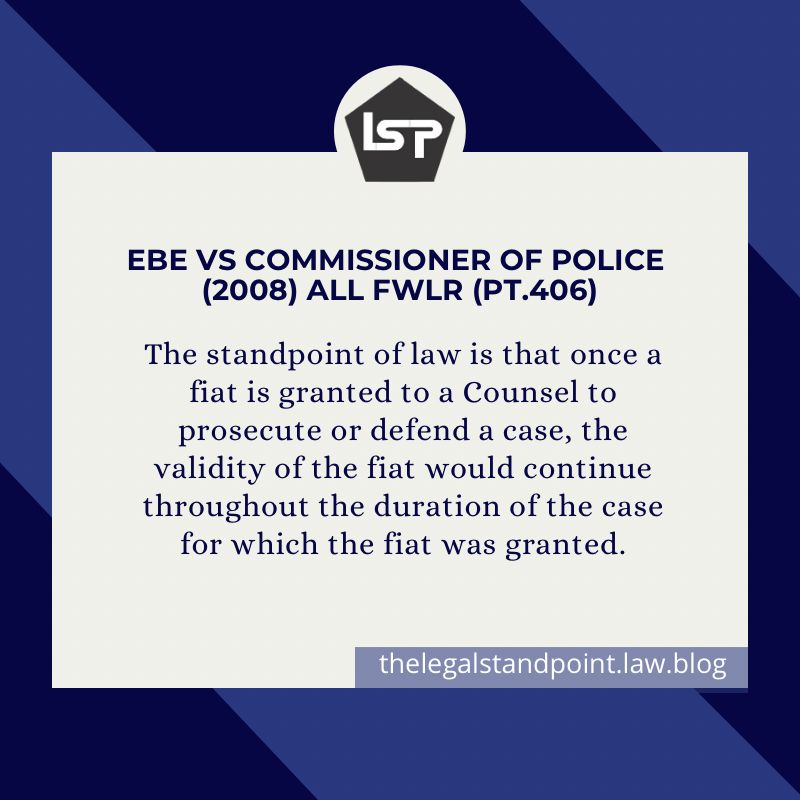
The Supreme Court in NWAIGWE v THE STATE (2013) LPELR 20941 (SC) held thus: “… Once a fiat is granted to a Counsel to prosecute or defend a case, the validity of the fiat would continue throughout the duration of the case for which the fiat was granted.” See also in Ebe v Commissioner of Police (2008) All FWLR (Pt.406).

In that case, the Appellant’s Counsel argued that the prosecuting Counsel had a fiat to prosecute Charge No MID/136C/2014 but was not authorized to file a fresh case at the High Court under Charge No HID/19C/2014. They claimed it was an entirely new charge. However, records indicate that it’s the same case that started at the Chief Magistrate Court, and a fiat was issued by the Attorney General to the Prosecuting Counsel to continue it in the High Court. The change in the charge number from MID/136C/2014 to HID/19C/2014 was criticized by the Appellant’s Counsel, but the court considered this argument as insignificant since charge numbers change based on the hierarchy of courts, even for the same case.

In the case of C.O.P v. ONUORAH (2020) LPELR-50797(CA), a key question was whether a fiat issued by the Attorney-General needed to have the NBA stamp and seal. The court’s ruling established that the fiat provided to J.O. Onyejekwe, Esq., by the Attorney General did not necessitate the inclusion of an NBA stamp and seal.

Though, “fiat” is commonly employed in legal circles, including lawyers, attorney generals, and other legal professionals. However, it can also be utilized by judges as it serves as an administrative tool designed to facilitate convenience and expedite the process of delivering justice.

As such, a fiat can be issued by a chief judge of a state to another judge in that jurisdiction to either take up a case or finish a case he started before completion. While this seems easy, the legal question is where does time start to count in the instance of a transferred judge and an existing case? This matter came up for consideration in ABUGA & ANOR v. AJAGABO (2020) LPELR-52281(CA).

In that case, the appeal stems from a case in the High Court of Justice, Nasarawa State, with a judgment date of October 16, 2014. The Respondent, the plaintiff at the court of first instance (trial court) sought certain declarations and an order regarding a farmland dispute in the Upper Area Court, Nasarawa Eggon. The trial was presided over by Judge V.V. Manga until he was transferred to the Chief Magistrate Court Wamba on October 25, 2012.

To allow Judge V.V. Manga concluded the case, the Respondent applied for a fiat from the Chief Judge of Nasarawa State. This fiat was approved on January 15, 2013, with a 40 working day limit to complete the proceedings. Judge V.V. Manga resumed proceedings on June 14, 2013, but the 40 working days expired on August 6, 2013, before the case concluded. The Respondent applied for another fiat, which was granted on September 4, 2013, allowing for an additional 22 working days to finish the case.

Judge V.V. Manga completed the proceedings and delivered a judgment, dismissing the Respondent’s case. The Respondent appealed to the High Court of Nasarawa State, arguing that the trial court exceeded the fiat’s allowed timeframe. The High Court accepted this argument and set aside the trial court’s decision, leading the Appellants to appeal to the Court of Appeal. One of the issues in question is whether the lower court correctly interpreted the start date of the fiat as the date it was issued.

The court of appeal held that the proper and purposive construction is that the period granted in the fiat would run from the date that the sole Judge commenced sitting and hearing of the part heard matter and not the day it was granted.

In conclusion, a fiat is a legal instrument issued by an authorized individual, such as the Attorney General or Chief Justices, to empower another person to handle a specific matter. When granted by the Attorney General, it remains in effect until the matter is concluded. In the case of justices, it begins from the date when the partially heard matter begins.

Thank you for reading. See you next week.