
In Nigeria, disputes can be resolved through two primary methods: litigation, which involves taking legal matters to the courts, and Alternative Dispute Resolution (ADR). ADR serves as an alternative means of settling conflicts. Unlike the often lengthy and adversarial process of litigation, ADR offers a swifter and more amicable resolution. It preserves the relationships between the involved parties, which is a significant contrast to litigation, as the Yoruba proverb provides “A ò kí n ti ilé ejó dé, kí á bá ara wa se òré which literally translates to mean m: we don’t come back from court to become friends.”
As such, arbitration and litigation or court suits are worlds apart. They are governed by different rules and have different legal bases. While the jurisdiction of a court is conferred by the Constitution or statutes, the jurisdiction of an arbitral tribunal has its roots in the agreement of parties.
This week’s article is on an interesting arbitration case, and our focus is on whether a court of law can sit on appeal over an arbitral award. Before answering this question, let’s run through the facts of the case:
The appellant and respondent had a contractual relationship that involved payments in both Naira and US Dollars. When a dispute arose, they turned to an arbitral tribunal, composed of arbitrators chosen by both parties, in accordance with their contractual agreement.
After the tribunal’s hearing, it issued an award in favor of the respondent, which included a 17% interest rate on the awarded sum, as per the parties’ agreement. However, the appellant refused to comply with the arbitral award. Instead, they offered a reduced amount to settle the debt, which the financially distressed respondent initially accepted but later rescinded, insisting on the full award amount. At the time of this disagreement, the appellant had not yet made the payment they had offered.
Subsequently, the appellant sought to have the arbitral award set aside by applying to the Federal High Court in Lagos through an originating summons. In response, the respondent filed an originating motion to have the award recognized and enforced. Both cases were consolidated and heard jointly. After hearing both parties, the trial court issued a judgment that recognized and ordered the enforcement of the arbitral award while dismissing the appellant’s application to set it aside. Unsatisfied with the outcome, the appellant pursued an appeal to the Court of Appeal, which also dismissed their case. Still dissatisfied, the appellant proceeded to appeal to the Supreme Court.
Several issues were distilled for determination in the case. The first is on jurisdiction. First off, the principle of law is that the Federal High Court lacks the requisite jurisdiction to adjudicate over claims arising from or primarily founded on simple contracts. Onuorah v. K.R. & P.C. Ltd. (2005) 6 NWLR (Pt. 921) 391; Tukur v. Government of Gongola State (1989) 4 NWLR (Pt. 117) 517. In this instant case, the matter is on a simple contract. Can we consider the enforcement of an arbitral award, which was the respondent’s primary concern, as a form of adjudication in a case? No. Why? Follow me.
The National Assembly holds the constitutional authority to grant the Federal High Court additional jurisdiction beyond the specific categories outlined in Section 251 of the 1999 Constitution, as amended, through the Arbitration and Conciliation Act, a law it has duly passed for this purpose. This granted jurisdiction, explicitly detailed in Sections 31 and 57 of the Act, empowers the Federal High Court to recognize and enforce arbitral awards or decisions made by arbitrators designated by the involved parties to settle contractual disputes. This constitutes a distinct, supplementary jurisdiction alongside the court’s exclusive jurisdiction defined in Section 251(1) of the 1999 Constitution, as amended.
For that reason, the Federal High Court possesses the jurisdiction to recognize and enforce an arbitral award irrespective of and no matter the subject matter of the dispute from which the award arose and was made. The court is not to adjudicate over the subject matter of the dispute from which the award arose and was made but to simply enforce the resolution of the dispute which the parties thereto voluntarily and freely chose to submit to the arbitral tribunal to resolve.
An arbitral award is a legally binding decision or judgment made by an arbitrator or a panel of arbitrators in the process of arbitration, resolving a dispute between parties outside of a court of law. By virtue of section 31(1) and section 32 of the Act, an arbitral award shall be recognized as binding and, subject to the Act, shall, upon application in writing to the court, be enforced by the court.
It is pertinent to state that an arbitral tribunal’s award does not constitute a decision by a court of law established under the Constitution or any statute. Arbitration is distinct from court proceedings, and it is considered an alternative dispute resolution method at the discretion of the involved parties, dependent on their mutual agreement to resolve disputes outside regular court adjudication. Parties can choose between going to court or referring their dispute to an arbitrator. Legal support for arbitration as an alternative dispute resolution method has been established for many years.
It is noteworthy that an application to set aside an arbitral award is not an appeal to a court of law. Mohammed Lawal Garba, JSC, in the case under review, opined that: “The court is not empowered to determine whether or not the findings of arbitrators and their conclusions are wrong in law. What the court has to do is to look at the award and determine whether, on the state of the law as understood by them and as stated on the fact of the award, the arbitrators complied with the law as they themselves rightly or wrongly perceived it… Put in another way, no court in Nigeria has the statutory jurisdiction to entertain and adjudicate over an appeal from the award made by an arbitral tribunal. No court can purport to sit over an appeal against an award made by an arbitration tribunal since it lacks the requisite judicial power and authority to confer or arrogate to itself the jurisdiction it does not have it all under any statute or law.”
Also, the court – based on the facts that parties have willingly chosen to go to arbitration – will not normally set aside the award unless there is a grave injustice carried out by the arbitrator while reaching that award. Setting aside an arbitral award isn’t like an appeal; it’s typically based on a significant error of law evident in the award itself, such as a decision on inadmissible evidence or illegal procedures, not simply a difference in legal interpretation. In this case, the appellant’s complaints of jurisdiction, misconduct, and errors of law were not substantiated. Hence, there was no reason to set aside the award.
Moving on to the timeframe, though Section 12(1) of the Nigerian National Petroleum Corporation Act states that no suit can be filed against the Corporation unless it commences within twelve months after the alleged act or damage occurred, the court held that Section 12(2) of the same Act is explicitly applicable to suits initiated against the Corporation and does not pertain to arbitral proceedings, which are consciously chosen by parties as an alternative dispute resolution method for contractual disputes.
Ongeneral comment, Kekere Ekun JSC opined that: “Arbitration clauses are quite common in commercial contracts. The advantages of arbitration are that the parties are free to choose their arbitrators, as opposed to the regular courts, where they cannot choose their Judges; they are free to choose the law that will govern their dispute; it is also perceived to be cost-effective at the end of the day. Parties agree to be bound by the award of the arbitrators. Unfortunately, this alternative dispute resolution mechanism, which ought to relieve the courts of some of the load of their heavy dockets, often results in even greater pressure on the courts because parties who are dissatisfied when an award is against them return to the same court seeking to have the award set aside or vehemently challenge an application for the recognition and enforcement of the award.”
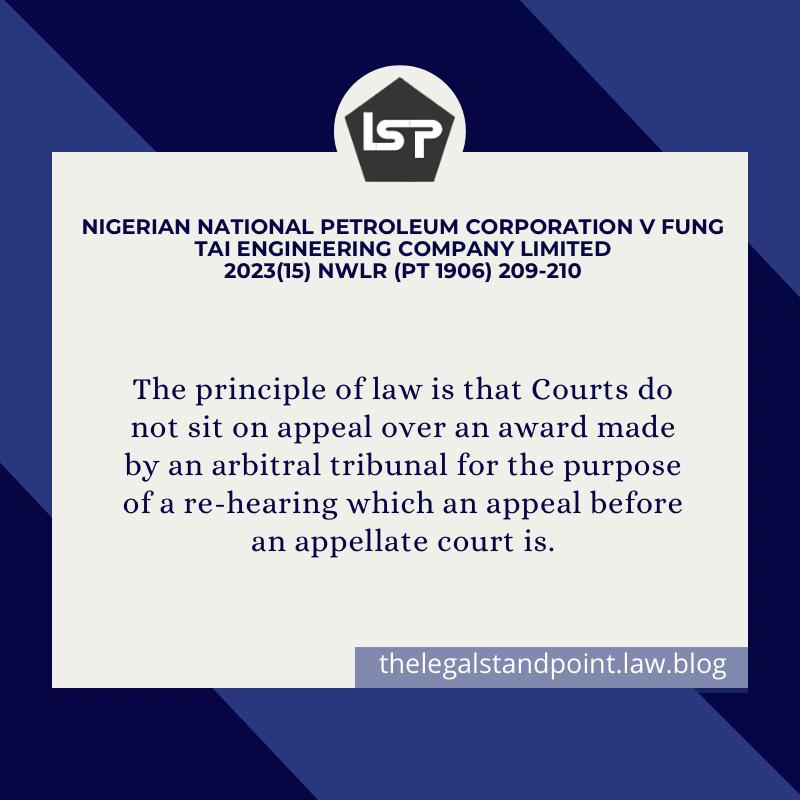
In conclusion, the principle of law is that Courts do not sit on appeal over an award made by an arbitral tribunal for the purpose of a re-hearing which an appeal before an appellate court is.
Thank you for reading. See you next week.

 THELEGALSTANDPOINT
This is a lot of value.✍️✍️
LikeLike