
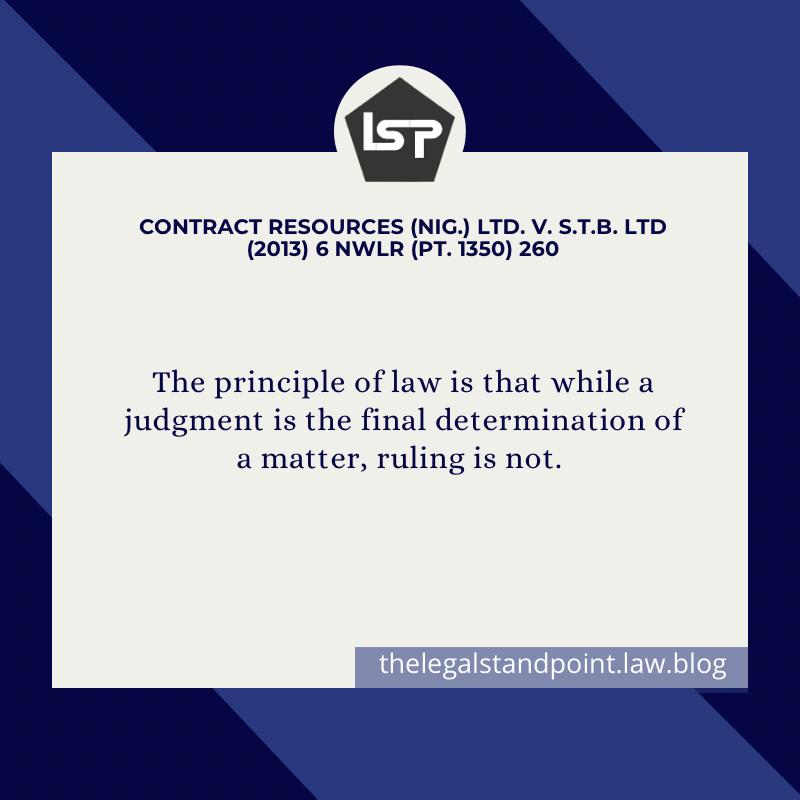
Rulings and judgments are fundamental concepts in the realm of justice and legal proceedings The term judgment is a decision or determination within the context of a court, similar to the concept of a ruling. However, it is crucial to distinguish between these two legal terms. A judgment, unlike a ruling, signifies the court’s ultimate and conclusive decision that effectively resolves the dispute at hand. In doing so, it also establishes the rights and obligations of the involved parties.
On distinction between judgment and ruling, the Supreme Court in Contract Resources (Nig.) Ltd. v. S.T.B. Ltd (2013) 6 NWLR (Pt. 1350) 260 held that: “The word judgment means a decision or determination in relation to a court just as ruling. However, in contradistinction to ruling, judgment represents a final decision of the court resolving the dispute and determining the rights and obligations of the parties“
On the other hand, a ruling represents a decision or order issued by a judge or court that pertains to specific procedural or interlocutory matters during the course of a legal case. Rulings do not conclusively resolve the central issues of the case but address procedural, evidentiary, or other preliminary matters. These can include, but are not limited to:
•Admissibility of Evidence: A judge may issue a ruling on the admissibility of certain evidence, determining whether it can be presented and considered in court proceedings. For example, in a criminal case, a ruling may decide whether a particular statement made by the defendant is admissible as evidence. Imagine you’re in a trial, and one side wants to use a letter as evidence. The judge has to decide if that letter is allowed in the game. This decision is a “ruling” because it’s about whether that move (the letter) is okay.
•Motions: Rulings can also be related to motions filed by either party. For instance, a ruling might decide on a motion to dismiss a case, an application for leave of court to file a divorce proceeding within the two years of marriage etc.
•Procedural Matters: Rulings can be made on procedural issues like the appointment of legal representatives, applications for adjournments, or requests for specific court procedures to be followed.
In conclusion, it is important to note that rulings are distinct from judgments. While rulings address specific issues within a case and can occur at various stages of the legal process, judgments represent the final, conclusive decisions that resolve the main dispute and establish the rights and obligations of the parties involved.
Thank you for reading. See you next week

 THELEGALSTANDPOINT
✍️✍️
LikeLike