
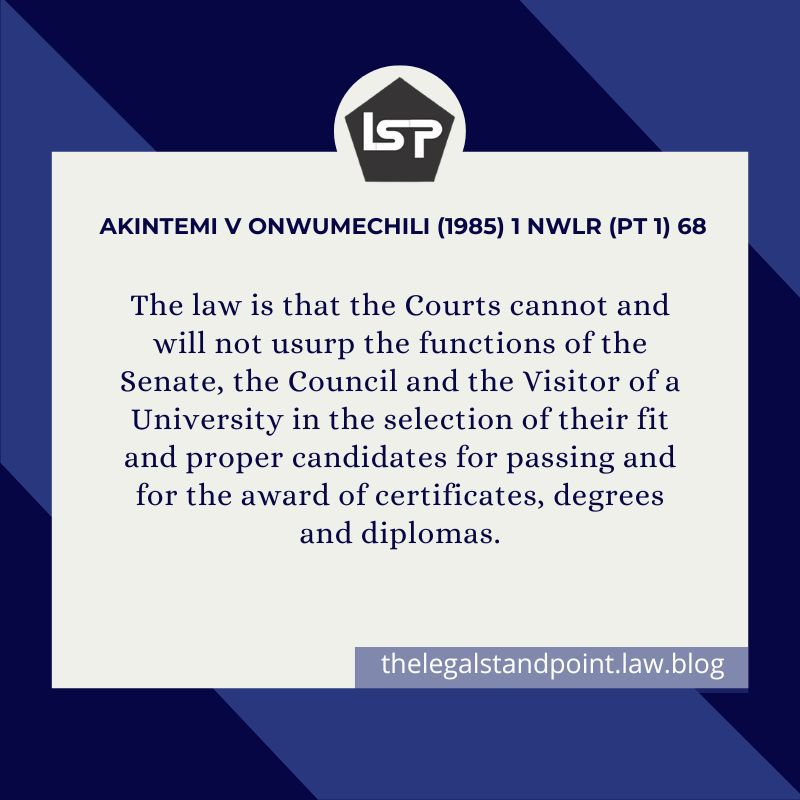
When students complete their studies, it’s the university’s senate that awards degrees, based on character and learning criteria outlined in the regulatory handbook. The Courts typically don’t intervene in this process.
So the fundamental legal principle here is that a court cannot intervene and force a university to grant a degree to a student. The exclusive authority for determining a student’s fitness in character and learning, as well as their eligibility for a degree, lies with the university’s senate, not the court. The regulatory handbooks of schools or faculties typically outline the criteria for character evaluation.
In University of Ilorin v Akinrogunde (2001) 3 NWLR (PT. 755) 626 at 646 PARA B-C, the court held as follows: “We must not lose sight of the fact that the University exist to train future responsible leaders of our great nation and that one of the conditions which they must fulfill before being presented as graduates is that they must be found worthy in learning and character. Therefore, if the character of a student is doubtful due to his arrest and prosecution by relevant agencies it is only reasonable for the University authorities to play safe by taking the necessary steps under the enabling enactment to save guard its reputation by not graduating a student who is later convicted and sentenced by a Court of competent jurisdiction or graduating an ex-convict.”
Similarly in Magit v University of Agriculture, Makurdi (2005) 19 NWLR (PT. 959) 211 at 245 PARA B-E where the Supreme Court held thus: “That in so far as the award of a degree or certificate to a student is concerned, in the discretion to award or refuse to award, the Courts have no jurisdiction in the matter. The Courts have no business flirting into the arena of a University deciding whether a thesis has met the standard of which it has been set. Any attempt by any Court, including this Court to dabble or encroach into the purely administrative and domestic affairs of a University including that of the 1st Respondent that may lead to undue interference nay, the weakening inadvertently so to speak of the powers and authority conferred on the Universities by statute as that conferred on the 1st Respondent will not be justifiable or justified.”
However, in ABU v Obanla (2021) LPELR-55101(CA), the court considered the circumstance(s) in which a Court can interfere with the domestic affairs of a University. In that case, Rashidat Suleiman Obanla, a former student of Ahmadu Bello University, graduated in Mathematics in 2012/2013. The Mathematics Department confirmed her graduation, but upon attempting to collect her certificate, she was informed of her expulsion in 2012 due to alleged cheating during an exam. The expulsion occurred without allowing her to explain, and she only discovered it when checking her results. Despite re-taking and passing the disputed course, completing her studies, and obtaining clearance, the university refused to issue her a graduation certificate, citing the prior expulsion. The respondent appealed to the Vice Chancellor but was unsuccessful. The university maintained she violated her Matriculation Oath, and the Mathematics Department was not informed of her expulsion by the Senate Standing Committee.
The court ruled that, since exam malpractice was alleged, it was the court’s responsibility, not the university’s, to determine whether the respondent was guilty or innocent. The court held that the university exceeded its authority by declaring the respondent guilty without legal proceedings. Talba JCA pointed out that the respondent was not arrested, prosecuted, or convicted by a competent court. The university, instead, assumed the court’s role by pronouncing guilt after an internal investigation, violating constitutional duties. Referring to Sofekun v. Akinyemi & Ors (1980) 5-7 SC 1 at 26, the Supreme Court emphasized the importance of safeguarding the court’s authority against interference to ensure fairness and protection against arbitrariness and oppression.
Given the evidence presented (Exhibit F) and the fact that the respondent was never arrested, prosecuted, convicted, and sentenced by a competent court, the court would be neglecting its constitutional duty if it doesn’t instruct the university to issue the degree certificate to the respondent.
Hence, the appellant’s argument that academic matters and degree awards fall exclusively under the university’s senate doesn’t hold in this case. This applies only when there is no allegation of a crime committed by a student. In instances involving alleged crimes, the university’s senate should permit relevant agencies to handle arrests and prosecutions in court, establishing guilt beyond reasonable doubt. Until this legal process is completed, the student should be presumed innocent by all authorities, including the university’s senate, as stipulated in Section 36(5) of the CFRN 1999 (as amended)
Thank you for reading. See you next week.
 THELEGALSTANDPOINT