
This week’s article addresses whether property forfeiture can occur without a conviction for an offense.
Forfeiture is the loss of certain rights, privileges, property, or honors as a consequence of committing an offense, crime, violation of conditions, or other wrongful acts. In Bokinni v Olaleye (1994) LPELR-22960(CA). and A-G Bendel State v Agbofodoh (1999) 2 NWLR (PT. 592) 476 the courts defined forfeiture as the relinquishment of something due to the commission of a crime, akin to a penalty or fine paid to expiate the wrongdoing.
Embezzlement often precedes forfeiture. When a government official misuses public money, the EFCC in Nigeria is responsible for taking legal action to recover the assets. The main law guiding this process is the Advance Fee Fraud and Other Fraud Related Offences Act, 2006. According to Section 17(3) of this law, the request for an interim forfeiture order should be made without involving the other party (ex parte). To obtain this order, the applicant only needs to provide enough initial evidence that the property might be linked to illegal activities or a crime and could eventually be taken away.
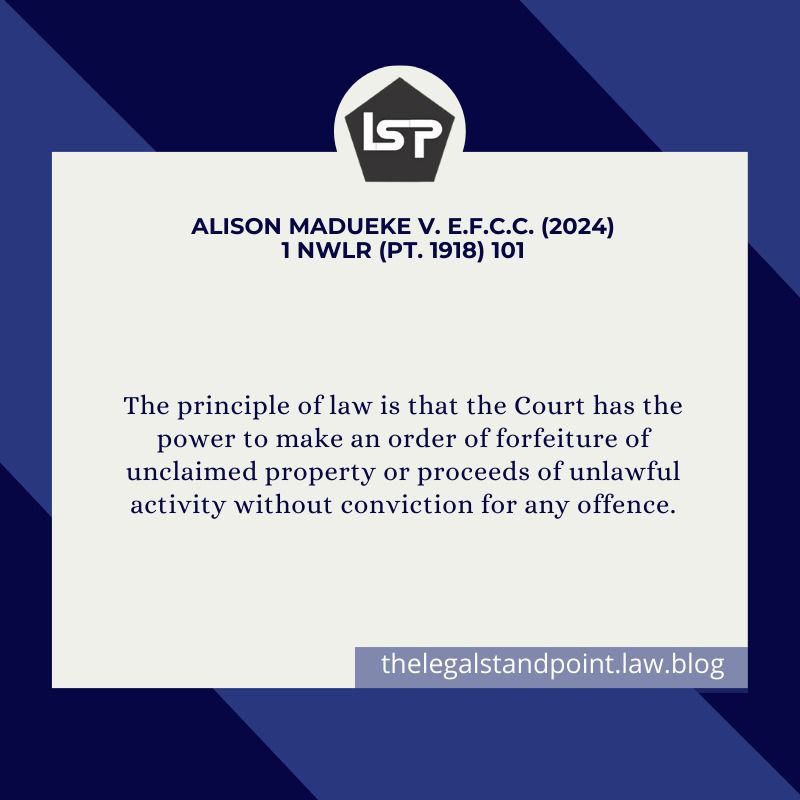
At this juncture, the case of Alison Madueke v. E.F.C.C (2024) 1 NWLR (Pt. 1918) 101 comes in handy. In that case, the Economic and Financial Crimes Commission (EFCC) accessed the appellant’s residence, recovering jewelry worth about $40 million. The EFCC then obtained an interim forfeiture order from the Federal High Court based on evidence suggesting the jewelry’s value exceeded the appellant’s legitimate income during her time as Minister of Petroleum Resources. The appellant argued that the jewelry were gifts received during her service, spanning nearly 50 years. However, the trial court, unconvinced, ordered the final forfeiture of the jewelry to the Federal Government of Nigeria. Dissatisfied, the appellant appealed to the Court of Appeal.
In this case, the trial court, by granting the ex parte application for interim forfeiture, acknowledged that the respondent had made a strong case for seizing the jewelry under the Advance Fee Fraud and Other Fraud Related Offences Act. This shifted the burden to the appellant to explain why a final forfeiture order shouldn’t be issued. The appellant had to prove, on a balance of probability, how she obtained the jewelry. The law places the burden on her since this information is within her knowledge, as stated in Section 140 of the Evidence Act and Section 36(5) of the Constitution.
The Court held that there is no need to prove any crime in forfeiture of property under Section 17 of the Act , as civil forfeiture is a unique remedy that rests on the legal fiction that the property, not the owner, is the target. Therefore, it does not require a conviction or even a criminal charge against the owner as it is not a punishment nor is it for criminal purposes.
The rationale behind this is that civil forfeiture proceedings are intended to cause the forfeiture of proceeds of unlawful activity and are targeted at the property, not the person, thus constituting in rem proceedings, not in personam proceedings. Oti v. EFCC (2020) 14 NWLR (P1743) 48.
In simple terms, sometimes if something valuable, like a house or money, seems to be connected to a possible wrongdoing, the law allows authorities to take it away temporarily. They don’t have to prove someone did something wrong; it’s just a precaution. This rule focuses on the thing itself, not necessarily the person who owns it. So, even if there’s no proof someone committed a crime, the authorities can still take away the valuable thing to make sure everything is okay.
In the case of Dame Patience Ibifaka Jonathan v. Federal Republic of Nigeria (supra) (2019) 10 NWLR (Pt. 1681) 533, the Supreme Court held that the Court has the power to make an order of forfeiture of unclaimed property or proceeds of unlawful activity without conviction for any offense.
In conclusion, the principle of law is that a property forfeiture action doesn’t require the conviction of an offense. The reasoning behind this is that it operates as an action against the property itself (in rem) rather than being dependent on the conviction of an individual.
Thank you for reading. See you next week

 THELEGALSTANDPOINT
Action against property? ✍️
LikeLike